Home
Class 11
PHYSICS
A particle of mass m is at rest the orig...

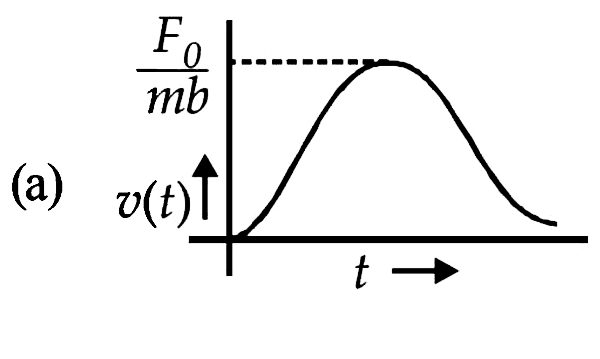
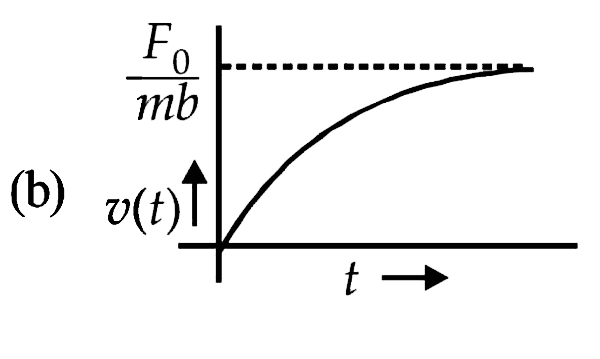
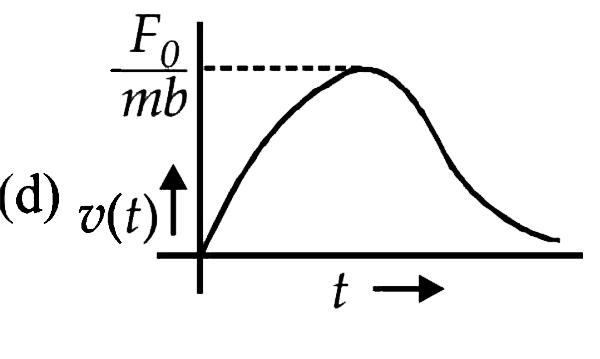
A particle of mass `m` is at rest the origin at time ` t= 0 ` . It is subjected to a force ` F(t) = F_(0) e^(-bt)` in the `x` - direction. Its speed ` v(t)` is depicted by which of the following curves ?

A

B

C

D

Text Solution

AI Generated Solution

The correct Answer is:

To solve the problem, we need to determine the velocity \( v(t) \) of a particle subjected to a force \( F(t) = F_0 e^{-bt} \) in the x-direction. Here are the steps to derive the expression for velocity: ### Step 1: Write down the relationship between force, mass, and acceleration. We know from Newton's second law that: \[ F = m \cdot a \] where \( a \) is the acceleration. Since acceleration can also be expressed as the derivative of velocity with respect to time, we have: \[ F = m \cdot \frac{dv}{dt} \] ### Step 2: Substitute the expression for force into the equation. Given the force \( F(t) = F_0 e^{-bt} \), we can substitute this into the equation: \[ m \cdot \frac{dv}{dt} = F_0 e^{-bt} \] ### Step 3: Rearrange the equation to isolate \( dv \). Rearranging gives us: \[ \frac{dv}{dt} = \frac{F_0}{m} e^{-bt} \] ### Step 4: Integrate both sides. To find the velocity, we need to integrate both sides with respect to time \( t \): \[ \int dv = \int \frac{F_0}{m} e^{-bt} dt \] The left side integrates to \( v \), and the right side can be integrated using the formula for the integral of an exponential function: \[ v = \frac{F_0}{m} \int e^{-bt} dt = \frac{F_0}{m} \left( -\frac{1}{b} e^{-bt} \right) + C \] where \( C \) is the constant of integration. ### Step 5: Determine the constant of integration. At \( t = 0 \), the particle is at rest, so \( v(0) = 0 \): \[ 0 = -\frac{F_0}{mb} e^{0} + C \implies C = \frac{F_0}{mb} \] ### Step 6: Substitute back to find the expression for velocity. Now substituting \( C \) back into the equation gives: \[ v(t) = -\frac{F_0}{mb} e^{-bt} + \frac{F_0}{mb} \] This can be simplified to: \[ v(t) = \frac{F_0}{mb} (1 - e^{-bt}) \] ### Step 7: Analyze the behavior of the velocity function. As \( t \to \infty \), \( e^{-bt} \to 0 \), thus: \[ v(t) \to \frac{F_0}{mb} \] This indicates that the velocity approaches a constant value as time increases. ### Conclusion: Identify the correct graph. The velocity function \( v(t) = \frac{F_0}{mb} (1 - e^{-bt}) \) starts at 0 when \( t = 0 \) and asymptotically approaches \( \frac{F_0}{mb} \) as \( t \) increases. This indicates that the graph of \( v(t) \) is an increasing function that approaches a horizontal asymptote. ### Final Answer: The correct curve that depicts the speed \( v(t) \) is option B. ---

To solve the problem, we need to determine the velocity \( v(t) \) of a particle subjected to a force \( F(t) = F_0 e^{-bt} \) in the x-direction. Here are the steps to derive the expression for velocity: ### Step 1: Write down the relationship between force, mass, and acceleration. We know from Newton's second law that: \[ F = m \cdot a \] where \( a \) is the acceleration. Since acceleration can also be expressed as the derivative of velocity with respect to time, we have: ...
Promotional Banner

Topper's Solved these Questions

  • MOMENTUM & IMPULSE

    SUNIL BATRA (41 YEARS IITJEE PHYSICS)|Exercise JEE Main And Advanced|30 Videos
  • ROTATIONAL MOTION

    SUNIL BATRA (41 YEARS IITJEE PHYSICS)|Exercise MCQs with one correct answer|1 Videos

Similar Questions

Explore conceptually related problems

A particle of mass m is at rest at the origin at time t=0 It is subjected to a force F(t)=F_(0)e^(-bt) in the X-direction. Its speed V(t) is depicted by which of the following curves

A block of mass 2 kg is free to move along the x -axis. It at rest and from t = 0 onwards it is subjected to a time-dependent force F(t) in the x direction. The force F(t) varies with t as shown in the figure. The kinetic energy of the block after 4.5 seconds is

A block of mass 2 kg is free to move along the x-axis it is at rset and from t=0 onwards it is subjected to a time dependent force F(t) in the x-direction The force F(t) varies with t as shown in the figure The kinetic energy of the block after 4.5 seconds, is:

At t = 0 aparticle of mass m start moving from rest due to a force vecF = F_(0) sin (omega t)hati :

SUNIL BATRA (41 YEARS IITJEE PHYSICS)-MOTION-JEE Main And Advanced
  1. A particle located at x = 0 at time t = 0, starts moving along with t...

    Text Solution

    |

  2. A particle is projected at 60(@) to the horizontal with a kinetic ene...

    Text Solution

    |

  3. The velocity of a particle is v = v(0) + gt + ft^(2). If its position ...

    Text Solution

    |

  4. A body is at rest at x =0 . At t = 0, it starts moving in the posi...

    Text Solution

    |

  5. Consider a rubber ball freely falling from a height h = 4.9 m on a hor...

    Text Solution

    |

  6. A particle has an initial velocity of 3hat(i) + 4 hat(j) and an accele...

    Text Solution

    |

  7. A particle is moving with velocity vecv = k( y hat^(i) + x hat(j)) , ...

    Text Solution

    |

  8. A point p moves in counter - clockwise direction on a circular path a...

    Text Solution

    |

  9. For a particle in uniform circular motion , the acceleration vec(a) a...

    Text Solution

    |

  10. A small particle of mass m is projected at an angle theta with the x...

    Text Solution

    |

  11. An object , moving with a speed of 6.25 m//s , is decelerated at a ra...

    Text Solution

    |

  12. A water fountain on the ground sprinkles water all around it. If the s...

    Text Solution

    |

  13. A boy can throw a stone up to a maximum height of 10 m. The maximum ho...

    Text Solution

    |

  14. Two cars of mass m(1) and m(2) are moving in circle of radii r(1) an...

    Text Solution

    |

  15. A particle of mass m is at rest the origin at time t= 0 . It is subj...

    Text Solution

    |

  16. A projectile is given an initial velocity of ( hat(i) + 2 hat (j) ) m...

    Text Solution

    |

  17. From a tower of height H, a particle is thrown vertically upwards wit...

    Text Solution

    |

  18. Two stones are thrown up simultaneously from the edge of a cliff 240...

    Text Solution

    |

  19. Airplanes A and B are flying with constant velocity in the same vertic...

    Text Solution

    |

  20. A rocket is moving in a gravity free space with a constnat acceleratio...

    Text Solution

    |
