Home
Class 11
PHYSICS
Two stones are thrown up simultaneously...

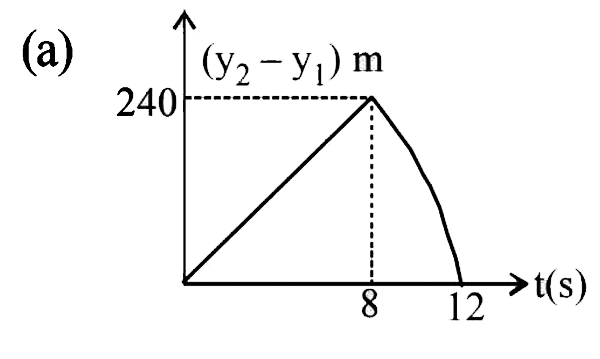
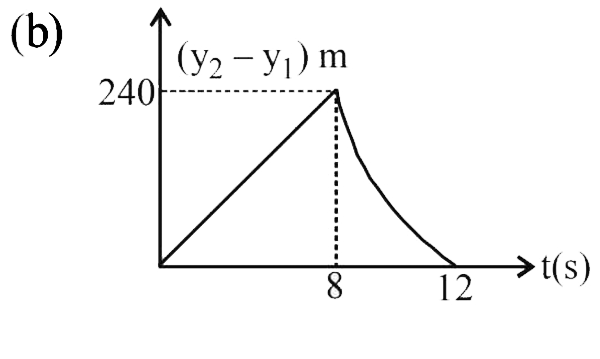
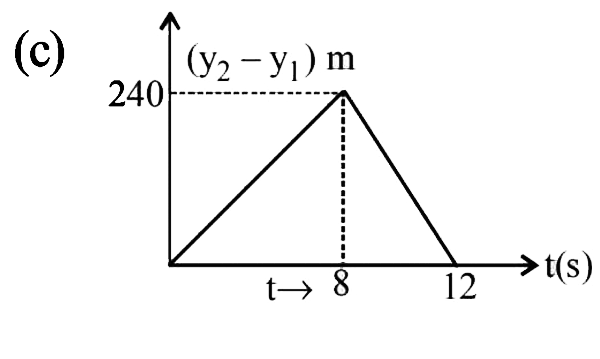
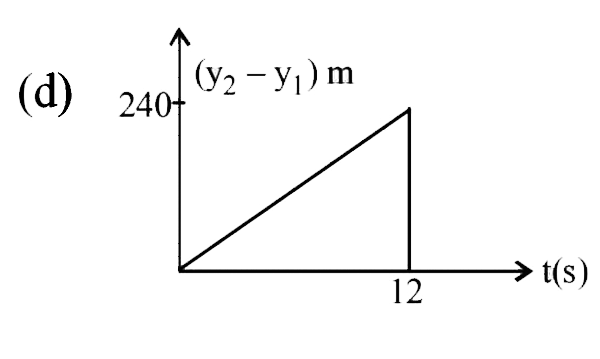
Two stones are thrown up simultaneously from the edge of a cliff ` 240 m ` high with initial speed of ` 10 m//s and 40 m//s` respectively . Which of the following graph best represents the time variation of relative position of the speed stone with respect to the first ?
( Assume stones do not rebound after hitting the groumd and neglect air resistance , take ` g = 10 m//s^(2))`
( The figure are schematic and not drawn to scale )

A

B

C

D

Text Solution

AI Generated Solution

The correct Answer is:

To solve the problem of two stones thrown from a cliff, we need to analyze their motion step by step. ### Step 1: Understand the problem We have two stones thrown from a height of 240 m. Stone A is thrown with an initial speed of 10 m/s, and Stone B is thrown with an initial speed of 40 m/s. We need to find the time variation of the relative position of Stone B with respect to Stone A. ### Step 2: Calculate the time taken for each stone to reach the highest point For Stone A (initial speed = 10 m/s): - The time taken to reach the highest point (where final velocity = 0): \[ v = u - gt \implies 0 = 10 - 10t \implies t = 1 \text{ second} \] For Stone B (initial speed = 40 m/s): - The time taken to reach the highest point: \[ v = u - gt \implies 0 = 40 - 10t \implies t = 4 \text{ seconds} \] ### Step 3: Calculate the maximum height reached by each stone Using the formula for displacement: \[ s = ut + \frac{1}{2}at^2 \] For Stone A: \[ s_A = 10 \times 1 + \frac{1}{2}(-10)(1^2) = 10 - 5 = 5 \text{ m} \] For Stone B: \[ s_B = 40 \times 4 + \frac{1}{2}(-10)(4^2) = 160 - 80 = 80 \text{ m} \] ### Step 4: Calculate the total height of each stone from the ground The total height from the ground: - Height of Stone A at its maximum: \[ H_A = 240 + 5 = 245 \text{ m} \] - Height of Stone B at its maximum: \[ H_B = 240 + 80 = 320 \text{ m} \] ### Step 5: Calculate the time taken for each stone to hit the ground For Stone A (total time of flight): - It goes up for 1 second and then comes down. The time to fall from 245 m: \[ s = ut + \frac{1}{2}gt^2 \implies 0 = 245 - \frac{1}{2}(10)t^2 \implies t^2 = 49 \implies t = 7 \text{ seconds} \] Total time for Stone A = 1 second (up) + 7 seconds (down) = 8 seconds. For Stone B (total time of flight): - It goes up for 4 seconds and then comes down. The time to fall from 320 m: \[ s = ut + \frac{1}{2}gt^2 \implies 0 = 320 - \frac{1}{2}(10)t^2 \implies t^2 = 64 \implies t = 8 \text{ seconds} \] Total time for Stone B = 4 seconds (up) + 8 seconds (down) = 12 seconds. ### Step 6: Determine the relative position of Stone B with respect to Stone A The relative position \(Y_B - Y_A\) can be calculated during their flight. For \(t < 1\) (both stones are still rising): \[ Y_A = 10t - 5t^2 \] \[ Y_B = 40t - 5t^2 \] \[ Y_B - Y_A = (40t - 5t^2) - (10t - 5t^2) = 30t \] For \(1 < t < 4\) (Stone A is falling, Stone B is still rising): \[ Y_A = 245 - 5(t - 1)^2 \] \[ Y_B = 40t - 5t^2 \] The relative position will change as Stone A falls. For \(t > 4\) (Stone A is falling, Stone B is falling): The relative position will be calculated based on their respective downward motions. ### Step 7: Analyze the graphs The graph representing the relative position will show a linear increase during the first second (when both are rising), a change in slope when Stone A starts falling, and then a parabolic shape as Stone B continues to fall after Stone A has hit the ground. ### Conclusion The graph that best represents the time variation of the relative position of Stone B with respect to Stone A will show a linear increase followed by a change in slope and then a parabolic curve after Stone A hits the ground.

To solve the problem of two stones thrown from a cliff, we need to analyze their motion step by step. ### Step 1: Understand the problem We have two stones thrown from a height of 240 m. Stone A is thrown with an initial speed of 10 m/s, and Stone B is thrown with an initial speed of 40 m/s. We need to find the time variation of the relative position of Stone B with respect to Stone A. ### Step 2: Calculate the time taken for each stone to reach the highest point For Stone A (initial speed = 10 m/s): - The time taken to reach the highest point (where final velocity = 0): ...
Promotional Banner

Topper's Solved these Questions

  • MOMENTUM & IMPULSE

    SUNIL BATRA (41 YEARS IITJEE PHYSICS)|Exercise JEE Main And Advanced|30 Videos
  • ROTATIONAL MOTION

    SUNIL BATRA (41 YEARS IITJEE PHYSICS)|Exercise MCQs with one correct answer|1 Videos

Similar Questions

Explore conceptually related problems

Two stones are through up simultaneously from the edge of a cliff 240 m high with initial speed of 10 m/s and 40 m/s respectively. Which of the following graphs best represents the time variation of relative position of the second stone with respect to the first? Assume stones do not rebound after hitting the ground and neglect air resistance, take . g= 10 m//s^(2) (The figures are schematic and not drawn to scale)

Two stones are thrown up simultaneously from the edge of a cliff 200 m high with initial speeds of 15 ms?^(-1) and 30^(-1) . Verify that the graph shown in Fig. 2 ( NCT). 13 , correctly represents the time variation of the relativ e position of the second stone with respect to the first. Neglect the air resistance and assume that the stones do not rebound after hitting the ground. Taje g= 10 ms^(-2) .Give equations for the linear and curved parts of the plot. .

Two stones are thrown up simultaneously with initial speeds of u_(1) and u_(2)(u_(2)gt_(1) u_(1)) . They hit the ground after 6 s and 10 s respectively. Which graph in fig. correctly represents the time variation of Deltax=(x_(2)-x_(1)) the relative position of the second stone with respect to the first upto t=10 s? Assume that the stones do not rebound after hitting the ground.

Two stones are thrown up simultaneously from the edge of a cliff with initial speed v and 2 v . The relative position of the second stone with respect to first varies with time till both the stones strike the ground as.

One stone is projected horizontally from a 20 m high cliff with an initial speed of 10 ms^(-1) . A second stone is simultaneously dropped from that cliff. Which of the following is true?

A stone is thrown upwards and it rises to a height 0f 200m. The relative velocity of the stone with respect to the earth will be maximum at :-

SUNIL BATRA (41 YEARS IITJEE PHYSICS)-MOTION-JEE Main And Advanced
  1. A particle located at x = 0 at time t = 0, starts moving along with t...

    Text Solution

    |

  2. A particle is projected at 60(@) to the horizontal with a kinetic ene...

    Text Solution

    |

  3. The velocity of a particle is v = v(0) + gt + ft^(2). If its position ...

    Text Solution

    |

  4. A body is at rest at x =0 . At t = 0, it starts moving in the posi...

    Text Solution

    |

  5. Consider a rubber ball freely falling from a height h = 4.9 m on a hor...

    Text Solution

    |

  6. A particle has an initial velocity of 3hat(i) + 4 hat(j) and an accele...

    Text Solution

    |

  7. A particle is moving with velocity vecv = k( y hat^(i) + x hat(j)) , ...

    Text Solution

    |

  8. A point p moves in counter - clockwise direction on a circular path a...

    Text Solution

    |

  9. For a particle in uniform circular motion , the acceleration vec(a) a...

    Text Solution

    |

  10. A small particle of mass m is projected at an angle theta with the x...

    Text Solution

    |

  11. An object , moving with a speed of 6.25 m//s , is decelerated at a ra...

    Text Solution

    |

  12. A water fountain on the ground sprinkles water all around it. If the s...

    Text Solution

    |

  13. A boy can throw a stone up to a maximum height of 10 m. The maximum ho...

    Text Solution

    |

  14. Two cars of mass m(1) and m(2) are moving in circle of radii r(1) an...

    Text Solution

    |

  15. A particle of mass m is at rest the origin at time t= 0 . It is subj...

    Text Solution

    |

  16. A projectile is given an initial velocity of ( hat(i) + 2 hat (j) ) m...

    Text Solution

    |

  17. From a tower of height H, a particle is thrown vertically upwards wit...

    Text Solution

    |

  18. Two stones are thrown up simultaneously from the edge of a cliff 240...

    Text Solution

    |

  19. Airplanes A and B are flying with constant velocity in the same vertic...

    Text Solution

    |

  20. A rocket is moving in a gravity free space with a constnat acceleratio...

    Text Solution

    |
