Home
Class 11
PHYSICS
A particle of mass m is attached to one ...

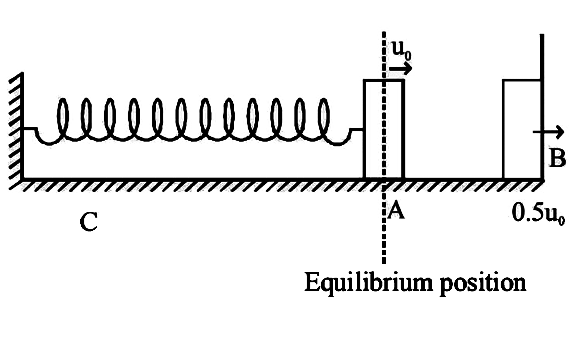
A particle of mass m is attached to one end of a mass-less spring of force constant k, lying on a frictionless horizontal plane. The other end of the spring is fixed. The particle starts moving horizontally from its equilibrium position at time `t=0` with an initial velocity `u_0`. when the speed of the particle is `0.5u_0`, it collides elastically with a rigid wall. After this collision

A

The speed of the particle when it returns to its equilibrium position is `u_0`.

B

The time at which the particle passes through the equilibrium position for the first time is `t=pi sqrt(m/k)`

C

The time at which the maximum compression of the spring occurs is `t=(4pi)/3 sqrt(m/k)`

D

The time at which the particle passes through the equilibrium position for the second time is `t=(5pi)/3sqrt(m/k)`

Text Solution

Verified by Experts

The correct Answer is:
A, D

(a,d) The particle collides elastically with rigid wall. Here
`e=V/(0.5u_0)=1 :. V=0.5u_0`

i.e. the particle rebounds with same speed. Therefore
the particle will return to its equilibrium position with
speed `u_0.` option (a) is correct.
The velocity of the particle becomes `0.5u_0` after time t.
Then using the equation `V=V_(max) cos wt` we get
`0.5u_0=u_0cos wt`
`:. pi/3=(2pi)/txxT :. t=T/6`
The time period `T=2pisqrt(m/k).Therefore t=pi/3sqrt(m/k)`
The time taken by the particle to pass through the
equilibrium for the first time `=2t=(2pi)/3sqrt(m/k).` Therefore
option (b) is incorrect
The time taken for the maximum compression
`=pi/3sqrt(m/k)+pi/3sqrt(m/k)+pi/3sqrt(m/k)=pisqrt(m/k)[1/3+1/3+1/2]`
`=(7pi)/6sqrt(m/k).` Therefore option c is incorrect.
The time taken for particle to pass through the
equilibrium position second time
`=2[pi/3sqrt(m/k)]+pisqrt(m/k)=pisqrt(m/k)(2/3+1)=5/3pisqrt(m/k)`
option (d) is correct.
Promotional Banner

Topper's Solved these Questions

  • MECHANICAL PROPERTIES OF MATTER AND FLUIDS

    SUNIL BATRA (41 YEARS IITJEE PHYSICS)|Exercise Subjective Problems|1 Videos
  • MOTION

    SUNIL BATRA (41 YEARS IITJEE PHYSICS)|Exercise JEE Main And Advanced|63 Videos

Similar Questions

Explore conceptually related problems

A small block of mass m is attached to free end of a spring of force cosntant k , whose other end is fixed to a rigid support . The block is lying on a frictionless horizontal plane and it starts movi0ng away from fixed end of the spring a\t t= 0 with intial velocity u When the speed of the block is 0.6mu it collides with a fixed heavy mass elastically. After the collision with a fixed heavy mass elastically . Aftere the collision the time at which the block passes through its equilibrium position for the first time is close to

A particle of mass m is fixed to one end of a massless spring of spring constant k and natural length l_(0) . The system is rotated about the other end of the spring with an angular velocity omega ub gravity-free space. The final length of spring is

A particle of mass m is attached to one end of a light inextensible string and the other end of the string is fixed in vertical plane as shown. Particle is given a horizontal velocity u = sqrt((5)/(2)gl) The maximum angle made by the string with downward vertical is

A ring of mass m is attached to a horizontal spring of spring constant k and natural length l_0 . The other end of the spring is fixed and the ring can slide on a horizontal rod as shown. Now the ring is shifted to position B and released Find the speed of the ring when the spring attains its natural length.

A particle of mass m is attached to one end of a light inextensible string and the other end of the string is fixed in vertical plane as shown. Particle is given a horizontal velocity u = sqrt((5)/(2)gl) The tension in the string at an instant when acceleration of the particle is horizontal and sqrt(3)g is

A block of mass m, attached to a spring of spring constant k, oscilltes on a smooth horizontal table. The other end of the spring is fixed to a wall. If it has speed v when the spring is at its naturla lenth, how far will it move on the table before coming to an instantaneous rest?

A block of mass m is attached to one end of a mass less spring of spring constant k. the other end of spring is fixed to a wall the block can move on a horizontal rough surface. The coefficient of friction between the block and the surface is mu then the compession of the spring for which maximum extension of the spring becomes half of maximum compression is .

A block of mass m, lying on a smooth horizontal surface, is attached to a spring (of negligible mass) of spring constant k. The other end of the spring is fixed, as shown in the figure. The block is initally at rest in its equilibrium position. If now the block is pulled withe a constant force F, the maximum speed of the block is :

A mass m is attached to the free end of a massless spring of spring constant k with its other end fixed to a rigid support as shown in figure. Find out the time period of the mass, if it is displaced slightly by an amount x downward.

SUNIL BATRA (41 YEARS IITJEE PHYSICS)-MOMENTUM & IMPULSE-JEE Main And Advanced
  1. The balls, having linear momenta vecp1=vecpi and vecp22=-vecpi, underg...

    Text Solution

    |

  2. A point mass of 1kg collides elastically with a stationary point mass ...

    Text Solution

    |

  3. A particle of mass m is attached to one end of a mass-less spring of f...

    Text Solution

    |

  4. A body of mass m moving with velocity V in the X-direction collides wi...

    Text Solution

    |

  5. Three particles A, B and C of equal mass move with equal speed V along...

    Text Solution

    |

  6. Two bodies A and B of masses m and 2 m respectively are placed on a sm...

    Text Solution

    |

  7. A ball of mass 100 gm is projected vertically upwards from the ground ...

    Text Solution

    |

  8. A bullet of mass M is fired with a velocity 50m//s at an angle with th...

    Text Solution

    |

  9. A block 'A' of mass 2m is placed on another block 'B' of mass 4m which...

    Text Solution

    |

  10. A cart is moving along +x direction with a velocityof 4 m//s. A person...

    Text Solution

    |

  11. A car P is moving with a uniform speed 5sqrt3 m//s towards a carriage ...

    Text Solution

    |

  12. A particle of mass m, moving in a cicular path of radius R with a cons...

    Text Solution

    |

  13. STATEMENT-l : In an elastic collision between two bodies, the relative...

    Text Solution

    |

  14. A bob of mass m, suspended by a string of length l1 is given a minimum...

    Text Solution

    |

  15. A machine gun fires a bullet of mass 40 g with a velocity 1200 ms^-1. ...

    Text Solution

    |

  16. Two sphere A and B of masses m(1) and m(2) respectivelly colides. A is...

    Text Solution

    |

  17. A bomb of mass 16kg at rest explodes into two pieces of masses 4 kg an...

    Text Solution

    |

  18. Statement 1 : Two particles moving in the same direction do not lose a...

    Text Solution

    |

  19. The figure shows the position-time (x-t) graph of one-dimensional moti...

    Text Solution

    |

  20. This question has statement I and statement II. Of the four choices gi...

    Text Solution

    |

