Home
Class 11
PHYSICS
Two light springs of force constants (k1...

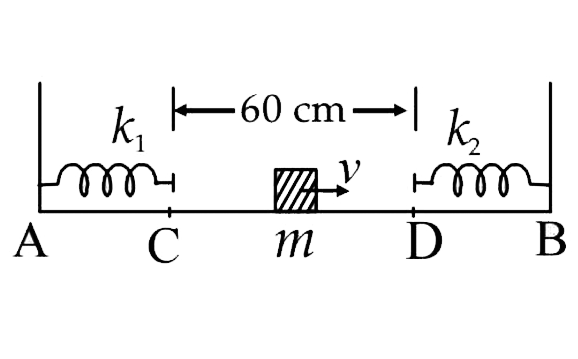
Two light springs of force constants `(k_1 and k_2)` and a block of mass (m) are in one line (AB) on a smooth horizontal table such that one end of each spring is fixed on rigid supports and the other end is free as shown in the figure. The distance (CD) between the free ends of the springs is (60 cms). If the block moves along (AB) with a velocity (120 cm//sec) in between the springs, calculate the period of oscillation of the block `k_1 = 1.8 N//m, k_2 = 3.2 N//m, m = 200 gm)`.
.

Text Solution

Verified by Experts

The correct Answer is:

B, C

The mass will strike the right spring, compress it. The K.E. of the mass will convert into P.E. of the spring. Again the spring will return to its natural size thereby verting its P.E. to K.E. of the block.The time taken for this process will
`beT/2`, where T=2pi sqrtm/k.
(##JMA_CHMO_C10_026_S01##).
:. t_(l) =T/2=pisqrtm/k_(2) =pisqrt(0/2)/(3.2)=0.785 sec`
The block will move from A to B without any acceeleration.
The time taken will be
`t_(2) =(60)/(120) =0.5`
Now the block will compress the left spring and then the spring again attains its natural length. ength. The time taken will be oscillation. The time taken for doing so
`t_(3)=pi sqrtm/k_(l) =pisqrt(0.2)/(1.8) =1.05 sec`.
Again the block moves from B to A, completin one oscillation. The time taken for doing so
`t_(4) =(60)/(120) =0.5`
:. The complete time of oscillation will be
`=t_(l)+t_(2)+t_(3)+t_(4)`
`=0.785+0.51.05+05`
`=2.83(app.).
Promotional Banner

Topper's Solved these Questions

  • ROTATIONAL MOTION

    SUNIL BATRA (41 YEARS IITJEE PHYSICS)|Exercise MCQs with one correct answer|1 Videos
  • UNITS & MEASUREMENTS

    SUNIL BATRA (41 YEARS IITJEE PHYSICS)|Exercise JEE Main And Advanced|58 Videos

Similar Questions

Explore conceptually related problems

Two light spring of force constants k_(1) and k_(2) and a block of mass m are in one line AB on a smooth horizontal table such that one end of each spring is fixed on rigid supports and the other end is free as shown in the figure. The distance CD between the spring is 60cm . If the block moves along AB with a velocity 120 cm//s in between the springs, calculate the period of oscillation of the block. (take k_(1) = 1.8 N//m , k_(2) = 3.2 N//m , m = 200 g )

Two light spring of force constants k_(1) and k_(2) and a block of mass m are in the line AB on a smooth horizontal table such that one end of each spring is fixed on right supports and the other and is free as shown in figure The distance CD between the free ends of the spring is 60 cm . If the block (k_(1) = 1.8 N//m, k_(2) = 3.2 N//m and m = 200g) . Is the motion simple harmonic?

Two identical springs of spring constant k are attached to a block of mass m and to fixed supports as shown in the figure. The time period of oscillation is

A block of mass m, lying on a smooth horizontal surface, is attached to a spring (of negligible mass) of spring constant k. The other end of the spring is fixed, as shown in the figure. The block is initally at rest in its equilibrium position. If now the block is pulled withe a constant force F, the maximum speed of the block is :

A block of mass m moving with velocity v_(0) on a smooth horizontal surface hits the spring of constant k as shown. Two maximum compression in spring is

A block of mass m, attacted to a string of spring constant k, oscillates on a smooth horizontal table. The other end of the spring is fixed to a wall. The block has a speed v when the spring is at its natural length. Before coming to an instantaneous rest. If the block moves a distance x from the mean position, then

Two springs are in a series combination and are attached to a block of mass 'm' which is in equilibrium. The spring constants and extension in the springs are as shown in the figure. Then the force exerted by the spring on the block is :

A block of mass m sliding n a smooth horizontal surface with velocity vecv meets a long horizontal spring fixed ast one end and having spring constant k as shown n figure. Find the maximum compression of the spring. Will the velocity of the block be the same as v whenit comes back to the original position shown?

A block of mass m, attached to a spring of spring constant k, oscilltes on a smooth horizontal table. The other end of the spring is fixed to a wall. If it has speed v when the spring is at its naturla lenth, how far will it move on the table before coming to an instantaneous rest?

SUNIL BATRA (41 YEARS IITJEE PHYSICS)-SIMPLE HARMONIC MOTION-JEE Main And Advanced
  1. A mass (M) attached to a spring, oscillates with a period of (2 sec). ...

    Text Solution

    |

  2. Two masses (m1) and (m2) are suspended together by a massless spring o...

    Text Solution

    |

  3. Two light springs of force constants (k1 and k2) and a block of mass (...

    Text Solution

    |

  4. Two non - viscous, incompressible and immiscible liquids of densities ...

    Text Solution

    |

  5. Two identical balls (A) and (B) each of mass (0.1 kg), are attached to...

    Text Solution

    |

  6. A thin rod of length (L) and area of cross - section (S) is pivoted at...

    Text Solution

    |

  7. A small body attached to one end of a vertically hanging spring is per...

    Text Solution

    |

  8. When a particle of mass m moves on the x-axis in a potential of the fo...

    Text Solution

    |

  9. When a particle of mass m moves on the x-axis in a potential of the fo...

    Text Solution

    |

  10. When a particle of mass m moves on the x-axis in a potential of the fo...

    Text Solution

    |

  11. Phase space deagrams are useful tools . in analyzing all kinds of d...

    Text Solution

    |

  12. Phase space deagrams are useful tools . in analyzing all kinds of d...

    Text Solution

    |

  13. Phase space deagrams are useful tools . in analyzing all kinds of d...

    Text Solution

    |

  14. In a simple harmonic oscillator, at the mean position

    Text Solution

    |

  15. If a spring has time period T, and is cut into n equal parts, then the...

    Text Solution

    |

  16. A child swinging on a swing in sitting position, stands up, then the t...

    Text Solution

    |

  17. A mass (M) is suspended from a spring of negligible mass. The spring i...

    Text Solution

    |

  18. Two particles (A) and (B) of equal masses are suspended from two massl...

    Text Solution

    |

  19. The length of a simple pendulum executing simple harmonic motion is in...

    Text Solution

    |

  20. The disperod of a particle varies according to the relation x=4 (cos p...

    Text Solution

    |
