Home
Class 11
PHYSICS
A thin rod of length (L) and area of cro...

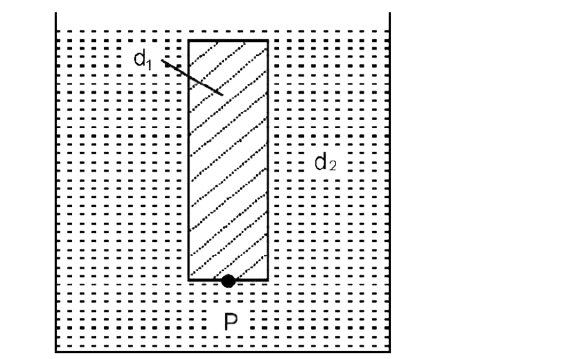
A thin rod of length (L) and area of cross - section (S) is pivoted at its lowest point (P) inside a stationary, homegeneous and non - viscous liquid. The rod is free to ratate in a vertical plane about a horizontal axis passing through (P). The density (d_1) of the material of the rod is smaller than the density (d_2) of the liquid. The rod is displaced by a small angle (theta) from its equilibrium position and then released. Show that the motion of the rod is simple harmonic and determine its angular frequency in terms of the given parameters.
.

Text Solution

Verified by Experts

The correct Answer is:

A, B, C, D

Let theta be the angle made by the rod at any instant t.
(##JMA_CHMO_C10_029_S01##)
The volume of the rod `=LS`,
Weight of the rod `=LS d_(1)g`
Upthrust acting on rod `=LS d_(1)g`
Since, `d_(2)gtd_(1) (given). Therfore net force acting at the centre of mass of the rod at tilted position of
`(LS d_(2)g-LSd_(1)g)
Taking moment of force about (P)
`tau=(LSd_(2)d-LSd_(1)g)xxPN`
where `PN=perpendincular distance of line of action of force from (P)
:. `tau=LSg(d_(2)-d_(1))xxL/2sin theta`
when `theta` is small, `sin theta~~theta`
:. `t =L^(2)sg)/2(d_(2)-d_(1))theta`. Since, tau prop theta`
:. Motion is simpoe harmonic.
:. On comparing it with `tau=C theta`
`We get `C=(L^(2)Dg)/2(d_(2)-d_(1))`
rArr `I omega^(2)=(L^(2)Sg)/2(d_(2)-(d_(1))`
The moment of inertia I of the rod (P)`
`1/(12)ML^(2)+M(L/2)^(2)`
`I=1/3ML^(2)=1/3LSd_(1)L^(2)`
From (i) and (ii)`
`omega^(2)xxL^(3)/3Sd_(1) =(L^(2)Dg)/2(d_(2)-d_(1)`
`rArr omega=sqrt((3Sg(d_(2)-d_(1)))/(2LSd_(1) rArr omega=sqrt(3(d_(2)-d_(1))g)/(2d_(1)L)`.
Promotional Banner

Topper's Solved these Questions

  • ROTATIONAL MOTION

    SUNIL BATRA (41 YEARS IITJEE PHYSICS)|Exercise MCQs with one correct answer|1 Videos
  • UNITS & MEASUREMENTS

    SUNIL BATRA (41 YEARS IITJEE PHYSICS)|Exercise JEE Main And Advanced|58 Videos

Similar Questions

Explore conceptually related problems

A thin rod of length L and area of cross section S is pivoted at its lowest point P inside a stationary, homogeneous and non-viscous liquid. The rod is free to rotate in a vertical plane about a horizontal axis passing through P. The density d_(1) of the rod is smaller than the density d_(2) of the liquid. The rod is displaced by a small angle theta from its equilibrium position and then released. Shown that the motion of the rod is simple harmonic and determine its angular frequency in terms of the given parameters ___________ .

A uniform metal rod is rotated in horizontal plane about a vertical axis passing through its end at uniform rate. The tension in the rod is

A rod of length l is pivoted about a horizontal , frictionless pin through one end. The rod is released from ret in a vertical position. Find the velocity of the CM of the rod when the rod is inclined at an angle theta from the vertical.

A rod with rectangular cross section oscillates about a horizontal axis passing through one of its ends and it behaves like a seconds pendulum, its length will be

The radius of gyration of a uniform rod of length l , about an axis passing through a point (l)/(8) away form the centre of the rod , and perpendicular to it is:

A uniform rod of mass m. length L, area of cross- secticn A is rotated about an axis passing through one of its ends and perpendicular to its length with constant angular velocity o in a horizontal plane If Y is the Young's modulus of the material of rod, the increase in its length due to rotation of rod is

Moment of inertia of a thin rod of mass m and length l about an axis passing through a point l/4 from one end and perpendicular to the rod is

A thin uniform rod of mass M and length L is free to rotate in vertical plane about a horizontal axis passing through one of its ends. The rod is released from horizontal position shown in the figure. Calculate the shear stress developed at the centre of the rod immediately after it is released. Cross sectional area of the rod is A. [For calculation of moment of inertia you can treat it to very thin]

SUNIL BATRA (41 YEARS IITJEE PHYSICS)-SIMPLE HARMONIC MOTION-JEE Main And Advanced
  1. Two non - viscous, incompressible and immiscible liquids of densities ...

    Text Solution

    |

  2. Two identical balls (A) and (B) each of mass (0.1 kg), are attached to...

    Text Solution

    |

  3. A thin rod of length (L) and area of cross - section (S) is pivoted at...

    Text Solution

    |

  4. A small body attached to one end of a vertically hanging spring is per...

    Text Solution

    |

  5. When a particle of mass m moves on the x-axis in a potential of the fo...

    Text Solution

    |

  6. When a particle of mass m moves on the x-axis in a potential of the fo...

    Text Solution

    |

  7. When a particle of mass m moves on the x-axis in a potential of the fo...

    Text Solution

    |

  8. Phase space deagrams are useful tools . in analyzing all kinds of d...

    Text Solution

    |

  9. Phase space deagrams are useful tools . in analyzing all kinds of d...

    Text Solution

    |

  10. Phase space deagrams are useful tools . in analyzing all kinds of d...

    Text Solution

    |

  11. In a simple harmonic oscillator, at the mean position

    Text Solution

    |

  12. If a spring has time period T, and is cut into n equal parts, then the...

    Text Solution

    |

  13. A child swinging on a swing in sitting position, stands up, then the t...

    Text Solution

    |

  14. A mass (M) is suspended from a spring of negligible mass. The spring i...

    Text Solution

    |

  15. Two particles (A) and (B) of equal masses are suspended from two massl...

    Text Solution

    |

  16. The length of a simple pendulum executing simple harmonic motion is in...

    Text Solution

    |

  17. The disperod of a particle varies according to the relation x=4 (cos p...

    Text Solution

    |

  18. A body executes simple harmonic motion. The potential energy (P.E), th...

    Text Solution

    |

  19. The bob of a simple pendulum executm simple harmonic motion in water w...

    Text Solution

    |

  20. A particle at the end of a spring executes S.H,M with a period t(2) I...

    Text Solution

    |
