Home
Class 11
PHYSICS
A train approaching a hill at a speed of...

A train approaching a hill at a speed of `40 km//hr` sounds a whistle of frequency `580 Hz` when it is at a distance of `1km` from a hill. A wind with a speed of `40km//hr` is blowing in the direction of motion of the train Find
(i) the frequency of the whistle as heard by an observer on the hill,
(ii) the distance from the hill at which the echo from the hill is heard by the driver and its frequency.
(Velocity of sound in air `= 1, 200 km//hr`)

Text Solution

Verified by Experts

The correct Answer is:
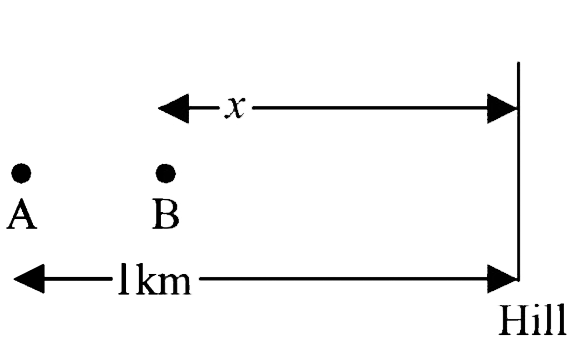
A, B, C

(i) The frequency of the whistle as heard by observer on the hill
`n' = n[(v + v_(m))/(v + v_(m) - v_(s))]`
`=580[(1200 + 40)/(1200 + 40 - 40)] = 599 Hz`

(ii) Let echo from the hill is heard by the driver at `B` which is at a distance `x` from the hill.
The time taken by the driver to reach from `A to B`
`t_(1) = (1 - x)/(40)` ...(i)
The time taken by the echo to reach from hill
`t_(2) = t_(AH) + t_(HB)`
`t_(2) = (1)/((1200 + 40)) +(x)/ ((1200 - 40))` ....(ii)
where `t_(AH) = time taken by sound from `A` to `H` with velocity (1200 + 40)`
`t_(HB) = time taken by sound from `H` to `B` with velocity 1200 - 40`
From (i) and (ii)
`t_(1) = t_(2)` rArr `(1 - x)/(40) = (1)/(1200 + 40) + (x)/(1200 - 40)`
rArr `x = 0.935 km`
The frequency of echo as heard by the driver can be calculate by considering that the source is the acoustic image.
`n' = n[((v - v_(m)) + v_(s))/((v - v_(m)) - v_(0))]`
`=580[((1200 - 40) + 40)/((1200 - 40) - 40)] = 621 Hz`
Promotional Banner

Topper's Solved these Questions

  • UNITS & MEASUREMENTS

    SUNIL BATRA (41 YEARS IITJEE PHYSICS)|Exercise JEE Main And Advanced|58 Videos
  • WORK, ENERGY & POWER

    SUNIL BATRA (41 YEARS IITJEE PHYSICS)|Exercise JEE Main And Advanced|64 Videos

Similar Questions

Explore conceptually related problems

A train approching a hill at a speed of 40 km//hr sounds a whitstle of frequency 600 Hz when it is at a distance of 1 km from a hill. A wind with a speed of 40 km//hr is blowing in the direction of motion of the train. Find, (a) The frequency of the whistle as heard by an observer on the hill. (b) the distance from the hill at which the echo from the hill is heard by the driver and its frequency (Veocity of sound in air = 1200 km//hr )

A train approaching a hill at a speed of 36 kmph sounds a whistle of frequency 500 Hz when it is at a distance of 1 km. A wind blows at 36 kmph in the direction of the motion of the train. Find (i) the frequency of the whistle as heard by an observer on the hill, (ii) the distance from the hill at which the echo from the hill is heard by the driver and its frequency. Velocity of sound = 1200 kmph

A train approaching a hill at a speed of 60 km//hour sounds a whistle of frequency 600Hz when it is distance of 1km from the hill. Wind is blowing in the direction of the train with a speed of 60 km//h Find the frequency of the whistle heard by an observer on the hill:speed of sound in air 1200km/h)

A locomotive approaching a crossing at a speed of 20 ms^(-1) sounds a whistle of frequency 640 Hz when 1 km from the crossing. There is no wind and the speed of sound in air is 330 ms^(-1) . What frequency is heard by an observer sqrt(3) km on the straight road from the crossing at right angle :-

A train approaching a crossing at a speed of 100 km/h sounds a whistle 400 Hz when it is 1.5 km from the crossing. There is no wind and the speed of sound in air is 340 m/s. What frequency is heard by an observer 1.0 km on the strainght road from the crossing at right angles.

A train in approaching a station with a uniform velocity of 72kmph and the frequency of the whistle of that train is 480Hz . The apparent increase in the frequency of that whistle heard by a stationary observer on the platform is (Velocity of sound in air is 340m//s )

A train is approaching towards a platform with a speed of 10 ms^(-1) , while blowing a whistle of frequency 340 Hz. What is the frequency of whistle heard by a stationary observer on the platform ? (given, speed of sound =340 ms^(-1) )

The frequency of the whistle of a train is observed to drop from 280 Hz to 260 Hz as the train moves away from a stationary listerner on the platform. Calculate the speed of the train, if speed of sound in air is 340 m/s.

SUNIL BATRA (41 YEARS IITJEE PHYSICS)-WAVES-JEE Main And Advanced
  1. Two tuning forks with natural frequencies of 340 Hz each move relative...

    Text Solution

    |

  2. The following equations represent transverse waves : z(1) = A cos(kx...

    Text Solution

    |

  3. A train approaching a hill at a speed of 40 km//hr sounds a whistle of...

    Text Solution

    |

  4. A source of sound is moving along a circular orbit of radius 3 meter w...

    Text Solution

    |

  5. The displacement of the medium in a sound wave is given by the equatio...

    Text Solution

    |

  6. Two radio stations broadcast their programmes at the same amplitude A ...

    Text Solution

    |

  7. A whistle emmitting a sound of frequency 440 Hz is tied to a string o...

    Text Solution

    |

  8. A band playing music at a frequency f is moving towards a wall at a sp...

    Text Solution

    |

  9. The air column in a pipe closed at one end is made to vibrate in its s...

    Text Solution

    |

  10. A long wire PQR is made by joining two wires PQ and QR of equal radii ...

    Text Solution

    |

  11. A 3.6m long vertical pipe resonates with a source of frequency 212.5 H...

    Text Solution

    |

  12. A boat is travelling in a river with a speed 2m//s. From this boat, a ...

    Text Solution

    |

  13. Two narrow cylindrical pipes A and B have the same length. Pipe A is o...

    Text Solution

    |

  14. A tuning fork of frequency 480 Hz resonates with a tube closed at one ...

    Text Solution

    |

  15. A string tied between x = 0 and x = l vibrates in fundamental mode. Th...

    Text Solution

    |

  16. A whistling train approaches a junction. An observer standing at jucti...

    Text Solution

    |

  17. A transverse harmonic disturbance is produced in a string. The maximum...

    Text Solution

    |

  18. Waves y(1) = Acos(0.5pix - 100pit) and y(2)Acos(0.46pix - 92pit) are t...

    Text Solution

    |

  19. Waves y(1) = Acos(0.5pix - 100pit) and y(2)Acos(0.46pix - 92pit) are t...

    Text Solution

    |

  20. Waves y(1) = Acos(0.5pix - 100pit) and y(2)Acos(0.46pix - 92pit) are t...

    Text Solution

    |

