Home
Class 12
PHYSICS
Three poistive charges of equal value q ...

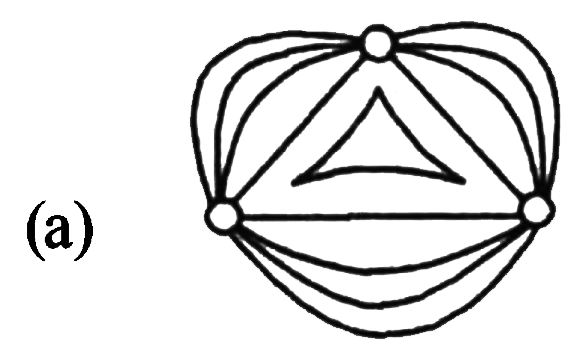
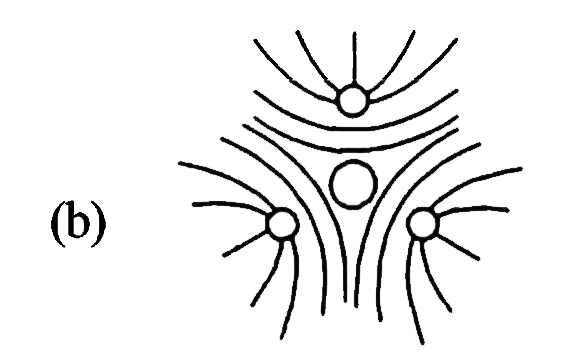
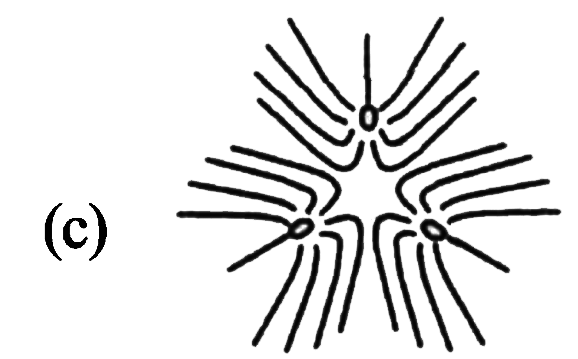
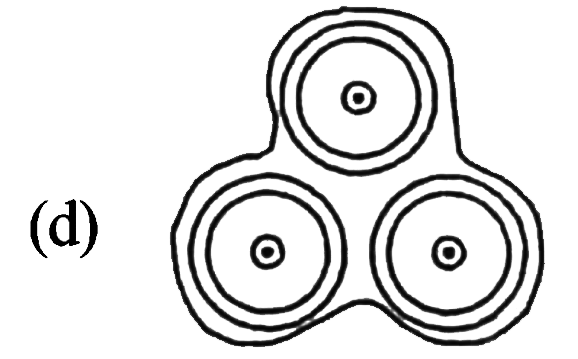
Three poistive charges of equal value q are placed at the vertices of an equilateral triangle. The resulting lines of force should be sketched as in

A

(a)

B

(b)

C

(c)

D

(d)

Text Solution

Verified by Experts

The correct Answer is:

C

Electric field lines do not form closed loops. Therefore options (a), (b) and (d) are wrong.
Option (c) is correct. There is repulison between ismilar charges.
Promotional Banner

Topper's Solved these Questions

  • ELECTROSTATICS

    SUNIL BATRA (41 YEARS IITJEE PHYSICS)|Exercise Subjective Problems|2 Videos
  • ELECTROSTATICS

    SUNIL BATRA (41 YEARS IITJEE PHYSICS)|Exercise Comprehension Based Questions|2 Videos
  • ELECTROMAGNETIC INDUCTION AND ALTERNATING CURRENT

    SUNIL BATRA (41 YEARS IITJEE PHYSICS)|Exercise JEE Main And Advanced|107 Videos
  • MODERN PHYSICS

    SUNIL BATRA (41 YEARS IITJEE PHYSICS)|Exercise MCQ (One Correct Answer|1 Videos

Similar Questions

Explore conceptually related problems

Three positive charges of equal value q are placed vertices of an equilarteral triangle. The resulting lines of should be sketched as in :-

Three positive charges of equal magnitude q are placed at the vertics of and equilatral triangle of side l. How can the system of charges be palced in equilibrium?

Three charges 2q, -q, and -q are located at the vertices of an equilateral triangle. At the center of the triangle,

Consider the charges q,q and -q placed at the vertices of an equilateral triangle of each side l. What is the force on each charge ?

Three point charges q are placed at three vertices of an equilateral triangle of side a. Find magnitude of electric force on any charge due to the other two.

Three point charges +q, +2q and Q are placed at the three vertices of an equilateral triangle. Find the value of charge Q (in terms of q), so that electric potential energy of the system is zero.

(a) Three point charges q,-4q and 2q are placed at the vertices of an equilateral triangle ABC of side 'l' as shown in the figure. Obtain the expression for the magnitude of the resultant electric force acting on the charge q. (b) Find out the amount of the work 4one to separate the charges at infinite distance.
