Home
Class 12
PHYSICS
Two non-conducting spheres of radii R(1...

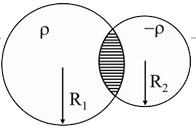
Two non-conducting spheres of radii `R_(1)` and `R_(2)` and carrying uniform volume charge densities `+rho` and `- rho` respectively are placed such that they partially overlapping region.

A

(a) The electrostatic field is zero

B

(b) The electrostatic potential is constant

C

(c) The electrostatic field is constant in magnitude

D

(d) The electrostatic field has same direction

Text Solution

Verified by Experts

The correct Answer is:
C, D

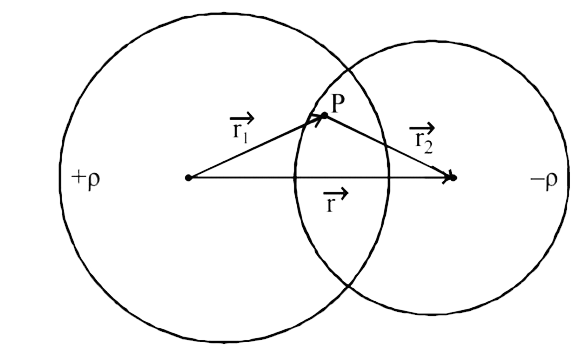
Let us consider a point P on the overlapping region. The electric field intensity at P due to positively charged sphere `=(rhovecr_1)/(3 in_0)`
The electric field intensity at P due to negatively charged sphere `=(rhovecr_2)/(3 in_0)`. The total electric field, `vecE=(rhovecr_1)/(3 in_0)+(rhovecr_2)/(3 in_0)=(rho)/(3 in_0)[vecr_1+vecr_2]`
`vecE=(rho)/(3 in_0)vecr`
Therefore the electric field is same in magnitude and direction option (c) and (d) are correct.
Promotional Banner

Topper's Solved these Questions

  • ELECTROSTATICS

    SUNIL BATRA (41 YEARS IITJEE PHYSICS)|Exercise Subjective Problems|2 Videos
  • ELECTROSTATICS

    SUNIL BATRA (41 YEARS IITJEE PHYSICS)|Exercise Comprehension Based Questions|2 Videos
  • ELECTROMAGNETIC INDUCTION AND ALTERNATING CURRENT

    SUNIL BATRA (41 YEARS IITJEE PHYSICS)|Exercise JEE Main And Advanced|107 Videos
  • MODERN PHYSICS

    SUNIL BATRA (41 YEARS IITJEE PHYSICS)|Exercise MCQ (One Correct Answer|1 Videos

Similar Questions

Explore conceptually related problems

Two non-conducting solid spheres of radii R and 2R, having uniform volume charge densities rho_1 and rho_2 respectively, touch each other. The net electric field at a distance 2R from the centre of the smaller sphere, along the line joining the centres of the spheres, is zero. The ratio rho_1/rho_2 can be

Two conducting spheres of radii r_(1) and r_(2) are equally charged. The ratio of their potentral is-

Two conducting spheres of radii r_(1) and r_(2) are charged to the same surface charge density . The ratio of electric field near their surface is

There are two nonconducting spheres having uniform volume charge densities rho and - rho . Both spheres have equal radius R . The spheres are now laid down such that they overlap as shown in Fig.2.125. Take vec(d) = O_(1) vec(O_(2)) . The electric field vec(E) in the overlapped region is

There are two nonconducting spheres having uniform volume charge densities rho and - rho . Both spheres have equal radius R . The spheres are now laid down such that they overlap as shown in Fig.2.125. Take vec(d) = O_(1) vec(O_(2)) . The potential difference Delta V between the centres of the two spheres for d = R is

Two charged spheres of radii R_(1) and R_(2) having equal surface charge density. The ratio of their potential is

Two conducting spheres of radii r_(1) and r_(2) having charges Q_(1) and Q_(2) respectively are connected to each other. There is

There is a hemisphere of radius R having a uniform volume charge density rho . Find the electric potential and field at the centre

