Home
Class 12
PHYSICS
A rigid insulated wire frame in the form...

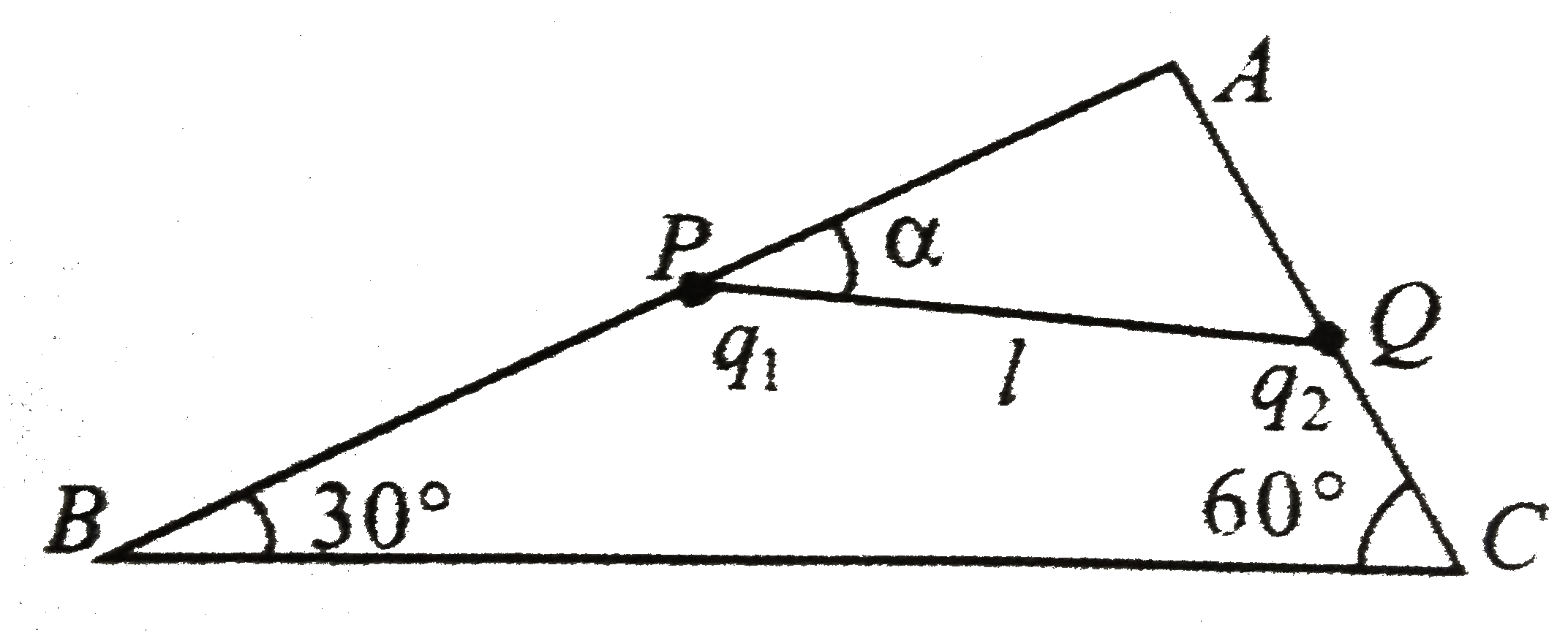
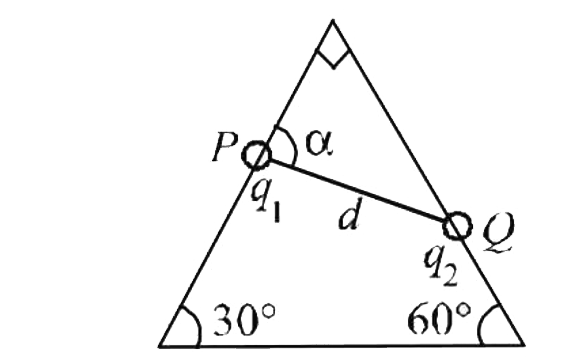
A rigid insulated wire frame in the form of a right-angled triangle ABC is set in a vertical plane as shown in fig. two beads of equal masses m each and carrying charges `q_(1)` and `q_(2)` are connected by a cord of length l and can slide without friction on the wires.
Considering the case when the beads are stationary, determine
(i) the angel `alpha`
(ii) the tension in the cord, and
(iii) The normal reaction on the beads.
If the cord is now cut, what are the value of the charges for which the beads continue to remain stationary?

Text Solution

Verified by Experts

The correct Answer is:
A, B, C

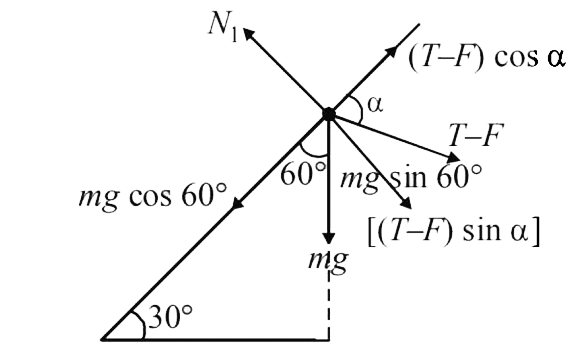
Because of equilibrium of charge `q_1` `N_1=mgsin60^@+(T-F)sinalpha` …(i)
and `(T-F) cos alpha=mgcos 60^@` …(ii)


Because of equilibrium of charge `q_2`
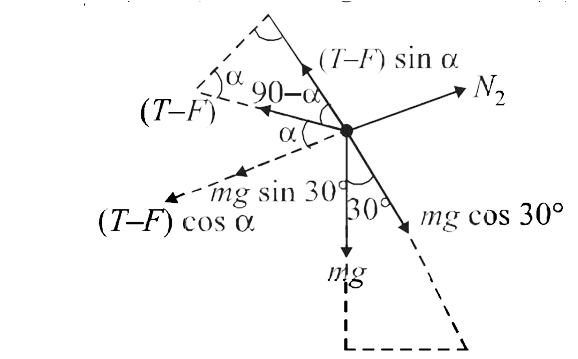
`(T-F) sin alpha=mgcos 30^@` ...(iii)
and `N_2=(T-F) cos alpha+mg sin 30^@` ...(iv)

From (i) and (iii)
`N_1=mgsin60^@+mgcos30^@`
`=mg(sqrt3/2+sqrt3/2)=sqrt3mg`
From (ii) and (iv)
`N_2=mgcos60^@+mgsin30^@=mg(1/2+1/2)=mg`
Also, `F=k(q_1q_2)/(l^2)`
Now from eqn. (ii) and (iii), we get
`(T-F)^2cos^2alpha+(T-F)^2sin^2alpha`
`=m^2g^2cos^(2)60^@+m^2g^2cos^(2)30^@`
`implies (T-F)^2=m^2g^2[1/4+3/4]=m^2g^2`
`implies T-F=+-mg` ...(v)
`implies T=mg+F=mg+k(q_1q_2)/(l^2)` ...(vi)
[Taking positive sign]
From (ii) and (v)
`mgcosalpha=mgcos60^@impliescos alpha=cos 60^@`
`:.` `alpha=60^@`
When the string is cut, `T=0`
`:.` From (vi)
`mg=+-k(q_1q_2)/(l^2)impliesq_1q_2=+-(mgl^2)/(k)`
Now the charges should be unlike for equilibrium.
Promotional Banner

Topper's Solved these Questions

  • ELECTROSTATICS

    SUNIL BATRA (41 YEARS IITJEE PHYSICS)|Exercise Subjective Problems|2 Videos
  • ELECTROSTATICS

    SUNIL BATRA (41 YEARS IITJEE PHYSICS)|Exercise Comprehension Based Questions|2 Videos
  • ELECTROMAGNETIC INDUCTION AND ALTERNATING CURRENT

    SUNIL BATRA (41 YEARS IITJEE PHYSICS)|Exercise JEE Main And Advanced|107 Videos
  • MODERN PHYSICS

    SUNIL BATRA (41 YEARS IITJEE PHYSICS)|Exercise MCQ (One Correct Answer|1 Videos

Similar Questions

Explore conceptually related problems

A rigeid insulated wire frame in the form of a right-angled traingle ABC is set in a vertical plane as shown in fig. two beads of equal masses m each and carrying charges q_(1) and q_(2) are connected by a cord of length l and can slide without friction on the wires. Cinsidering the case when the beads are stationary, determine (i) the angel alpha (ii) the tension in the cord, and (iii) The normal recation on teh beads. If the cord is now cut, what are the value of the charges for which the beads continue to remain stationary?

A conductor of length l and mass m can slide without any friction along the two vertical conductors connected at the top through a capacitor. A uniform magnetic field B is set up _|_ to the plane of paper. The acceleration of the conductor

A conducting wire of length l and mass m can slide without friction on two parallel rails and is connected to capacitance C . The whole system lies in amagnetic field B and a constant force F is applied to the rod . Then

Two point masses, m each carrying charges -q and +q are attached to the ends of a massless rigid non - conducting wire of length L. When this arrangement is placed in a uniform electric field, then it deflects through an angle theta . The minimum time needed by the rod to align itself along the field is

The Fig. showns a string of equally placed beads of mass m, separated by distance. The beads are free to slide without friction on a thin wire. A constant force F act on the first bead initially at rest till it makes collision with the second bead. The second bead then collides with the third and so on. Supposed that all collisions are elastic,

A wire, which passes through the hole in a small bead, is bent in the form of quarter of a circle. The wire is fixed vertically on ground as shown in the figure. The bead is released from near the top of the wire and it slides along the wire without friction. As the bead moves from A to B, the force it applies on the wire is

Beads A and B each of mass m , are connected by a light inextensible cord. They are constrained (restricted) to move on a frictionless ring in a vertical plane as shown. The beads are released from rest at the position shown. The tension in the cord just after the release is.

A bead of mass m is fitted on a rod and can move on it without friction. Initially the bead is at the middle of the rod moves transitionally in the vertical plane with an accleration a_(0) in direction forming angle alpha with the rod as shown. The acceleration of bead with respect to rod is: z