Let us consider a shell of the thickness dx at a distance x from the centre of a sphere
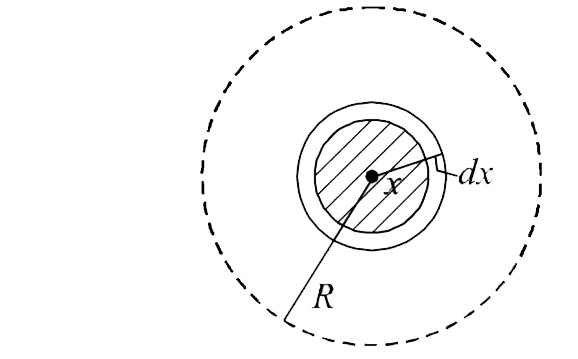
The vol. of the shell `=4/3pi[(x+dx)^3-4/3pix^3]`
`=4/3pi[(x+dx)^3-x^3]`
`=4/3pix^3[(1+(dx)/(x))^3-1]`
`=4/3pix^3[1+(3dx)/(x)-1]`
`=4/3pix^3xx(3dx)/(x)=4pix^2dx`
Let `rho` be the charge per unit volume of the sphere
`:.` Charge of the shell `=dq=4pix^2rhodx` ...(i)
Potential at the surface of the sphere of radius x
`=(1)/(4piepsilon_0)xx(rhoxx4/3pix^3)/(x) [:' V=kq/r]`
`:.` Potential at the surface of the sphere of radius x `=(rhox^2)/(3epsilon_0)`
Work done in bringing the charge `dq` on the sphere of radius x
`dW=(rhox^2)/(3epsilon_0)xxdqimpliesdW=(rhox^2)/(3epsilon_0)xx4pix^2rhodx`
Therefore the work done in accumulating the charge Q over a spherical volume of radius R meters
`W=int_0^R(4pirho^2)/(3epsilon_0)x^4dx=(4pirho^2)/(3epsilon_0)[(x^5)/(5)]_0^R=(4pirho^2)/(3epsilon_0)(R^5)/(5)`
`=(4pi)/(3epsilon_0)((Q)/(4//3piR^3))^2(R^5)/(5)=(3Q^2)/(20piepsilon_0R)`
This is also the energy stored in the system.
(b) The above energy calculated is
`E=(3Q^2)/(5xx(4piepsilon_0)R)=(3KQ^2)/(5R)` where `K=(1)/(4piepsilon_0)`
`:.` `E=(3GM^2)/(5R)` [ `:'` Q is replaced by M]
But `g=(GM)/(R^2)impliesgMR=(GM^2)/(R)`
`F=(Kq_1q_2)/(r^2)`, `F=(Gm_1m_2)/(r^2)`
`:.` `E=3/5gMR=3/5xx10xx2.5xx10^(31)=1.5xx10^(32)J`
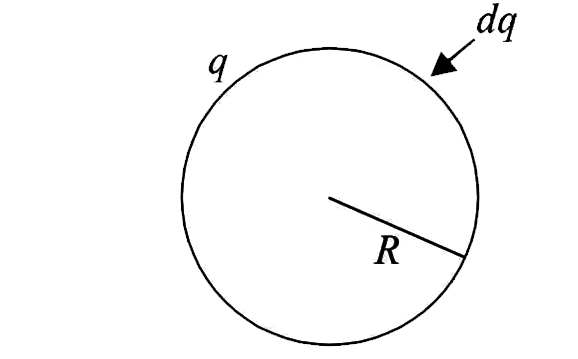
(c) During the charging process, let at any instant the spherical conductor has a charge q on its surface.
The potential at the surface `=(1)/(4piepsilon_0)xx(q)/(R)`
Small amount of work done in increasing charge dq more on the surface will be
`dW=(1)/(4piepsilon_0)xxq/Rxxdq`
`:.` Total amount of work done in bringing charge Q on the surface of spherical conductor.
`W=(1)/(4piepsilon_0R)int_0^Qqdq=(1)/(4piepsilon_0R)[(q^2)/(2)]_0^Q=(Q^2)/((8piepsilon_0R))`