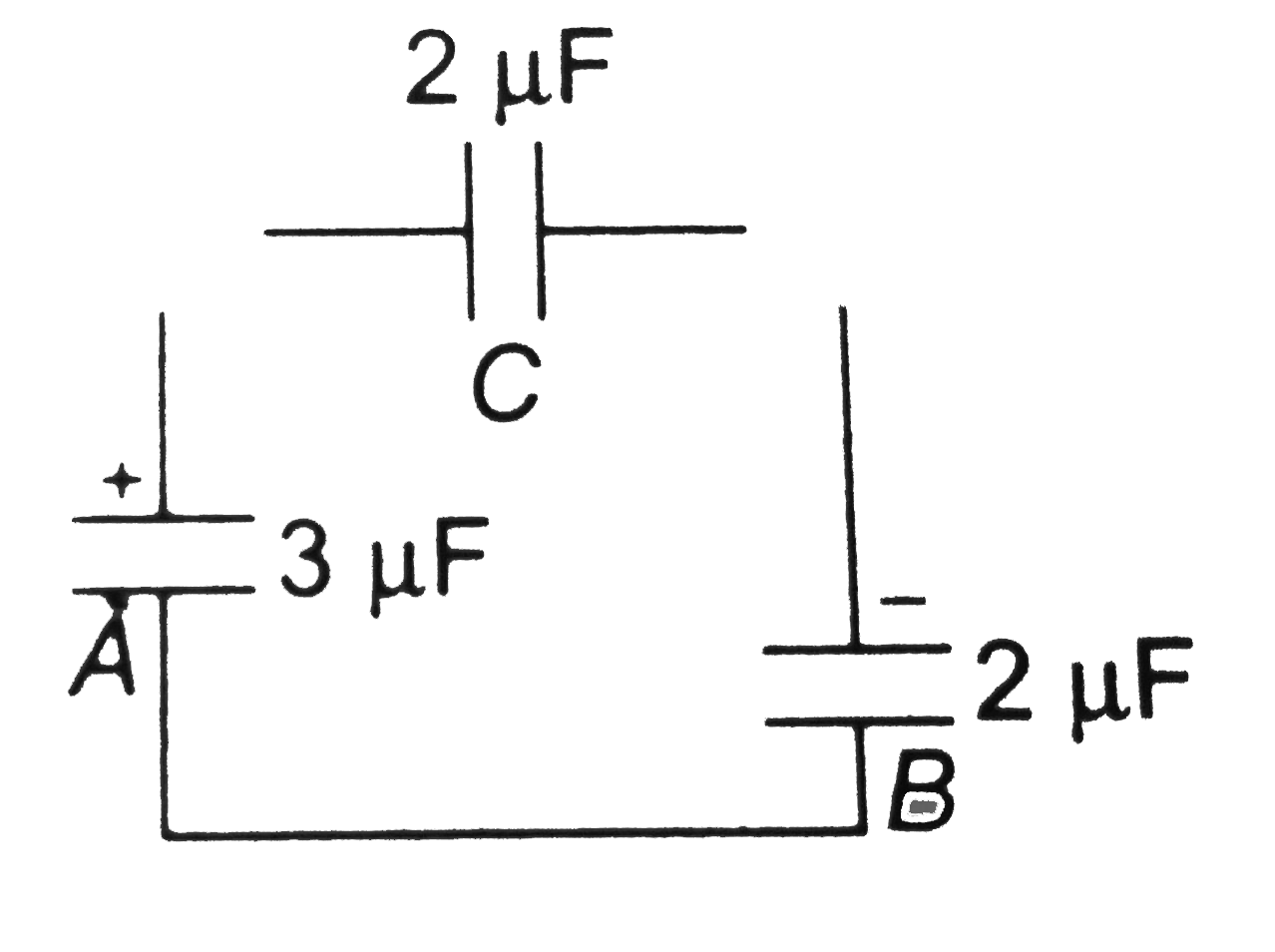
(i) KEY CONCEPT: Use charge conservation to solve this problem.
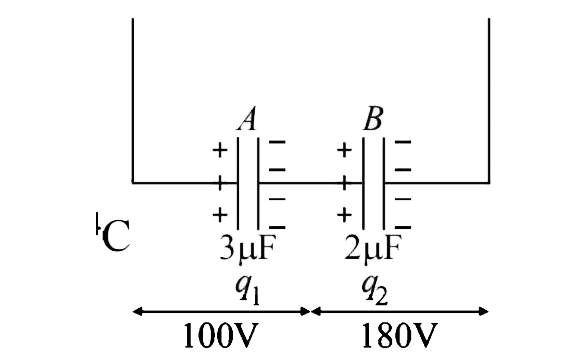
INITIALLY:
Charge on capacitor A
`q_A=3xx10^-6xx100=3xx10^4C`
Charge on capacitor B
`q_B=2xx10^-6xx180=3.6xx10^-4C`
FINALLY:
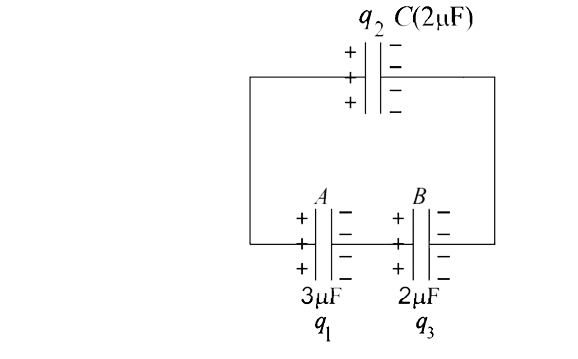
Let the charge on capacitor A, C and B be `q_1, q_2` and `q_3` respectively.
By charge conservation.
The sum of charge on +ve plate of capacitor A and C should be equal to `q_A`.
`:.` `q_1+q_2=3xx10^-4C` ...(i)
Similarly the sum of charge on -ve plates of capacitor C and B will be equal to `q_B`
`:.` `-q_2-q_3=-3.6xx10^-4C`
`implies q_2+q_3=3.6xx10^-4C` ...(ii)
Applying Kirchoff's law in the closed loop, we get
`(q_1)/(3xx10^-6)-(q_2)/(2xx10^-6)+(q_3)/(2xx10^-6)=0`
`implies 2q_1-3q_2+3q_3=0` ...(iii)
On solving (i), (ii) and (iii), we get
`q_1=90xx10^-6C`, `q_2=210xx10^-6C`, and `q_3=150xx10^-6C`,
(ii) Amount of electrostatic energy in the system initially
`U_i=U_A+U_B=1/2C_A(V_A)^2+1/2C_B(V_B)^2`
`=1/2xx3xx10^-6(100)^2+1/2xx2xx10^-6(180)^2`
`=4.74xx10^-2J`
Amount of electrostatic energy stored finally
`U_f=1/2(q_1^2)/(C_A)+1/2(q_2^2)/(C_B)+1/2(q_3^2)/(C_C)`
`=1/2((90xx10^-6)^2)/(3xx10^-6)+1/2((210xx10^-6)^2)/(2xx10^-6)+1/2((150xx10^-6)^2)/(2xx10^-6)+1/2((150xx10^-6)^2)/(2xx10^-6)=1.8xx10^-2J`