Home
Class 12
PHYSICS
Four point charges +8mC, -mC, and +8mC a...

Four point charges `+8mC`, `-mC`, and `+8mC` are fixed at the points `-sqrt(27/2)m`, `-sqrt(3/2)m, +sqrt(3/2)m` and `+sqrt(27/2)m` respectively on the y-axis. A particle of mass `6xx10^-4kg` and charge `+0.1muC` moves along the -x direction. Its speed at `x=+oo` is `V_0`. Find the least value of `V_0` for which the particle will cross the origin. Find also the kinetic energy of the particle at the origin. Assume that space is gravity free.
Given `(1)/(4piepsilon_0)=9xx10^9Nm^2//C^2`.

Text Solution

Verified by Experts

The correct Answer is:
A, C, D

Let the particle at some instant be at a point P distant x from the origin. As shown in the figure, there are two forces of repulsion acting due to two charges of +8 mC. The net force is `2F cos alpha` towards light.
Similarly there are two forces of attraction due to two charges of `-1 mC`. The net force due to these force is `2F cos beta` towards left.
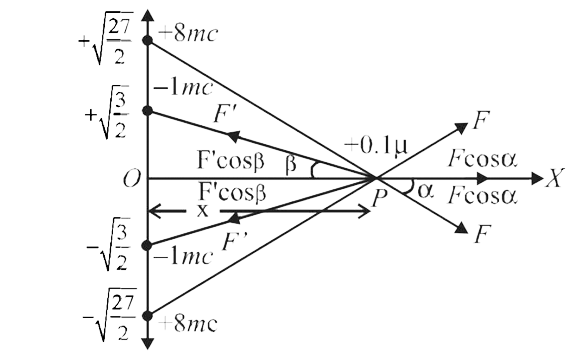
The net force on charge `0.1 muC` is zero when
`2F cos alpha=2F^' cos beta`
`(Kxx8xx10^-6xx0.1xx10^-6)/(sqrt(x^2+27/2))^2xx(x)/(sqrt(x^2+27/2))`
`=(Kxx1xx10^-6xx0.1xx10^-6)/(sqrt(x^2+3/2))^2xx(x)/(sqrt(x^2+3/2))`
`implies x=+-sqrt(5/2)`
This means that we need to move the charge from `-oo` to `sqrt(5/2)` . Thereafter the attractive forces will make the charge move to origin.
The electric potential of the four charges at `x=sqrt(5/2)` is
`V=(2xx9xx10^9xx8xx10^-6)/(sqrt(5/2)+27/2)`-(2xx9xx10^9xx10^-6)/(sqrt(5/2)+3/2)`
`=2xx9xx10^9xx10^-6[8/4-1/2]=2.7xx10^4V`
Kinetic energy is required to overcome the force of repulsion from `prop` to `x=sqrt(5/2)`.
The work done in this process is `W=q(V)`
where V=p.d between `oo` and `x=sqrt(5/2)`.
`:.` `W=0.1xx10^-6xx2.7xx10^4=2.7xx10^-3J`
By energy conservation `1/2mV_0^2=2.7xx10^-3`
`implies 1/2xx6xx10^-4V_0^2=2.7xx10^-3`
`implies V_0=3m//s`
K.E. at the origin
Potential at origin `V_(x=0)=(2xx9xx10^9xx8xx10^-6)/(sqrt(27/2))-(2xx9xx10^9xx10^-6)/(sqrt(3/2))`
`=2.4xx10^4`
Again by energy conservation
`K.E. =q[V_(x=(sqrt5)/(2))-V_(x=0)]`
`:.` K.E. =0.1xx10^-6[2.7xx10^4-2.4xx10^4]`
`=0.1xx10^-6xx0.3xx10^4`
`=3xx10^-4J`

Promotional Banner

Topper's Solved these Questions

  • ELECTROSTATICS

    SUNIL BATRA (41 YEARS IITJEE PHYSICS)|Exercise Comprehension Based Questions|2 Videos
  • ELECTROSTATICS

    SUNIL BATRA (41 YEARS IITJEE PHYSICS)|Exercise Comprehension Based Questions|2 Videos
  • ELECTROMAGNETIC INDUCTION AND ALTERNATING CURRENT

    SUNIL BATRA (41 YEARS IITJEE PHYSICS)|Exercise JEE Main And Advanced|107 Videos
  • MODERN PHYSICS

    SUNIL BATRA (41 YEARS IITJEE PHYSICS)|Exercise MCQ (One Correct Answer|1 Videos

Similar Questions

Explore conceptually related problems

Four point charges +8muC,-1muC,-1muC and , +8muC are fixed at the points -sqrt(27//2)m,-sqrt(3//2)m,+sqrt(3//2)m and +sqrt(27//2)m respectively on the y-axis. A particle of mass 6xx10^(-4)kg and +0.1muC moves along the x-direction. Its speed at x=+ infty is v_(0) . find the least value of v_(0) for which the particle will cross the origin. find also the kinetic energy of the particle at the origin in tyhis case. Assume that there is no force part from electrostatic force.

Four point charges q, -2q, -q and 2q are placed at points (0,0,0) m , (sqrt(2), 0,0) m, (sqrt(2), sqrt(2),0)m " and " (0, sqrt(2) , 0) m respectively . The electric field at point ((1)/(sqrt2), (1)/(sqrt2),0) m " is " (q=1muC)

two point charges 2 muC and -4 muC are situated at points (-2m, 0m) and (2m, 0m) respectively. Find out potential at point C( 4m, 0m) and D (0 m, sqrt(5) m) .

A particle of mass m=5 kg is moving with a uniform speed v=3 sqrt(2) in the XOY plane along the line Y=X+4 . The magnitude of the angular momentum of the particle about the origin is

A particle of mass 2 g and charge 1 muC is held at rest on a frictionless surface at a distance of 1m from a fixed charge of 1 mC. If the particle is released it will be repelled. The speed of the particle when it is at distance of 10 m from fixed charge is :

A particle of mass m and charge q is lying at the origin in a uniform magnetic field B directed along x-axis. At time t = 0, it is given a velocity v_0 , at an angle theta with the y-axis in the xy-plane. Find the coordinates of the particle after one revolution.
