Home
Class 12
PHYSICS
The nuclear charge (Ze) is non uniformll...

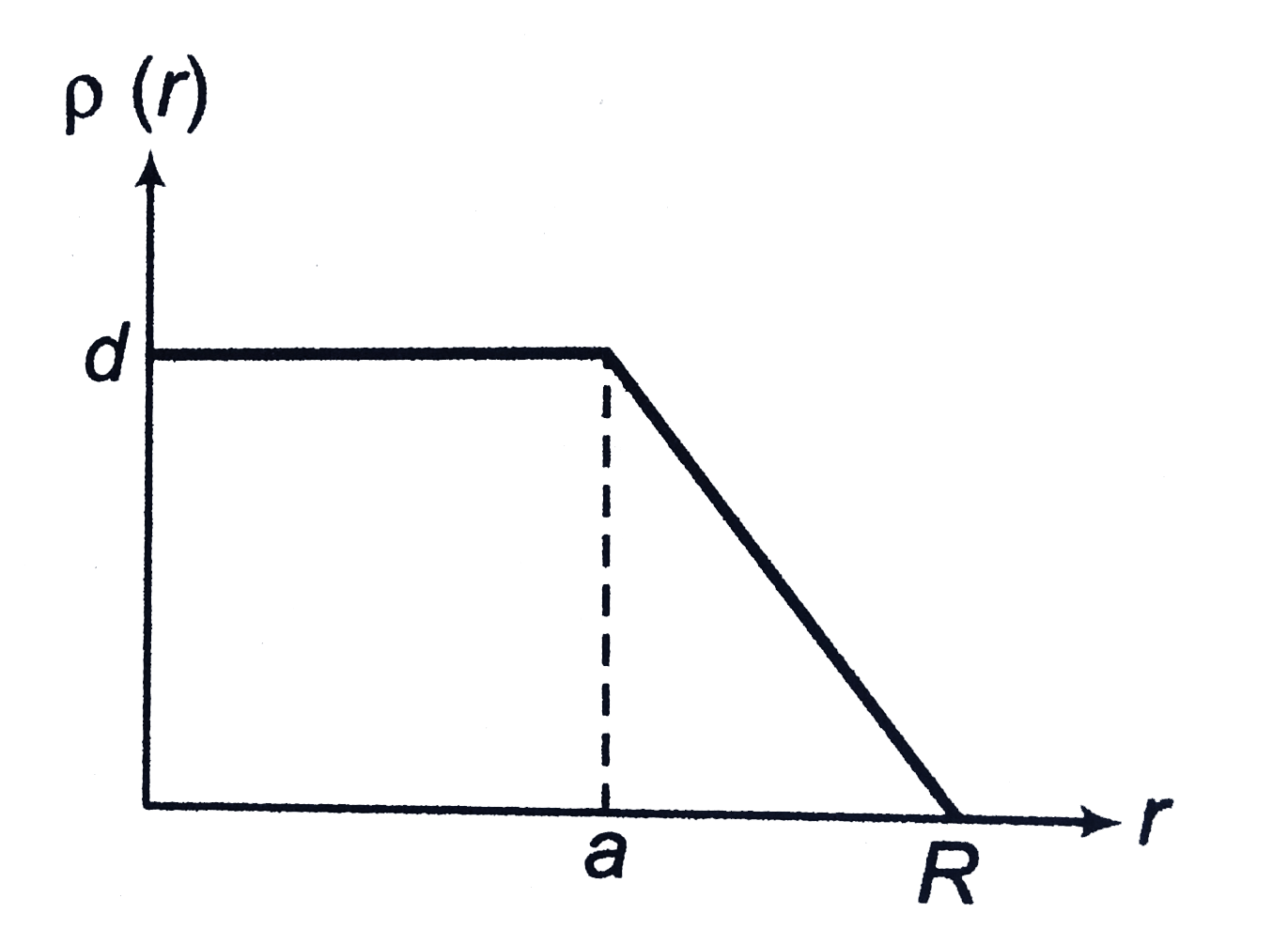
The nuclear charge (`Ze`) is non uniformlly distribute with in a nucleus of radius r. The charge density `rho(r)` (charge per unit volume) is dependent only on the radial distance r form the centre of the nucleus s shown in figure. The electric field is only along the radial direction.

The electric field at `r=R` is

A

(a) independent of a

B

(b) directly proportional to a

C

(c) directly proportional to `a^2`

D

(d) inversely proportional to a

Text Solution

Verified by Experts

The correct Answer is:
A

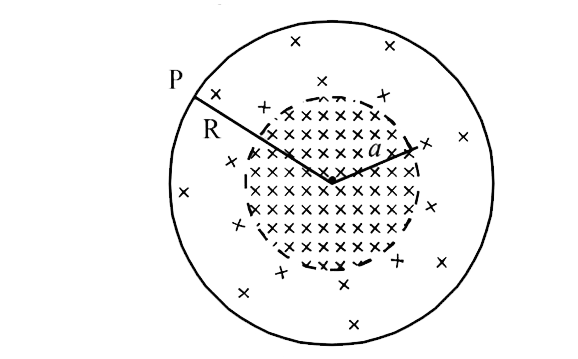
When the point of observation is on the surface of sphere then the whole charge inside the sphere (when distributed symmetrically about the centre) behaves as a point charge on the centre. Therefore until the charge distribution is symmetrical about the centre it does not matter what is the ratio a/R. The electric filed remains constant and is equal to
`E=(1)/(4piin_0)*(Ze)/(R)`
Promotional Banner

Topper's Solved these Questions

  • ELECTROSTATICS

    SUNIL BATRA (41 YEARS IITJEE PHYSICS)|Exercise Subjective Problems|2 Videos
  • ELECTROSTATICS

    SUNIL BATRA (41 YEARS IITJEE PHYSICS)|Exercise Comprehension Based Questions|2 Videos
  • ELECTROMAGNETIC INDUCTION AND ALTERNATING CURRENT

    SUNIL BATRA (41 YEARS IITJEE PHYSICS)|Exercise JEE Main And Advanced|107 Videos
  • MODERN PHYSICS

    SUNIL BATRA (41 YEARS IITJEE PHYSICS)|Exercise MCQ (One Correct Answer|1 Videos

Similar Questions

Explore conceptually related problems

The nuclear charge ( Ze ) is non uniformlly distribute with in a nucleus of radius r. The charge densilty rho(r) (charge per unit volume) is dependent only on the radial distance r form the centre of the nucleus s shown in figure. The electric field is only along the radial direction. The electric field within the nucleus is generaly observed to be linearly dependent on r. This implies

The nuclear charge ( Ze ) is non uniformlly distribute with in a nucleus of radius r . The charge density rho(r) (charge per unit volume) is dependent only on the radial distance r form the centre of the nucleus s shown in figure. The electric field is only along the radial direction. For a=0 the value of d (maximum value of rho as shown in the figure) is

Charges q is uniformly distributed over a thin half ring of radius R . The electric field at the centre of the ring is

A charge +Q , is uniformaly distributed within a sphere of radius R. Find the electric field, due to this charge distribution, at a point distant r form the centre of the spehre where : (i) 0 lt r lt R and (ii) r gt R

A sphere of radius R has a charge density sigma . The electric intensity at a point at a distance r from its centre is

An isolated solid metal sphere of radius R is given an electric charge. The variation of the intensity of the electric field with the distance r from the centre of the sphere is best shown by

A solid sphere of radius R has a volume charge density rho=rho_(0) r^(2) (where rho_(0) is a constant ans r is the distance from centre). At a distance x from its centre (for x lt R ), the electric field is directly proportional to :

The electric field at a distance (3R)/2 from the centre of a charged conducting spherical shell of radius R is E. The electric field at a distance R/2 from the centre of the sphere is :

A sphere of radius R carries charge such that its volume charge density is proportional to the square of the distance from the centre. What is the ratio of the magnitude of the electric field at a distance 2 R from the centre to the magnitude of the electric field at a distance of R//2 from the centre?

