Home
Class 12
PHYSICS
Three charges -q1, +q2 and -q3 are place...

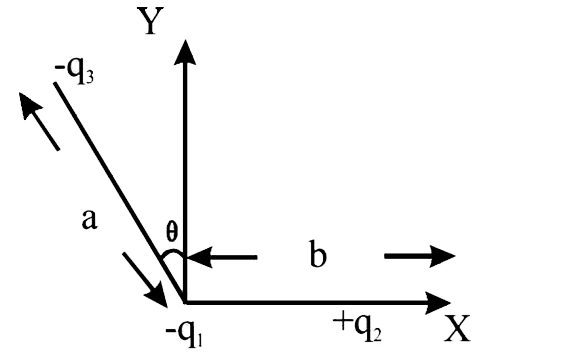
Three charges `-q_1`, `+q_2` and `-q_3` are placed as shown in the figure. The x-component of the force on `-q_1` is proportional to

A

(a) `(q_2)/(b^2)-(q_3)/(a^2)cos theta`

B

(b) `(q_2)/(b^2)+(q_3)/(a^2)sin theta`

C

(c) `(q_2)/(b^2)+(q_3)/(a^2) cos theta`

D

(d) `(q_2)/(b^2)-(q_3)/(a^2) sin theta`

Text Solution

Verified by Experts

The correct Answer is:
B

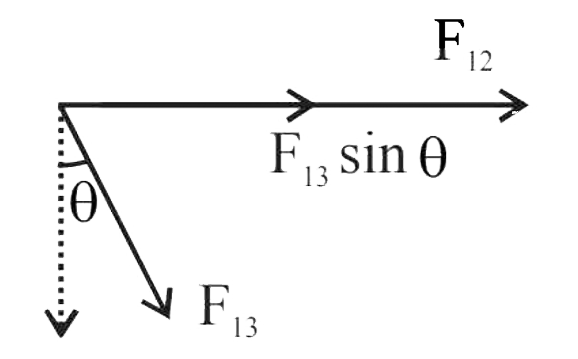
Force on charge `q_1` due to `q_2` is `F_(12)=k(q_1q_2)/(a^2)`
Force on charge `q_1` due to `q_3` is `F_(13)=k(q_1q_3)/(a^2)`
The X-component of the force `(F_x)` on
`q_1` is `F_(12)+F_(13) sin theta`
`:.` `F_x=k(q_1q_2)/(b^2)+k(q_1q_2)/(a^2)sintheta`
`:.` `F_xprop(q_2)/(b^2)+(q_3)/(a^2)sin theta`
Promotional Banner

Topper's Solved these Questions

  • ELECTROSTATICS

    SUNIL BATRA (41 YEARS IITJEE PHYSICS)|Exercise Subjective Problems|2 Videos
  • ELECTROSTATICS

    SUNIL BATRA (41 YEARS IITJEE PHYSICS)|Exercise Comprehension Based Questions|2 Videos
  • ELECTROMAGNETIC INDUCTION AND ALTERNATING CURRENT

    SUNIL BATRA (41 YEARS IITJEE PHYSICS)|Exercise JEE Main And Advanced|107 Videos
  • MODERN PHYSICS

    SUNIL BATRA (41 YEARS IITJEE PHYSICS)|Exercise MCQ (One Correct Answer|1 Videos

Similar Questions

Explore conceptually related problems

The value of charge q_1 ,q_2 and q_3 as shown in the figure are

Charge +2Q and -Q are placed as shown in figure. The point at which electric field intensit is zero will be

Three charges +q, +q, +2q are arranged as shown in figure. What is the field at point P (center of side AC)

Three charges q_(1), q_(2) and q_(3) are shown in figure . Determine the net force acting on charge q_(1) . The charges and separation are given as q_(1) =- 1.0 xx 10^(-6)C, q_(2) =+ 3.0 xx 10^(-6)C , and q_(3) = - 2.0 xx 10^(-6)C, r_(12) = 15 cm, r_(13) = 10 cm and theta = 30^(@) .

Charge 2Q and -Q are placed as shown in figure. The point at which electric field intensity is zero will be somewhere

Conisder a system of three charges q//3 , q//3 and -2q//3 placed at point A, B and C, respectively, as shown in the figure. Take O to be centre of the circle of radius R and angle CAB=60^@

