

Home
Class 11
PHYSICS
A block of mass m is placed on the incli...

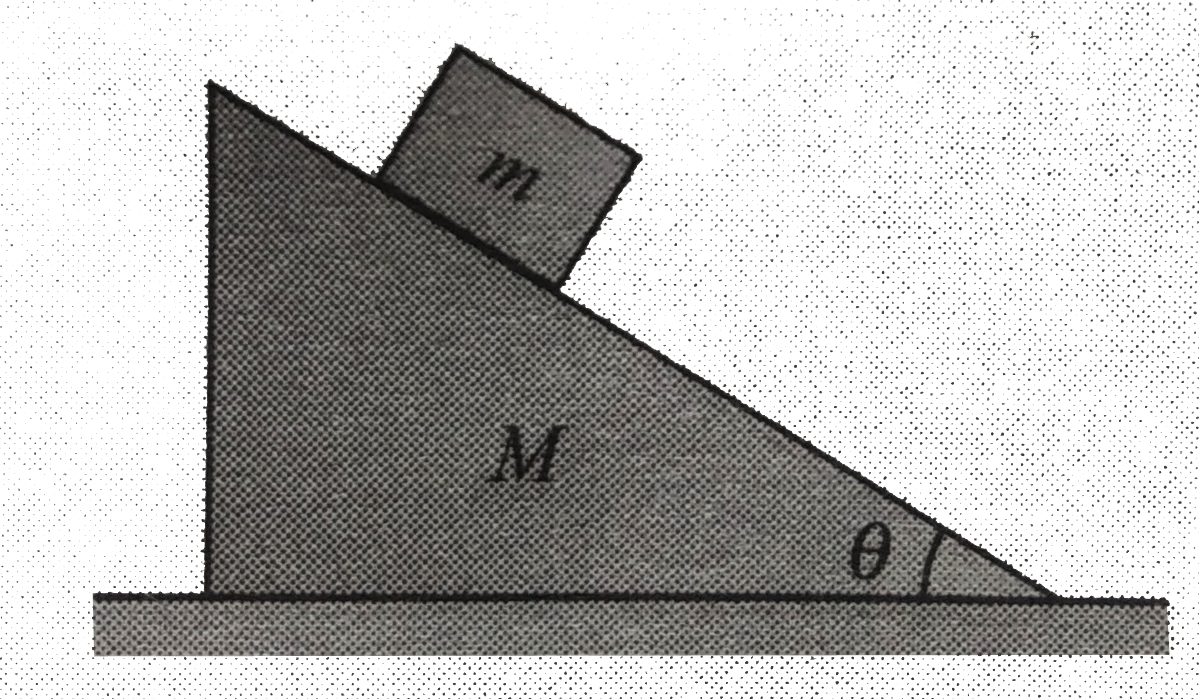
A block of mass m is placed on the inclined sufrace of a wedge as shown in fig. Calculate the acceleration of the wedge and the block when the block is released. Assume all surfaces are frictionless.

Promotional Banner

Similar Questions

Explore conceptually related problems

A block of mass m is placed on a smooth wedge of mass M, as shown in the figure . Just after placiing block m over wedge M.

A block of mass m is initially lying on a wedge of mass M with an angle of inclination theta as shown in figure. Calculate the displacement of the wedge when the block is released and reaches to the bottom of the wedge.

A block is released on the convex surface of a hemispherical wedge as shown in Fig. Determine the displacement of the wedge when the block reaches the angular position theta

A block is released on the convex surface of a hemispherical wedge as shown in Fig. Determine the displacement of the wedge when the block reaches the angular position theta

In fig. mass m is being pulled on the incline of a wedge of mass M. All the surfaces are smooth. Find the acceleration of the wedge.

In fig. mass m is being pulled on the incline of a wedge of mass M. All the surfaces are smooth. Find the acceleration of the wedge.

A block of mass 'm' is placed on wedge of mass 'M'. If all the surfaces are smooth Normal reaction between the wedge and block is

A block A (mass 4M) is placed on the top of a wedge block B of base length l (mass=20M) as shown in figure. When the system is released from rest. Find the distance moved by the block B till the block A reaches ground Assume all surfaces are frictionless.

A block of mass m slides down on inclined wedge of same mass m as shown in figure . Friction is absent everywhere . Acceleration of centre of mass of the block and wedge is

A block of mass m slides down on inclined wedge of same mass m as shown in figure . Friction is absent everywhere . Acceleration of centre of mass of the block and wedge is