

Home
Class 11
PHYSICS
Consider one mole of a perfect gas in a ...

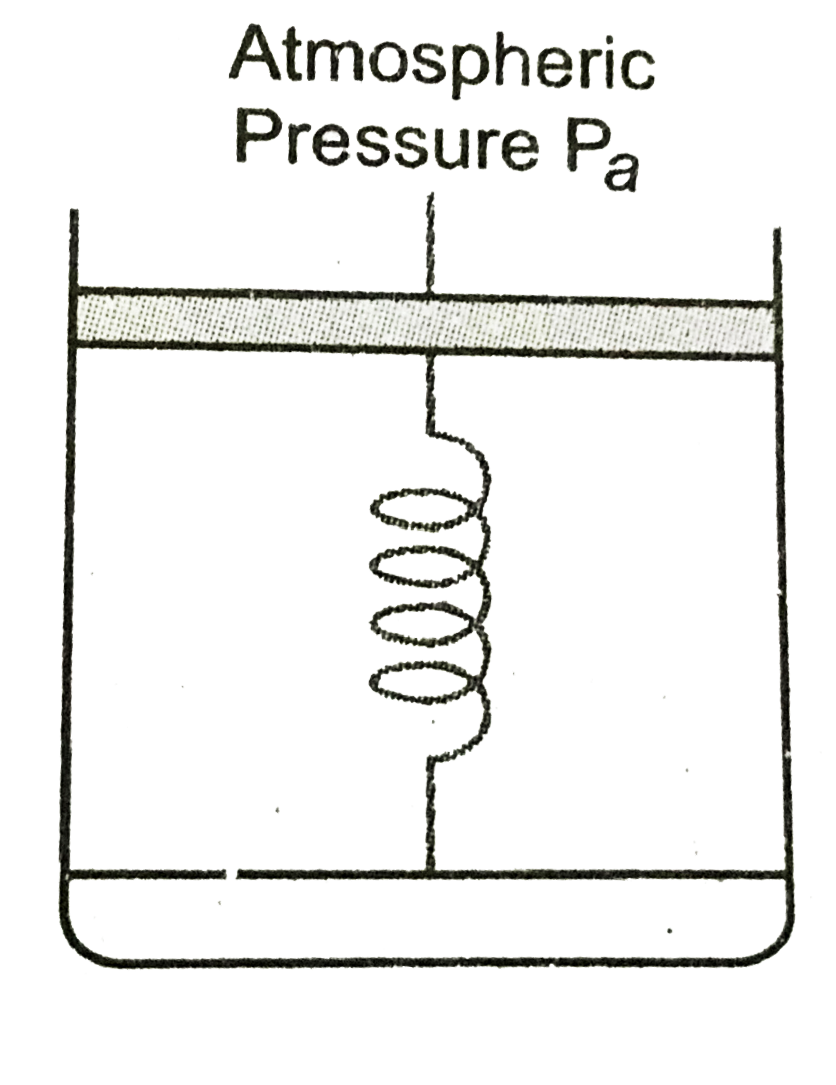
Consider one mole of a perfect gas in a cyclinder of unit cross section with a piston attached, (figure) A spring (spring constant K) is attached (unstretched length `L`) to the piston and the bottom of the cylinder. Initially, the spring is unstretched and the gas is in equilibrium. A certain amount of heat `Q` is supplied to the gas causing an increase of volume from `V_(0) "to" V`.
(a) What is the initial pressure of the system?
(b) What is the final pressure of the system?
(c) Using the first law of thermodynamics, write down a relation between `Q, P_(a), V, V_(0)` and `K`.

Promotional Banner

Similar Questions

Explore conceptually related problems

Consider one mole of perfect gas on a cylinder of units cross-section with a piston attached (figure). A spring (spring constant K ) is attached ( unstretched length L ) to the piston and to the bottom of the cylinder . Initially the spring is unstretched and the gas is in equilibrium. A certain amount of heat Q is supplied to the gas causing an increase of value from V_(0) to V_(1) . (a) What is the initial pressure of the system ? (b) What is the final pressure of the system? (c) Using the first law of thermodynamic, write down a relation between Q, p_(a),V,V_(0) and K.

Consider one mole of perfect gas in a cylinder of unit cross section with a piston attached as shown in figure. A spring (spring constant k) is attached (unstretched length L ) to the piston and to the bottom of the cylinder. Initially the spring is unstretched and the gas is in equilibrium. A certain amount of heat Q is supplied to the gas causing an increase of value from V_0 to V_1 . (a) What is the initial pressure of the system ? (b) What is the final pressure of the system ? (c) Using the first law of thermodynamics, write down a relation between Q, P_a , V, V_0 and k.

Consider one mole of perfect gas on a cylinder of units cross-section with a piston attched (figure). A spring (spring constant K ) is attched (unstrecthed lengthL ) to the piston and to the bottom of the cylinder . Inditially the spring is unstrecthed and the gas is in equailibrium. A certain amount of heat Q is supplied to the gas causing an increase of value from V_(0) to V_(1) . (a) What is the initial pressure of the system ? (b) What is the final pressure of the system? (c) Using the first law of thermodynamic, write down a relation between Q, p_(a),V,V_(0) and K.

In the equilibrium conditions shown in the figure all the springs have unstretched length l

A block of mass m having charge q is attached to a spring of spring constant k . This arrangement is placed in uniform electric field E on smooth horizontal surface as shown in the figure. Initially spring in unstretched. Find the extension of spring in equilibrium position and maximum extension of spring.

A block of mass m having charge q is attached to a spring of spring constant k . This arrangement is placed in uniform electric field E on smooth horizontal surface as shown in the figure. Initially spring in unstretched. Find the extension of spring in equilibrium position and maximum extension of spring.

One mole of a perfect gas in a cylinder fitted with a piston has a pressure P, volume V and temperature T. if the temperature is increased by 1K keeping pressure constant, the increase in volume is

Consider the situation shown in figure. Initially the spring is unstretched when the system is released from rest. Assuming no friction in the puley, find the maximum eleongation of the spring.

Consider the situation shown in figure. Initially the spring is unstretched when the system is released from rest. Assuming no friction in the pulley, find the maximum elongation of the spring?