

Home
Class 11
PHYSICS
Two ball of same mass are projected as s...

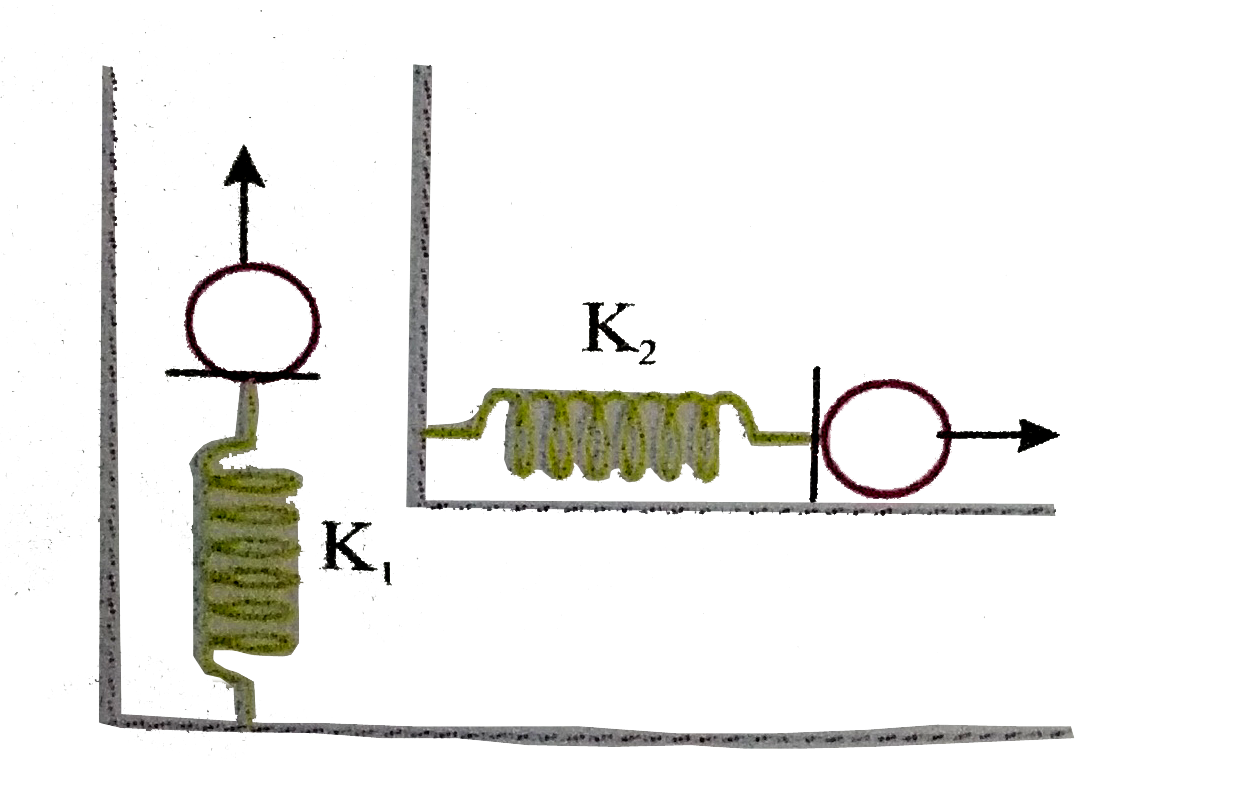
Two ball of same mass are projected as shown. By compressing equally (say `x`) the springs of different force constants `K_(1)` and `K_(2)` by equal magnitude. The first ball is projected upwards along smooth wall and the other on the rough horizontal floor with coefficient of friction `mu`. If the first ball goes up by height `h`, then the distance covered by the second ball will be :
.

Promotional Banner

Similar Questions

Explore conceptually related problems

Two balls of same mass are projected as shown, by compressing the springs of different force constants K_(1) and K_(2) by equal distance. The first ball is projected upwards along smooth wall and the other on the rough horizontal floor with coefficient of friction mu . if the first ball goes up by height h, then the distance covered by the second ball will be

A ball (initially at rest) falls vertically for 2 s and hits a smooth plane inclined at 30^(@) to the horizontal. The coefficient of restitution is (5)/(8) . The distance along the plane between the first and second impact of the ball is

A ball (initially at rest) falls vertically for 2 s and hits a smooth plane inclined at 30^(@) to the horizontal. The coefficient of restitution is (5)/(8) . The distance along the plane between the first and second impact of the ball is

Two balls are projected with the same velocity but with different angles with the horizontal. Their ranges are equal. If the angle of projection of one is 30° and its maximum height is h, then the maximum height of other will be

A ball is dropped from the roof of a tower of height (h). The total distanc coverd by it in the last second of its motion is equal to the distance covered by in first three seconds. What will be the velocity at the end of 9 secind ?

Three small balls of equal mass (m) are suspended from a thread and two springs of same force constant (K) such that the distances between the first and the second ball and the second third ball are the same. Thus the centre of mass of the whole system coincides with the second ball. The thread supporting the upper ball is cut and system starts a free fall. Find the distance of the centre of mass of the system from the second ball when both the springs acquire their natural length in the falling system.

A ball is droped from a 256 m high eower and at the same time another ball is projected vertical upward with velocity 32 m s^-1 in line with the first ball. Find when and where the two balls will meet each other. (g= 10 m s^-2)

A ball is dropped from the roof of a tower height h . The total distance covered by it in the last second of its motion is equal to the distance covered by it in first three seconds. The value of h in metre is (g=10m//s^(2))

A ball is dropped from the roof of a tower height h . The total distance covered by it in the last second of its motion is equal to the distance covered by it in first three seconds. The value of h in metre is (g=10m//s^(2))