Home
Class 12
MATHS
Find the area of the region bounde...

Find the area of the region bounded by the curve ` x^(2) = 16 y `, lines ` y = 2, y = 6 ` and Y - axis lying in the first quadrant.

Text Solution

Verified by Experts
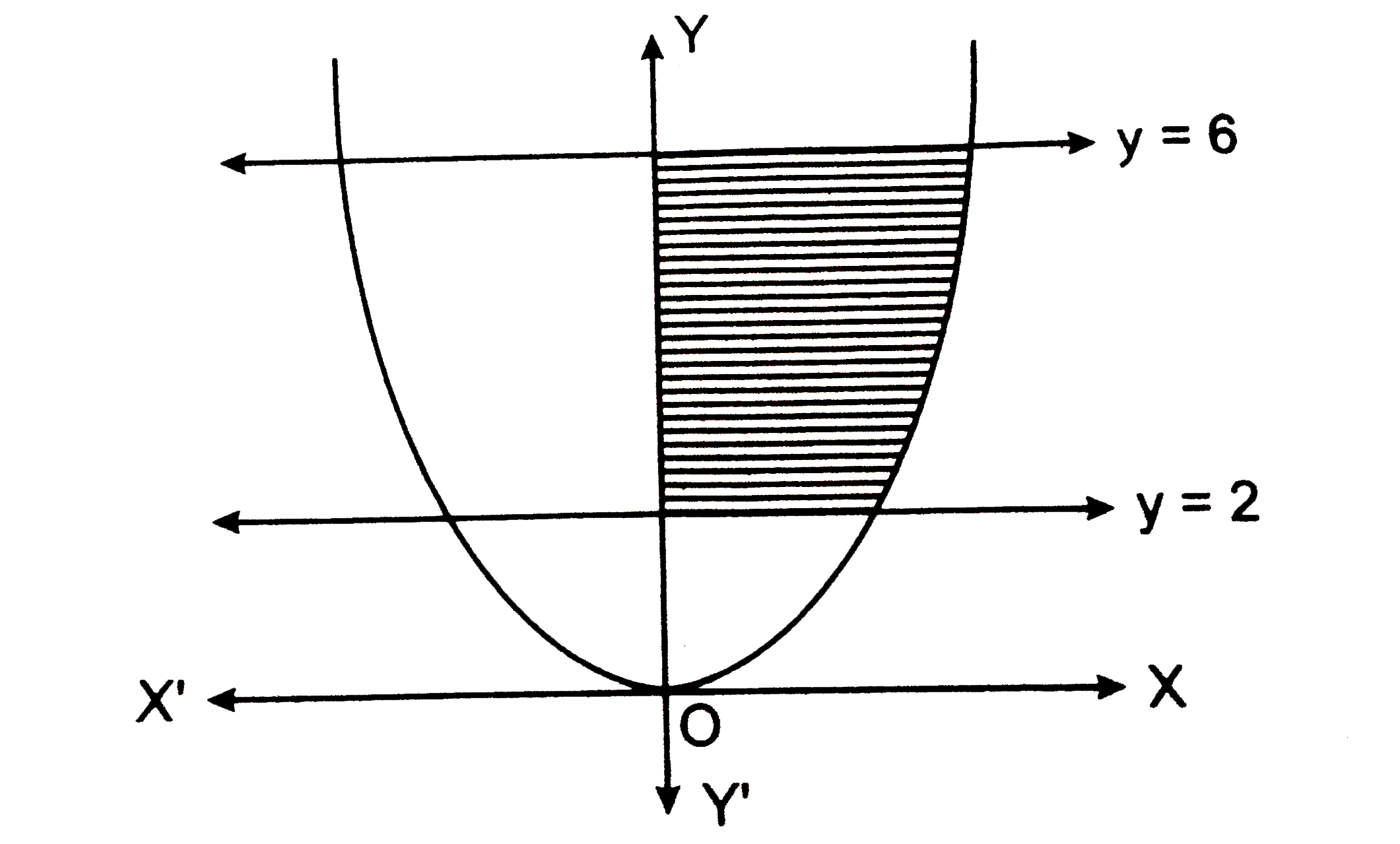
Given curve is `x^(2) = 16y`
Required area ` = int_(2)^(6) x.dy`
` therefore " "A = int_(2)^(6)sqrt(16y)dy`

` = 4. [(2)/(3)y^(3//2)]_(2)^(6)`
` = (8)/(3)(6sqrt(6) - 2sqrt(2))`
` = (16)/(3)(3sqrt(6)- sqrt(2))`sq unit.
= 31.65 sq units.
Promotional Banner

Topper's Solved these Questions

  • JULY 2017

    GURUKUL PUBLICATION - MAHARASHTRA PREVIOUS YEAR PAPERS|Exercise SECTION - II|20 Videos
  • JULY 2016

    GURUKUL PUBLICATION - MAHARASHTRA PREVIOUS YEAR PAPERS|Exercise Section-II|20 Videos
  • JULY 2018

    GURUKUL PUBLICATION - MAHARASHTRA PREVIOUS YEAR PAPERS|Exercise SECTION II|20 Videos

Similar Questions

Explore conceptually related problems

Find the area of the region bounded by the curves x=2y-y^2 and y=2+x .

Find the area of the region bounded by the curves 2y^2=x, 3y^2=x+1, y=0 .

The area of the region bounded by the curve y = x ^(2) and the line y =16 is :

Find the area of the region bounded by the curve x^(2) = 12y , the Y−axis and the given lines y = 2, y = 4, x ge 0

Find the area of the region bounded by the curve y = x^(2) , the X−axis and the given lines x = 0 , x = 3

Find the area of the region bounded by the curves y=x^(3) and the lines y=x+6 and y=0

Find the area of the region bounded by the curve y-3 and the lines y=x+6 and y=0

Find the area of the region bounded by the curve y = x^2 , the x-axis, and the lines x = 1 and x = 3.

Examples: Find the area of the region bounded by the curve y^(2)=2y-x and the y-axis.

GURUKUL PUBLICATION - MAHARASHTRA PREVIOUS YEAR PAPERS- JULY 2017-SECTION - II
  1. Given f(x) = 2x, x > 0 , 0 , x le 0 then f(x) is ........

    Text Solution

    |

  2. If int(0)^(prop)(3x^(2)+2x+1)dx=14, then prop = …….

    Text Solution

    |

  3. Prove that the function given by f(x)=x^3-3x^2+3x-100is increasing in...

    Text Solution

    |

  4. Differentiate 3^(x) w.r.t.log(3x)

    Text Solution

    |

  5. Check whether the conditions of Rolle's theorem are satisfied by the f...

    Text Solution

    |

  6. Evaluate int(sqrt(tanx))/(sinx. cos x) dx

    Text Solution

    |

  7. Find the area of the region bounded by the curve x^(2) = 16...

    Text Solution

    |

  8. Given X~ B (n,P) If n= 10 and p=0.4 , find E(X) and Var (X) .

    Text Solution

    |

  9. It the function f(x) = ((5^(sinx) - 1)^(2))/(x log (1 +2 x)) for x ...

    Text Solution

    |

  10. The probability mass function for X number of major defects in a ra...

    Text Solution

    |

  11. Suppose that 80% of all families own a television set. If 5 families...

    Text Solution

    |

  12. Find the approximate values of : cos(60^(@)30')," given "1^(@)=0.01...

    Text Solution

    |

  13. The rate o growth of bacteria is proportional to the number present . ...

    Text Solution

    |

  14. int(-a)^(a)f(x)dx= 2int(0)^(a)f(x)dx, if f is an even function 0, if...

    Text Solution

    |

  15. If f (x) is continuous on 0-4, 2], defined as f(x)=6b-3ax, "for" -4 ...

    Text Solution

    |

  16. If u and v are two functions of x then prove that: intuv dx =uint vd...

    Text Solution

    |

  17. Probability distribution of X is given by Find P(X le 2) and ob...

    Text Solution

    |

  18. Solve the differential equation. (dy)/(dx) - y = e^(x) Hence fin...

    Text Solution

    |

  19. If y = f(x) and x = g(y), where g is the inverse of f, i.e., g = f^(-1...

    Text Solution

    |

  20. int8/((x+2)(x^2+4))dx

    Text Solution

    |

