Home
Class 12
PHYSICS
With the help of a neat labelled diagra...

With the help of a neat labelled diagram, describe the Geiger-Marsden experiment. What is mass defect ?
The photoelectric work function for a metal surface is `2 : 3 eV`. If the light of wavelength `6800 Å` is incident on the surface of metal, find threshold frequency and incident frequency. will there be an emission of photoelectron or not ?
[Velocity of light `c = 3 xx 10^(8) m//s`, Planck's constants, `h = 6.63 xx 10^(-34) Js`]

Text Solution

Verified by Experts
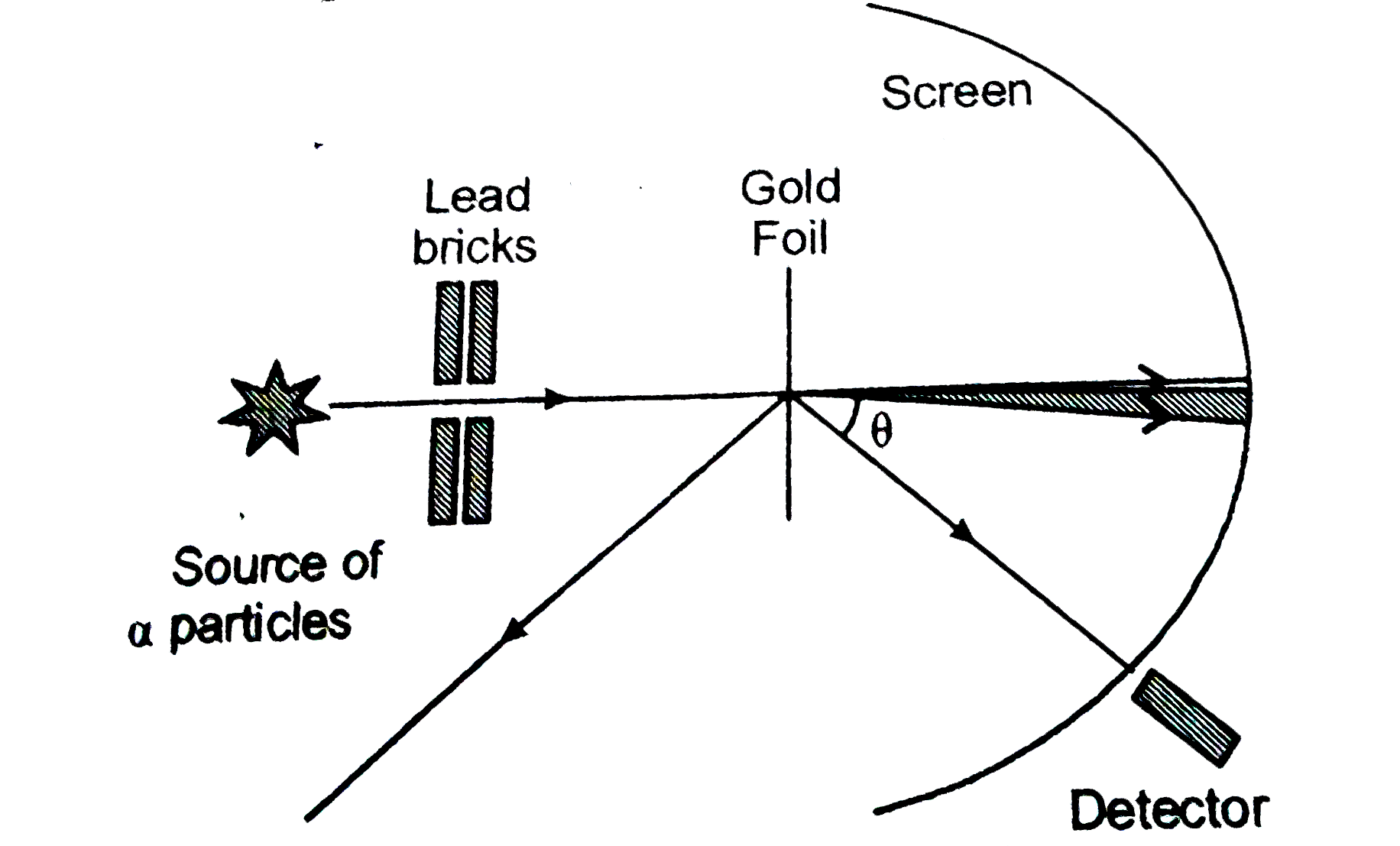
Geiger-Marsden experiment : The setup of the Geiger- Marsden experiment is as shown below .

In this experiment,a narrow beam of `alpha`-particle from a radioactive soure was incident on a gold foil. The scattered `alpha`-particles were detected by the detector fixed on a rotating stand. The detector used had a zinc sulphide screen and a microscope.
The `alpha`-particles produced scintillations on the screen which could be observed through a microscope. This entire setup is enclosed in an evacuated chamber.
They observed the number of `alpha`-particles as a function of scattering angle. Now, the scattering angle is the deviation `(theta)` of `alpha`-particles from its original direction.
They observed that most `alpha`-particles passed undeviated and only a few `(-0.14%)` scattered by more than `1^(@)`. Few were deflected slightly and only a few (1in 8000) deflected by more than `90^(@)`. Some particles even bounced back with `18^(@)`.
Mass defect : It is observed that the mass of a nucleus of smaller than the sum of the masses of the contituent nucleons in the free state. The difference between the actual mass of the nucleus and the sum of the massses of constituent nucleons is called mass defect.
The mass defect is
`Deltam = [Zm_(p) +(A-Z) m_(n)] - M`
where Z is the atomic number (number of protons ), A is the mass number, (A-Z) is the number of neutrons, `m_(p)` is the mass of the a proton, `m_n` is the mass of a neutron and is the measured mass of a nucleus.
Given : `phi_(0) = 2.3 eV = 2.3 xx 1.6 xx 10^(-19) J = 3.68 xx 10^(-19) J`
`lambda = 6800 Å = 6800 xx 10^(-10) m c = 3 xx 10^(8) m//s`.
`h= 6.63 xx 10^(-34) Js`
We know that the incident frequency is given as
`v = c/lambda`
`:. v = (3 xx10^(8))/(6800 xx 10^(-10)) = 4.41 xx 10^(14)`
Now, if the incident frequency is greater than the threshold frequency , then photoelectrons will be emitted from the metal surface. The threshold frequency is given from work function as ltbr `v_(0) = (phi_(0))/(h)`
`:. v_(0) = (3.68 xx 10^(-19))/(6.63 xx 10^(-34)) = 5.55 xx 10^(14) Hz`
Since `v lt v_(0)`, photoelectrons will not be emitted.
Promotional Banner

Topper's Solved these Questions

  • FEBRUARY 2016

    GURUKUL PUBLICATION - MAHARASHTRA PREVIOUS YEAR PAPERS|Exercise SECTION-II|21 Videos
  • FEBRUARY 2014

    GURUKUL PUBLICATION - MAHARASHTRA PREVIOUS YEAR PAPERS|Exercise SECTION-II|21 Videos
  • FEBRUARY 2018

    GURUKUL PUBLICATION - MAHARASHTRA PREVIOUS YEAR PAPERS|Exercise SECTION-II|21 Videos

Similar Questions

Explore conceptually related problems

Draw a neat and labelled energy level diagram and explain Balmer series and Bracket series of spectral lines for hydrogen atom. The work function for a metal suface is 2.2 eV. If light of wavelength 5000 Å is incident on the surface of metal, find the threshold frequency and incident frequency. Will there be an emmission of photoelectrons or not ? (c=3xx10^(8)m//s, 1eV=1.6xx10^(-19)J, h=6.63 xx10^(-34)J.s.)

Photoelectric work function for a surface is 2.4 eV. Light of wavelength 6.8 xx 10^(-7) m shines on the surface. Find the frequency of incident light and also the threshold frequency. Will there be photoelectric emission or not ?

The work function of a metal is 2.5 eV. Light of wavelength 3600 Å is incident on this metal surface. The velocity of emitted photoelectrons will be

The photoelectric work function of a surface is 2.2 eV. The maximum kinetic energy of photoelectrons emitted when light of wavelength 6200 Å is incident on the surface, is

If the work function of a metal is 'phi' and the frequency of the incident light is 'v' , there is no emission of photoelectron if

The work function of metal is 1 eV . Light of wavelength 3000 Å is incident on this metal surface . The velocity of emitted photo - electrons will be

If the photoelectric work function of a metal is 5 eV , the threshold frequency of the metal is

The work function of a metal is 3.4 eV. A light of wavelength 3000Å is incident on it. The maximum kinetic energy of the ejected electron will be :

The work function for a metal surface is 2.0 eV. Determine the longest wavelength that will eject photoelectrons from the metal surface.

Light of wavelength 200 nm incident on a metal surface of threshold wavelength 400 nm kinetic energy of fastest photoelectron will be

GURUKUL PUBLICATION - MAHARASHTRA PREVIOUS YEAR PAPERS- FEBRUARY 2016-SECTION-II
  1. Draw a neat labelled diagram for the construction of 'cyclotron '.

    Text Solution

    |

  2. Give any 'two' points of differences between diamagnetic and ferromagn...

    Text Solution

    |

  3. PROPAGATION OF ELECTROMAGNETIC WAVES

    Text Solution

    |

  4. The combined resistance of a galvanometer of resistance 500 Omega ...

    Text Solution

    |

  5. The susceptibility of magnesium at 200K is 1.8 xx 10^(-5). At what t...

    Text Solution

    |

  6. The co-efficient of mutual induction between primary and secondary ...

    Text Solution

    |

  7. The decay constant of radioactive substance is 4.33 xx 10^(-4) per ...

    Text Solution

    |

  8. If the polarising angle for a given medium is 60^@, then the refract...

    Text Solution

    |

  9. The resolving power of a telescope depends on

    Text Solution

    |

  10. Electric field intensity due to a charged sphere at a point outside ...

    Text Solution

    |

  11. In potentiometer experiment, if l(1) is the balancing length for e.m.f...

    Text Solution

    |

  12. The energy of a photon of wavelength lambda is given by

    Text Solution

    |

  13. Which of the following gates correspond to the truth table given belo...

    Text Solution

    |

  14. The process of superimposing a low frequency signal on a high freque...

    Text Solution

    |

  15. State the principle on which transformer works. Explain its working wi...

    Text Solution

    |

  16. With the help of a neat labelled diagram, describe the Geiger-Marsde...

    Text Solution

    |

  17. Determine the change in wavelength of light during its passage fro...

    Text Solution

    |

  18. In biprism experiment, 10th dark band is observed at 2.09 mm from the...

    Text Solution

    |

  19. Describe Kelvin's method to determined the resistance of galvanome...

    Text Solution

    |

  20. Explain the elementary idea of an oscillator with the help of block ...

    Text Solution

    |

