Home
Class 12
PHYSICS
Define linear simple harmonic motion. As...

Define linear simple harmonic motion. Assuming the expression for displacement of a particle starting from extreme position, explain graphically the varition of velocity and acceleration w.r.t. time.
A clock reagulated by seconds pendulum, keeps correct time. During summer, length of pendulum increases to 1.005 m. How much will the clock gain or loose in one day `(g=9.8m//s^(2)andpi=3.142)`.

Text Solution

Verified by Experts
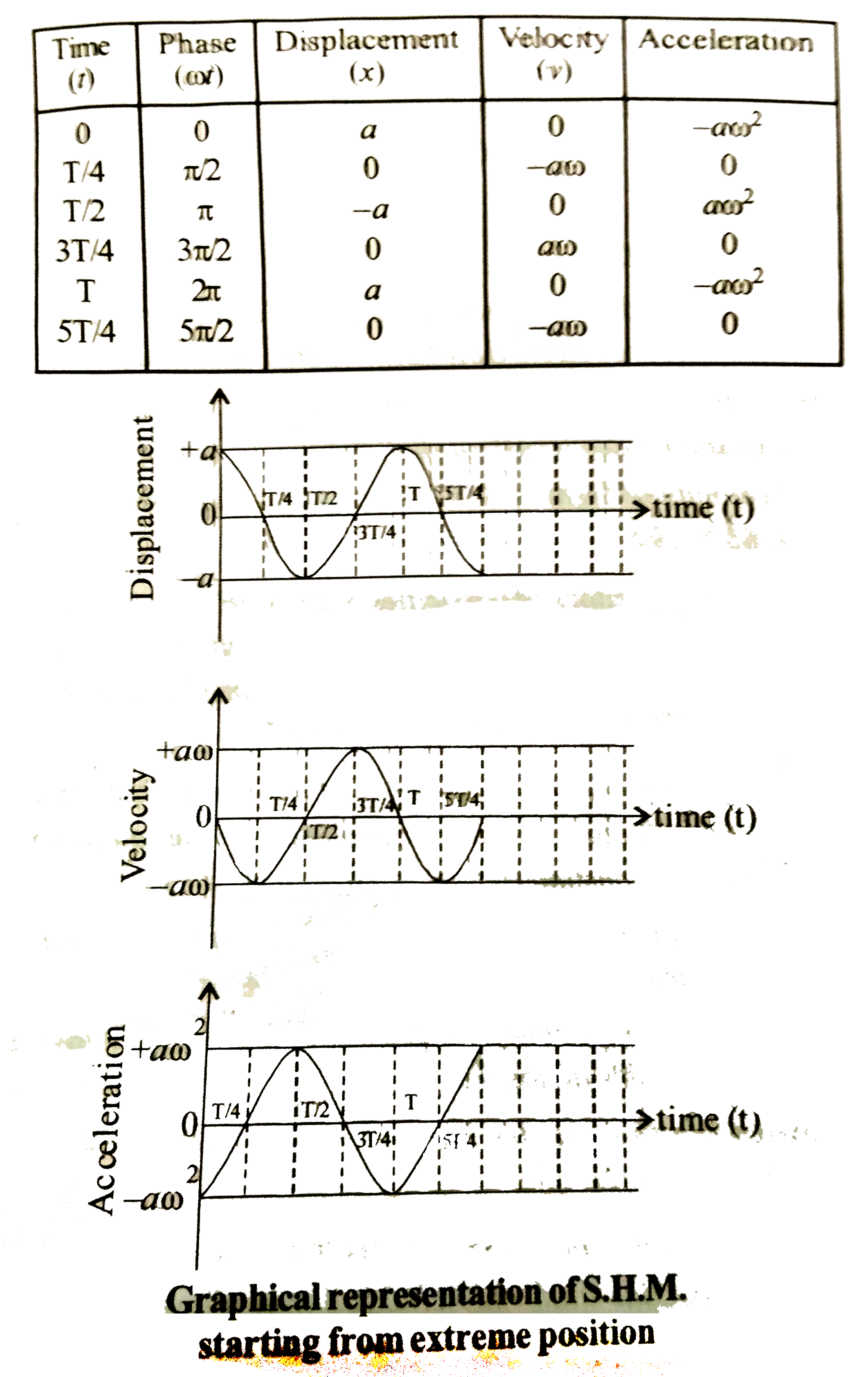
Linear Simple Harmonic Motion : It is defined as the linear periodic motion of a body, in which the restoring force (or acceleration) is always directed towards the mean position and its magnitude is directly proportional to the displacement from the mean position.
Particle performing S.H.M. starting fromm extreme position :
Equation of displacement is `x=acosomegat`
At extreme position, `alpha=pi//2`.
`:.` Velocity of particle is `v=(dx)/(dt)=(d)/(dt)(acosomegat)`
And `v=-aomegasinomegat`
acceleration of a particle `=(dv)/(dt)`
`=(d)/(dt)=(-aomegasinomegat)`
`=-aomega^(2)cosomegat`.
Substiuting `omega=2pi//T` in above equaitons

(i) Displancement, veloctiy and acceleration of S.H.M. are periodic functions of time.
(ii) Displancement-time curve and acceleration-time curve are cosine curve and velocity-time curve is a since curve.
(iii) Phase difference between displacement and velocity is
`(pi)/(2)` radian.
(iv) Phase difference between velocity and acceleration is `(pi)/(2)` radian.
(v) Phase difference between displacement and acceleration is `pi` radian.
(vi) At extreme position, displancement and acceleration is maximum while velocity is minimum.
(vii) After the phase of `2pi` radian, all curves repeat the same path.
Given L=1.005m and g `=9.8m//s^(2)`
Period of simple pendulum (T)
`=2pisqrt((L)/(g))`
`T=2xx3.142xxsqrt((1.005)/(9.8))`
`=2.012sec.
Now, seconds pendulum has a period of 2 sec.
Therefore, the given clock will loose `(2.012-2)sec=0.012` sec during summer.
`:.` Loss in period per day `(24xx3600xx0.012)/(2.012)`
`=515.3` sec.
Promotional Banner

Similar Questions

Explore conceptually related problems

A particle is executing simple harmonic motion with an amplitude of 10 cm and time period of 4s. Calculate its displacement, velocity and acceleration after 1/2 seconds, starting from the mean position.

A simple harmonic motion along the x-axis has the following properties: amplitude =0.4m the time to go from one extreme position to other is 2s and x=0.3m at t=0.5 a. the general equation of the simple harmonic motion is

A particle is executing simple harmonic motion with time period of 4 s and amplitude 10 cm. Calculate displacement, velocity after (1)/(2) second starting from mean position.

Velocity-time equation of a particle moving in a straight line is, v=(10+2t+3t^2) (SI units) Find (a) displacement of particle from the mean position at time t=1s, if it is given that displacement is 20m at time t=0 . (b) acceleration-time equation.

Define phase of S.H.M. Show variation of displacement, velocity and acceleration with phase for a particle perfoming linear S.H.M. graphically, when it starts from extreme position. A body starts rotating from rest. Due to a couple of 20 Nm it completes 60 revolutions in one minute. Find the moment of inertia of the body.

Velocity-time graph of a particle moving in a straight line is shown in figure. At time t= 0, displacement of the particle from mean position is 10 m. Find (a) acceleration of particle at t = 1 s, 3 s and 9 s. (b) position of particle from mean position at t = 10 s. (c) write down s-t equation for time interval (i) 0letle2s , (ii) 4sletle8s

A particle executing simple harmonic motion along a straight line. The velocity of the particle is 5ms^(-1) , when it is at a distance of 4 m from mean position and 3ms^(-1) , when at a distance of 9 m from mean position. Calculate the time taken by the particle to travel 3 m from the positive extremity of oscillation.

As velocity of the particle increases from zero and finally it decreases to zero hence acceleration is not remain positive for all the time of motion. Find out the average velocity of the motion V(m/s) 4 1/2 0 >t(sec) 1

A clock with a brass pendulum shaft keeps correct time at a certain temperature. a. How closely must the temperature be controlled if the clock is not to gain or lose more that 1 s a day? Does the answer depend on the period of the pendulum? b. Will an increase of temperature cause the clock to gain or lose? (alpha_("brass")=2 xx 10^(-5)//^(@)C)

