Expression for path difference and fringe width of interferences pattern: Let S be a narrow slit, illuminated by monochromatic light of `lamda` wavelength `S_(1)andS_(2)` are two narrow and parallel slits which are separated by a short distance 'd' and are equidistant from S. The light waves from S will arrive at `S_(1)andS_(2)` which will proceed to produce an interference pattern on screen XY kept at very large distancae D, from the sources `S_(1)andS_(2)`.
Let O be a point on screen such that OM is the perpendicular bisector of the line joining `S_(1)andS_(2)`.
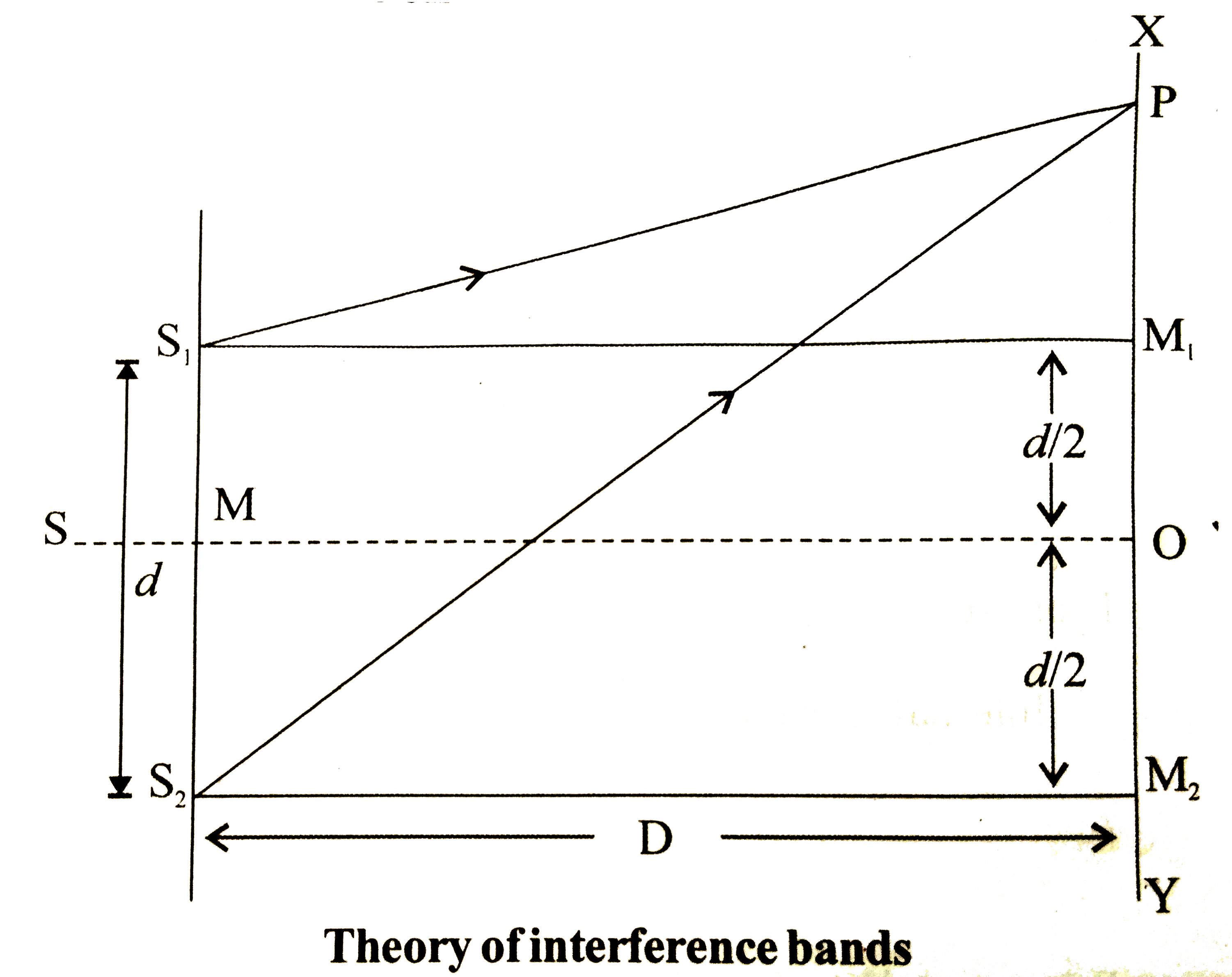
Since `S_(1)O=S_(2)O` the path difference between waves reaching O is zero, hence O is bright point O is called the centre of the interfernce pattern.
Let P be any point on screen at a distance 'x' from O. The path difference is `S_(2)P-S_(1)P`. Suppose `S_(1)M_(1)andS_(2)M_(2)` are perpendiculars on the screen.
Now, `PM_(1)=x-(d)/(2)andPM_(2)=x+(d)/(2)` ltbr In `DeltaS_(2)M_(2)P`,
`(S_(2)P)^(2)=(S_(2)M_(2))^(2)+(PM_(2)^(2))`
`:.(S_(2)P)^(2)=D^(2)+(x+(d)/(2))" "......(i)`
In `DeltaS_(1)M_(1)P`
`(S_(1)P)^(2)=(S_(1)M_(1))^(2)+(PM_(1))^(2)`
`:.(S_(1)P)^(2)=D^(2)+(x+(d)/(2))" "......(ii)`
`:.(S_(2)P)^(2)-(S_(1)P)^(2)=D^(2)+(x+(d)/(2))-D^(2)-(x+(d)/(2))^(2)`
`(S_(2)P-S_(1)P)(S_(2)P+S_(1)P)=x^(2)+xd+(d^(2))/(4)-x^(2)+xd-(d^(2))/(4)`
`:.S_(2)P-S_(1)P=(2xd)/(S_(2)P+S_(1)P)`
AS `Dgtgtgtx` and, So we make assumption `S_(1)P=S_(2)P=D`
`:.S_(2)P-S_(1)P=(2xd)/(2D)=(xd)/(D)`
which is expression for path difference.
Note : (i) The point P will be bright if the path difference is an even multiple of `(lamda)/(2)`
i.e., `S_(2)P-S_(1)P=(xd)/(D)=2n(lamda//2)`
`implies x=n(lamdaD)/(d)` where n=1, 2.......
(iii) The point P will be dark if the path difference is an odd multiple of `(lamda)/(2)`
i.e., `S_(2)P-S_(1)P=(xd)/(D)=(2m-1)(lamda)/(2)`
`impliesx(2m-1)(lamdaD)/(d)" "m=1,2......`
Expression for Fringe width (Band width) : Band (fringe) width is the distance between the centre of two adjacent bright or dark bands.
Let `x_(n)andx_(n+1)` be the distance of `n^(th)and (n+1)^(th)` bright band on the same side of central bright band.
Now, `x_(n)=n(lamdaD)/(d)`
`x_(n+1)=((n+1)lamdaD)/(d)`
`x_(n+1)-x_(n)=(n+1-n)(lamdaD)/(d)`
`:.X=(lamdaD)/(d)" "......(iii)`
where, X is band width or fringe width.
Similarly, let `x_(m)andx_(m+1)` be the distances of `m^(th)` and `(m+1)^(th)` dark band on the same side of central bright band.
Now, `x_(m)=(2m-1)(lamdaD)/(2d)`
`x_(m+1)=[2( m+1)-1](lamdaD)/(2d)`
`x_(m+1)-x_(m)=[2(m+1)-1-2m+1](lamdaD)/(2d)`
`x_(m+1)-x_(m)=(lamdaD)/(d)`
`:.X'=(lamdaD)/(d)" "......(iv)`
where, X' is the band width or fringe width.
Equataions (iii) and (iv) represent the expression for band width
`X=X'=(lamdaD)/(d)`
Hence, the band width of bright band and dark band is same.
Numerical :
Given : `_(0)mu_(g)=(3)/(2),_(a)mu_(w)=(4)/(3),_(w)mu_(g)=?`
`_(w)mu_(g)=(""_(a)mu_(g))/(""_(a)mu_(w))=(3//2)/(4//3)=(9)/(8)=1.12.`
Therefore, the refractive index of glass w.r.t. water is 1.12.


