Home
Class 12
PHYSICS
Explain the formation os stationary wave...

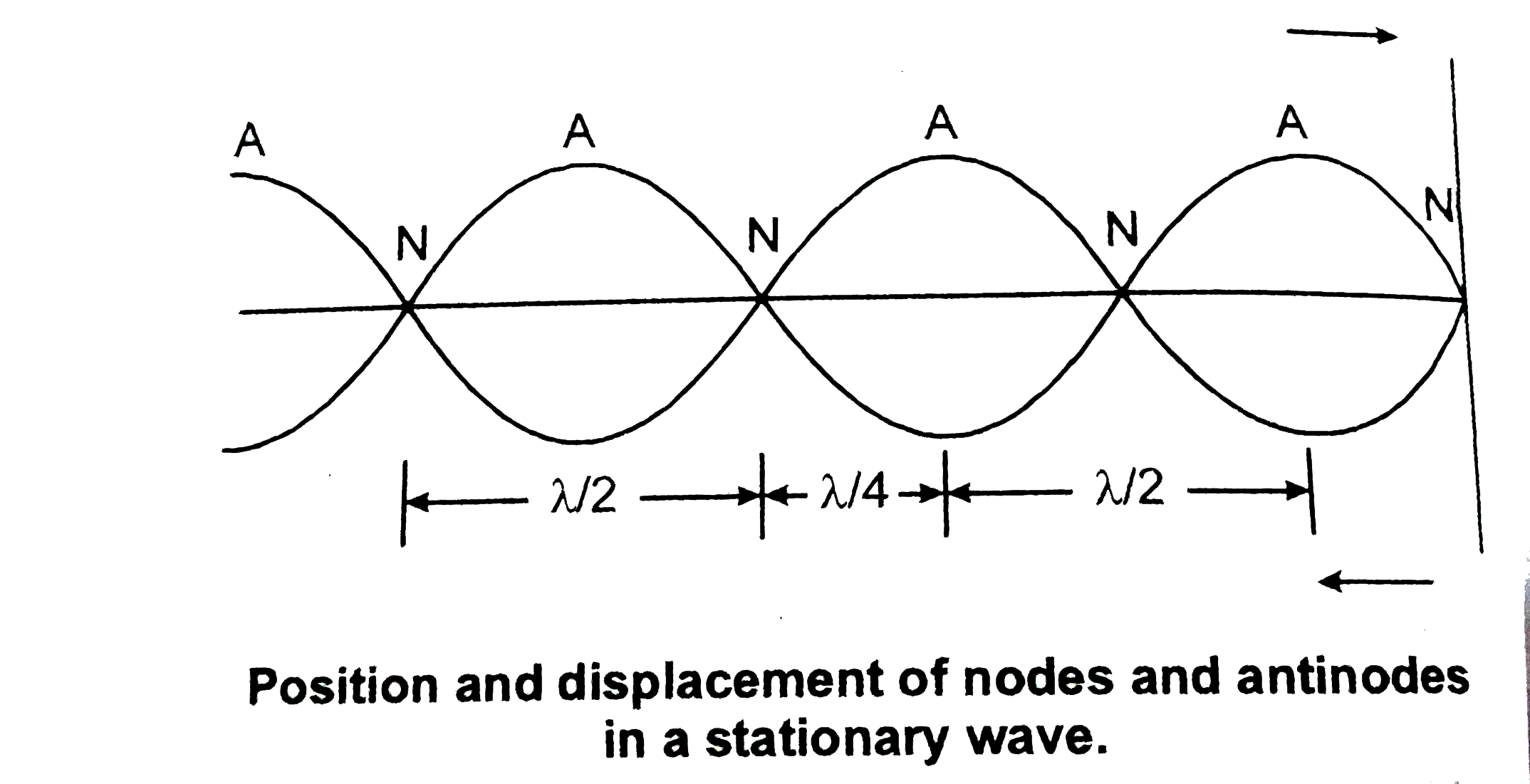
Explain the formation os stationary waves by analytical method. Show the formation of stationary wave diagramatically.
A mass of 1 kg is hung from a steel wire of radius 0.5 mm and length 4 m. Calculate the extension produced. What should be the area of cross-section of the wire so that elastic limit is not exceeded? Change in radius is negligible ?
Given `g=9.8m//s^(2)`, Elastic limit of steel is `2.4xx10^(8)N//m^(2)`, Y for steel `(Y_("steel"))=20xx10^(10)N//m^(2),pi=3.142`).

Text Solution

Verified by Experts
Formation of stationary waves :
Consider two simple harmonic progressive waves of equal amplitude and frequency propagating on a long uniform string in opposite directions.
If wave with frequency n and wavelength `lambda` is travelling along positive direction of X-axis then
`y_(1)=a sin 2pi(nt-(x)/(lambda))`
If wave with frequency n and wavelength `lambda` is travelling along negative direction of X-axis then
`y_(2)=a sin 2pi(nt+(x)/(lambda))`
The resultant displacement of stationary wave is given by the principle of superposition of waves.
`y=y_(1)+y_(2)`
`y=a sin 2pi(nt+(x)/(lambda))+a sin 2pi(nt-(x)/(lambda))`
`y=2a[sin(2pi nt)cos((2pi x)/(lambda))]`
`y=(2a " cos" (2pi x)/(lambda))sin (2pi nt)`
`y=A sin (2 pi nt)`
`y=A sin omega t " " (because omega =2pi n)`
where, ` A=2a "cos" (2pi x)/(lambda)`
(amplitude of resultant stationary wave)
Amplitude is periodic in space, hence we can see loops in case of transverse waves forming stationary wave on string.
This equation represents the resultant displacement of two simple harmonic progressive waves which is not moving. Thus, the waves are said to be stationary waves.

Numerical : Given : `M=1kg`
`r=0.5 mm =0.5 xx 10^(-3) m.`
`L=4m`
Y for steel `=20xx10^(10)N//m^(2)`
Elastic limit of steel `=2.4 xx 10^(8)N//m^(2)`
Now, Young's Modulus,
`Y=(FL)/(Al)`
`therefore l=(FL)/(pi r^(2)Y) " " [because F=mg]`
`l=(1 xx 9.4 xx 4)/(3.142 xx (0.5xx10^(-3))^(2)(20xx10^(10)))`
`=0.495 mm.`
Elastic limit of steel `=2.4 xx 10^(8)N//m^(2)`
If r' be the minimum radius of wire then,
Elastic limit `=(F)/(pi r'^(2))`
Elastic limit of steel = Maximum stress the wire can withstand
`(F)/(pi r'^(2))=2.4 xx 10^(8)`
`pi r^(2)=(F)/(2.4xx10^(8))`
`=(1xx9.8)/(2.4xx10^(8))`
`therefore` Area of cross section of wire (A')
`=4.083 xx 10^(-8)m. `
`=4.083xx10^(-5) mm.
Promotional Banner

Topper's Solved these Questions

  • MARCH 2017

    GURUKUL PUBLICATION - MAHARASHTRA PREVIOUS YEAR PAPERS|Exercise SECTION II|21 Videos
  • MARCH 2015

    GURUKUL PUBLICATION - MAHARASHTRA PREVIOUS YEAR PAPERS|Exercise SECTION-II|21 Videos
  • OCTOBER 2015

    GURUKUL PUBLICATION - MAHARASHTRA PREVIOUS YEAR PAPERS|Exercise SECTION-2|21 Videos

Similar Questions

Explore conceptually related problems

What are stationary waves ? State the necessary condition for the formation of stationary waves.

A mass of 5 kg is hung from a copper wire of 5 mm diameter and 2 m in length. Calculate the extension produced. What should be the minimum diameter of the wire so that its elastic limit is not exceeded ? Elastic limit for copper =1.5xx10^(9) dyne cm^(-2) and Y for copper =1.1xx10^(12) dyne cm^(-2)

A steel wire of diameter 1 mm, and length 2 m is stretched by applying a force of 2.2 kg wt. the extension produced in the wire is

The length of a steel wire is 0.82 m and its mass is 4 xx 10^(-3) kg. Calculate the speed of transverse waves on the wire if the wire is under a tension of 80 N.

Explain the formation of stationary waves by analytical method. Shwo that nodes and antinodes are equally spaced in sationary waves. The radius gyration of a body about an axis, at a distance of 0.4 m from its centre of mass is 0.5m . Find its radius of gyrtion about a parallel axis passing through its centre of mass.

The graph between applied force and change in the length of wire within elastic limit is a

GURUKUL PUBLICATION - MAHARASHTRA PREVIOUS YEAR PAPERS- MARCH 2017-SECTION II
  1. Explain the formation os stationary waves by analytical method. Show t...

    Text Solution

    |

  2. If A.C. voltage is applied to a pure capacitor, then votage across the...

    Text Solution

    |

  3. DOPPLER EFFECT

    Text Solution

    |

  4. If a watch-glass containing a small quantity of water is placed on tw...

    Text Solution

    |

  5. A device that converts one from of energy into another form is termed ...

    Text Solution

    |

  6. When a p-n-p transistor is operated in saturation region, then its ……...

    Text Solution

    |

  7. In a photon-electron collision ……………………. .

    Text Solution

    |

  8. If the charge on the condenser of 10 mu F is doubled, then the energy ...

    Text Solution

    |

  9. Distinguish between interference and diffraction of light.

    Text Solution

    |

  10. A galvanometer can be converted into a voltmeter by connecting a

    Text Solution

    |

  11. State the advantages of a potentimeter over a voltmeter.

    Text Solution

    |

  12. Draw a neat and labelled block diagram of a receiver.

    Text Solution

    |

  13. A rectangular coil of a moving coil galvanometer contains 100 turns, e...

    Text Solution

    |

  14. The magnetic flux through a loop is varying according to relation phi=...

    Text Solution

    |

  15. An unknown resistance is placed in the left gap and resistance of 50 o...

    Text Solution

    |

  16. Find the frequency of revolution of an electron in Bohr's 2nd orbit, i...

    Text Solution

    |

  17. Explain with a neat diagram, how a p-n junction diode is used as a hal...

    Text Solution

    |

  18. Self induction and Mutual induction

    Text Solution

    |

  19. A cube of marble having each side 1 cm is kept in an electric field of...

    Text Solution

    |

  20. An electron in an atom revolves around the nucleus in an orbit of radi...

    Text Solution

    |

  21. Describe the biprism experiment to find the wavelength of the monochro...

    Text Solution

    |