Home
Class 12
CHEMISTRY
Write four points of difference between ...

Write four points of difference between properties of nitrogen and other element of group 15.
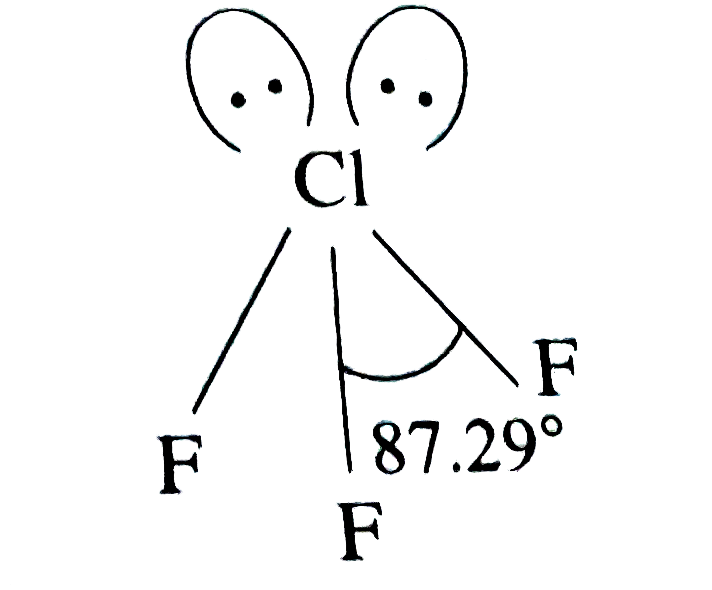
Explain structure of `CIF_(3)`.
Conductivity of a solution is `6.23 xx 10^(-5) Omega^(-1) cm^(-1)` and its resistance is 13710 `Omega`. If electrodes are electrode. Why is molality of a solution independent of temperature?

Text Solution

Verified by Experts
(1) At ordinary temperature nitrogen is gas while other elements are solids.
(2) Nitrogen exists as diatomic molecule but other elements of the group are tetra atomic.
(3) Nitrogen has tendency to form `p pi - p pi` bonds but other elements form `p pi- d pi` instead of `p pi - p pi`.
(4) Due to small size and high electronegativity nitrogen has tendency to form hydrogen bonds in hydride compounds but other compound are not.
(5) Nitrogen shows wide range of oxidation state from -3 to + 5 but other elements not.
Explain structure of `CIF_(3)`
Ground state of `._(17)Cl`
Cross-sectional ara of electrode:
`K = (1)/(R ) xx (1)/(a)`
`6.23 xx 10^(-5) = (1)/(13710) xx (0.7)/(a)`
`a = 0.8196 cm^(3)`
Promotional Banner

Topper's Solved these Questions

  • FEBRUARY 2018

    GURUKUL PUBLICATION - MAHARASHTRA PREVIOUS YEAR PAPERS|Exercise CHEMISTRY (SECTION -II)|24 Videos

Similar Questions

Explore conceptually related problems

Molar conductivity of a solutions is 1.26xx10^(2) Omega^(-1)cm^(2) "mol"^(-1) its molarity is 0.01. its specific conductivity will be

A conductance cell when filled with 0.5 M KCI solution (conductivity = 6.67 xx 10^(-3) Omega^(-1) cm^(-1) ) register a resistance of 243 Omega . Its cell constant is .

Specific conductivity of 0.01N H_(2)SO_(4) solution is 6 xx 10^(-3) S cm^(-1) . Its molar conductivity is

Which of the following have maximum molar conductivity. (i) 0.08M solution and its specific conductivity is 2 xx 10^(-2) Omega^(-1) cm^(-1) (ii) 0.1M solution and its resistivity is 50 Omega cm .

At 25^(@)C , a conductivity cell was filled with 0.1 M NalL solution. The conductivity of this solution is 9.2 xx 10^(3) s cm^(-1) and resistance is 176.6 ohm . The cross-sectional is 176.6 ohm . What must have been the distance between the electrodes ?

The equivalent conductance of solution is …… . [If cell constant is 1.25 cm^(-1) and resistance of N//10 solution is 2.5xx10^(3) Omega ].

The resistance of 0.05 M NaOH solution is 31.6 Omega and its cell constant is 0.357 cm^(-1) . Calculate its conductivity and molar conductivity .

The resistance of 1/10 M solution is 2.5xx10^(3) ohm. What is the molar conductivity of solution? (cell constant= 1.25 cm^(-1) )

0.1 mole, per litre solution present in conductivity cell where electrode of 100 cm^(2) area placed at 1 cm and resistance observe is 5xx10^(3) ohm, what is molar conductivity of solution?

GURUKUL PUBLICATION - MAHARASHTRA PREVIOUS YEAR PAPERS- FEBRUARY 2016-SECTION-I
  1. Calculate C - Cl bond enthalpy from following reaction : CH(3) Cl(g)...

    Text Solution

    |

  2. Define cell constant. Draw a neat and well labelled diagram of primary...

    Text Solution

    |

  3. Write four points of difference between properties of nitrogen and oth...

    Text Solution

    |

  4. What are neutral oxides? Explain the nature of zinc oxide with the hel...

    Text Solution

    |

  5. The molecular formula of H(2)S(2)O(2) represents which oxoacid among t...

    Text Solution

    |

  6. Iodine exists of……..

    Text Solution

    |

  7. Absolute entropies of solids, liquid and gases can be determined by ……...

    Text Solution

    |

  8. The determination of molar mass from elevation in boiling point is cal...

    Text Solution

    |

  9. The Process of leaching, alumina using the sodium carbonate is called…...

    Text Solution

    |

  10. On calculating the strength of current in amperes if a charge of 840 C...

    Text Solution

    |

  11. A to B is a first order reaction with rate 6.6 xx 10^(-5) m-s^(-1). Wh...

    Text Solution

    |

  12. Sc^(3+) is colourless is aqueous solution whereas Ti^(3+) is coloured.

    Text Solution

    |

  13. Double Salt and Coordination Compound

    Text Solution

    |

  14. How is chlorobenzene prepared from aniline? How is chlorobenzene conve...

    Text Solution

    |

  15. What is metamerism? Explain metamerism with suitable examples of ether...

    Text Solution

    |

  16. What are ketones? How are ketones classified?

    Text Solution

    |

  17. How are (a) I-nitropropane and (b) 2-nitropropane prepared from suitab...

    Text Solution

    |

  18. Define antioxidants. Draw structure of BHT

    Text Solution

    |

  19. What are carbohydrates? Write the reaction for the preparation of Nylo...

    Text Solution

    |

  20. What are f-block elements? Distinguish between lanthanoid and actinoid...

    Text Solution

    |

