Home
Class 12
PHYSICS
A point object is placed at a diatance o...

A point object is placed at a diatance of 25 cm from a convex lens of focal length 20 cm. If a glass slab of thickness t and refractive index 1.5 is inserted between the lens and the object, the image is formed at infinity. The thickness t is

A

5 cm

B

10 cm

C

15 cm

D

20 cm

Text Solution

Verified by Experts

The correct Answer is:
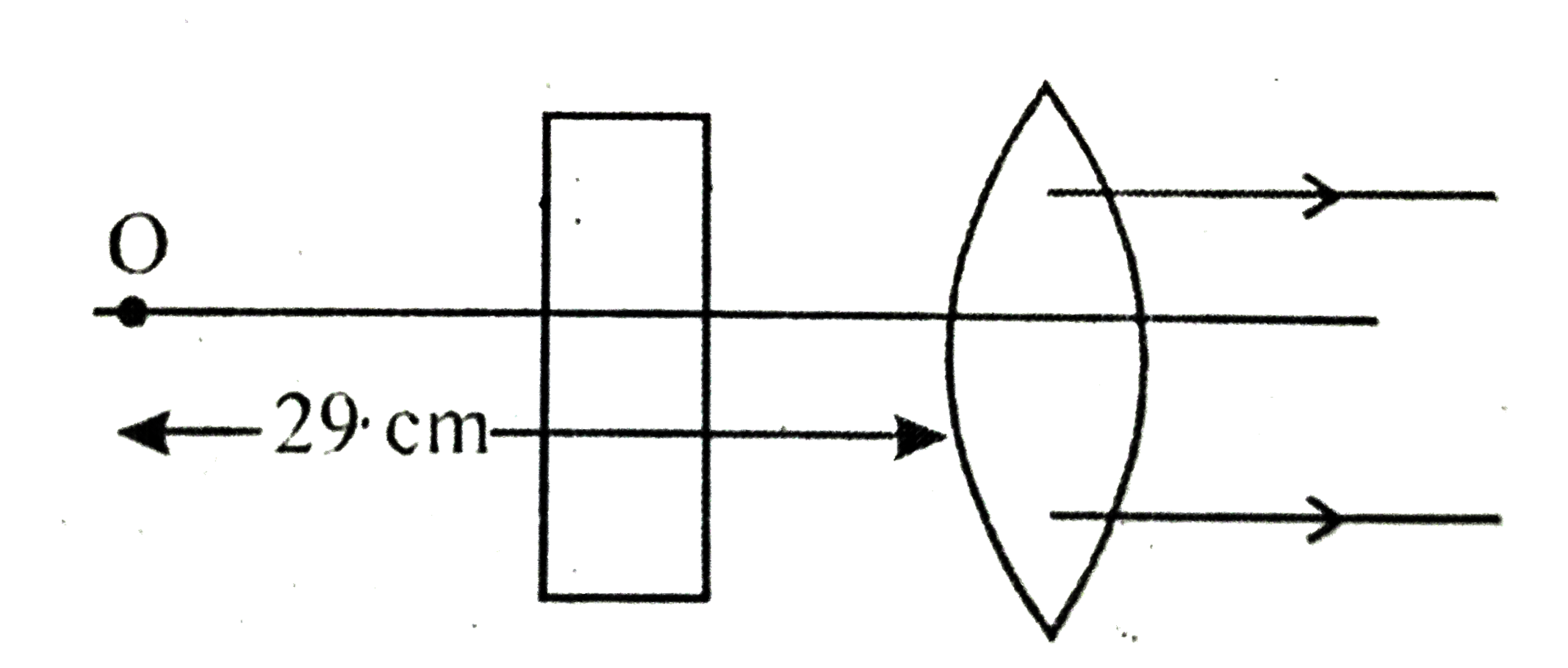
C

To solve this problem first find the object for lens. This object is the image formed by the glass slab.

Applying lens formula
` ( 1 ) /( v ) - ( 1 ) /( u ) = ( 1 ) /( f ) rArr ( 1 ) /( oo) - (1 ) /(20) = ( 1 ) /( f ) rArr u = - 20 `cm
Here -ve sign indicates that object is at the left of the lens.
` therefore ` shift of image by the glass slab = 25 - 20 = 5cm
shift of image by the galss slab = ` t (1- ( 1 ) /( mu )) `
` rArr 5 = t (1 - ( 1 ) /( 1.5) ) rArr t = 15 cm `
Promotional Banner

Topper's Solved these Questions

Similar Questions

Explore conceptually related problems

A point object is placed at a distance of 25 cm from a convex lens of focal length 20cm. If a glass slab of thickness t and refractive index 1.5 is inserted between the lens and the object, the image is formed at infinity. The thickness t is

A point object is placed at a distance of 25cm from a convex lens of focal length 20cm .If a glass slab of thickness t and refractive index 1.5 is inserted between the lens and object.The image is formed at infinity .Find the thickness?

A point object is placed at a distance 25cm from a convex lens of focal length 20cm. If a glass slab of thickness t annd refractive index 1.5 is inserted between the lens and object, image is formed at . Thickness t is found to be K times of 5cm. Fink K.

A point object is placed at a distance of 25cm from a convex lens. Its focal length is 22cm. A glass slab of refractive index 1.5 is inserted between the lens and the object, then the image is formed at infinity. Find the thickness of the glass slab (in cm).

A point object O is placed at a distance of 41 cm from a convex lens of focal length f = 20 cm on its principal axis. A glass slab of thickness 3 cm and refractive index mu = 1.5 is placed between the lens and the object with its faces perpendicular to the principal axis of the lens. Image of the object is formed at point I_(1) . Now the glass slab is tilted by an angle of theta = 1° (as shown in the Figure) and the final image is formed at I_(2) . Calculate the distance between points I_(1) and I_(2) . Consider only paraxial rays for the lens and near normal incidence for the glass slab.

An object is placed at a distance of 20 cm from a convex lens of focal length 10 cm . The image is formed on the other side of the lens at a distance

ALLEN-AIIMS 2019-PHYSICS
  1. The sun (diameter d) subtends an angle theta radian at the pole of a c...

    Text Solution

    |

  2. An opaque cylindrical tank with an open top has a diameter of 3.00m an...

    Text Solution

    |

  3. A point object is placed at a diatance of 25 cm from a convex lens of ...

    Text Solution

    |

  4. An equi-convex lens of focal length 10 cm and refractive index (mug=1....

    Text Solution

    |

  5. A boy of height 1.5m with his eye level at 1.4m stands before a plane ...

    Text Solution

    |

  6. Two plane mirrors are inclined at 70^@. A ray incident on one mirror a...

    Text Solution

    |

  7. A beam of diameter 'd' is incident on a glass hemisphere as shown. If ...

    Text Solution

    |

  8. Two lenses in contact made of materials with dispersive powers in the ...

    Text Solution

    |

  9. A beam of monochromatic light is incident at i= 50^(@) on one face of ...

    Text Solution

    |

  10. Find the height of image in the following diagram.

    Text Solution

    |

  11. A plane mirror is moving with velocity -2 hati - 3 hatj + 4hatk ....

    Text Solution

    |

  12. Find the lateral shift of a light ray while it passws through a paral...

    Text Solution

    |

  13. A thin convex lens from a real Image of a certain object 'p' times it ...

    Text Solution

    |

  14. The distance between the objective lens and the eye lens of an astrono...

    Text Solution

    |

  15. A far sighted person has a near point of 60 cm. What power lens should...

    Text Solution

    |

  16. If the potential at the center of a uniformly charged sphere of radius...

    Text Solution

    |

  17. A charge q is placed at the point P as shown in figure on the axis of ...

    Text Solution

    |

  18. A point charge Q is placed at the centre of a spherical conducting she...

    Text Solution

    |

  19. Two spherical , nonconducting and very tin shells of uniformly distrib...

    Text Solution

    |

  20. An infinite number of concentric rings carry a charge Q each alternate...

    Text Solution

    |

