

Home
Class 12
PHYSICS
(a) Derive the relation a sin theta=lamb...

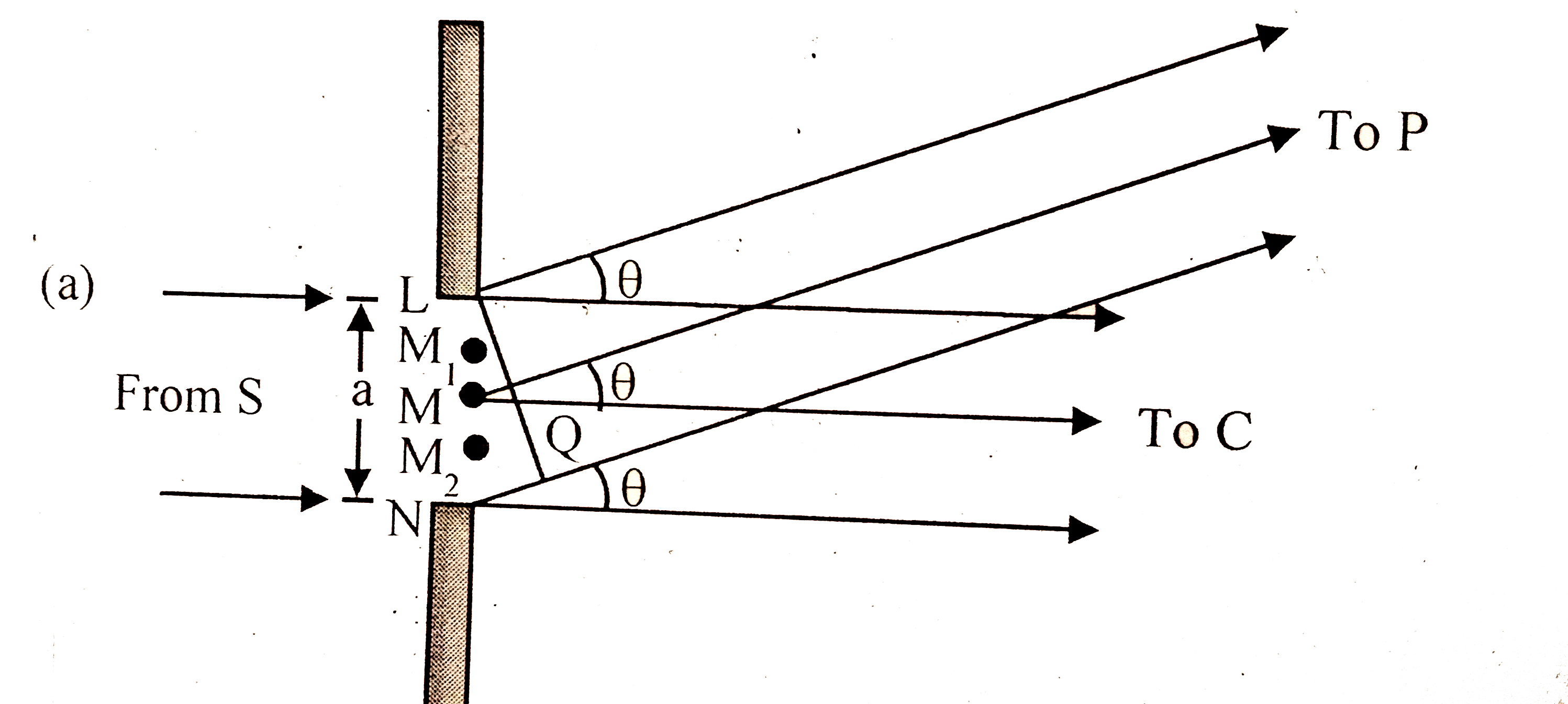
(a) Derive the relation a `sin theta=lambda` for the first minimum of the diffraction pattern produced due to a single slit of width ‘a’ using light of wavelength`lambda`.
(b) State with reason, how the linear width of central maximum will be affected if
(i) monochromatic yellow light is replaced with red light, and
(ii) distance between the slit and the screen is increased.
(c) Using the monochromatic light of same wavelength in the experimental set-up of the diffraction pattern as well as in the interference pattern where the slit separation is 1 mm, 10 interference fringes are found to be within the central maximum of the diffraction pattern. Determine the width of the single slit, if the screen is kept at the same distance from the slit in the two cases.

Text Solution

Verified by Experts


From diagram path difference between the waves from L and N `= a sin theta`
When first minimum is obtained at P, then path difference `= lambda`
Wavelets from first half of the slit has a corresponding wavelet from second half of the slit differing by a path of `(lambda)/(2)` and cancel each other ]
Condition for first minimum -
`lambda= a sin theta`
(b) We know that `beta_( cm) = ( 2 lambda D)/(d)`
(i) increases , (ii) increases
(c) `10(lambda)/(d)= 2 (lambda)/(a)`
Or `a = (d)/(5)= 0.2 mm`
Promotional Banner

Topper's Solved these Questions

Similar Questions

Explore conceptually related problems

In the diffraction pattern due to a single slit of width 'd' with incident light of wavelength 'lamda', at an angle of diffraction 'theta', the condition for first minimum is

The first minimum of a single slit diffraction pattern is observed at angle 2^(@) with a light of wavelength 698 nm. The width of this slit is

Determine the angular separation between central maximum and first order secondary maximum of the diffraction pattern due to a single slit of width 0.25 mm when light of wavelength 5890 Å falls on it normally.

Determine the angular spread between central maximum and first order maximum of the diffraction pattern due to a single slit of width 0.25 mm , when light of wavelength 5890 Å is incident on it normally ?

The angular width of the central maximum of the diffraction patternn in a single slit (of width a) experiment, with lamda as the wavelenth of light, is

In a single slit diffraction of light of wavelength lambda by a slit of width e, the size of the central maximum on a screen at a distance b is

In a single slit diffraction pattern, how is the angular width of central bright maximum changed when (i) the slit width is decreased. (ii) the distance between the slit and screen is increased. (iii) Light of smaller wavelength is used. Justify your answer.

In a single slit diffraction experiment, the width of the slit is made double its original width. Then the central maximum of the diffraction pattern will become