

Home
Class 11
PHYSICS
Consider the decay of a free neutron at ...

Consider the decay of a free neutron at rest: n`top+e^(-)` Show that the tow-body dacay of this type must necessarily give an electron of fixed energy and, therefore, cannot for the observed continous energy distribution in the `beta`-decay of a neutron or a nucleus.

Promotional Banner

Similar Questions

Explore conceptually related problems

Consider the decay of the free neutron at rest: n = p + e^- . Show that the two-body decay of this type must necessarily give an electron of fixed energy and, therefore, cannot account for the observed continuous energy distribution in the beta decay of a neutron or a nucleus.

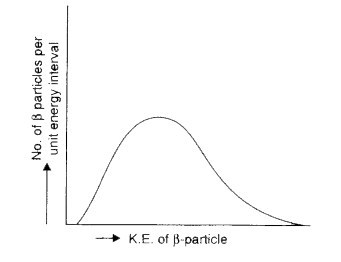
Consider the decay of a free neutron at rest : n to p +e^(-) Show that the two body decay of this type must necessary give an electron of fixed energy and therefore cannot account distribution in the beta - decay of a neutron or a nucleous as shown in figure . [ Note : The simple result of this exercise was one among the several arguments advanced by W . Pauli to perdict the existence of a third particle in the decay products of beta - decay . This particle is known as neutrino spin 1/2 ( like e^(-) p or n ) but is neutral ad either massless or having an extremely small mass (compared to the mass of electron) and which interacts very weakly with matter . The correct decay process of neutron is : n to p+e(-)+v)

Draw the graph showing distribution of kinetic energy of electrons emitted during beta decay.

STATEMENT-1 : In the decay of a free neutron at rest, into a proton and electron, it has been predicated that a third particle must also be emitted because the emitted electrons do not have a definite kinetic energy. and STATEMENT-2 : For the simple decay of a stationary particle into two moving particles, the kinetic energies of the particle must have a sharply defined value.

STATEMENT-1 : In the decay of a free neutron at rest, into a proton and electron, it has been predicated that a third particle must also be emitted because the emitted electrons do not have a definite kinetic energy. and STATEMENT-2 : For the simple decay of a stationary particle into two moving particles, the kinetic energies of the particle must have a sharply defined value.

During alpha-decay , a nucleus decays by emitting an alpha -particle ( a helium nucleus ._2He^4 ) according to the equation ._Z^AX to ._(Z-2)^(A-4)Y+._2^4He+Q In this process, the energy released Q is shared by the emitted alpha -particle and daughter nucleus in the form of kinetic energy . The energy Q is divided in a definite ratio among the alpha -particle and the daughter nucleus . A nucleus that decays spontaneously by emitting an electron or a positron is said to undergo beta -decay .This process also involves a release of definite energy . Initially, the beta -decay was represented as ._Z^AX to ._(Z+1)^AY + e^(-)"(electron)"+Q According to this reaction, the energy released during each decay must be divided in definite ratio by the emitted e' ( beta -particle) and the daughter nucleus. While , in alpha decay, it has been found that every emitted alpha -particle has the same sharply defined kinetic energy. It is not so in case of beta -decay . The energy of emitted electrons or positrons is found to vary between zero to a certain maximum value. Wolfgang Pauli first suggested the existence of neutrinoes in 1930. He suggested that during beta -decay, a third particle is also emitted. It shares energy with the emitted beta particles and thus accounts for the energy distribution. During beta^+ decay (positron emission) a proton in the nucleus is converted into a neutron, positron and neutrino. The reaction is correctly represented as