

Home
Class 12
PHYSICS
Refer to Fig. 6.12(a). The arm PQ of the...

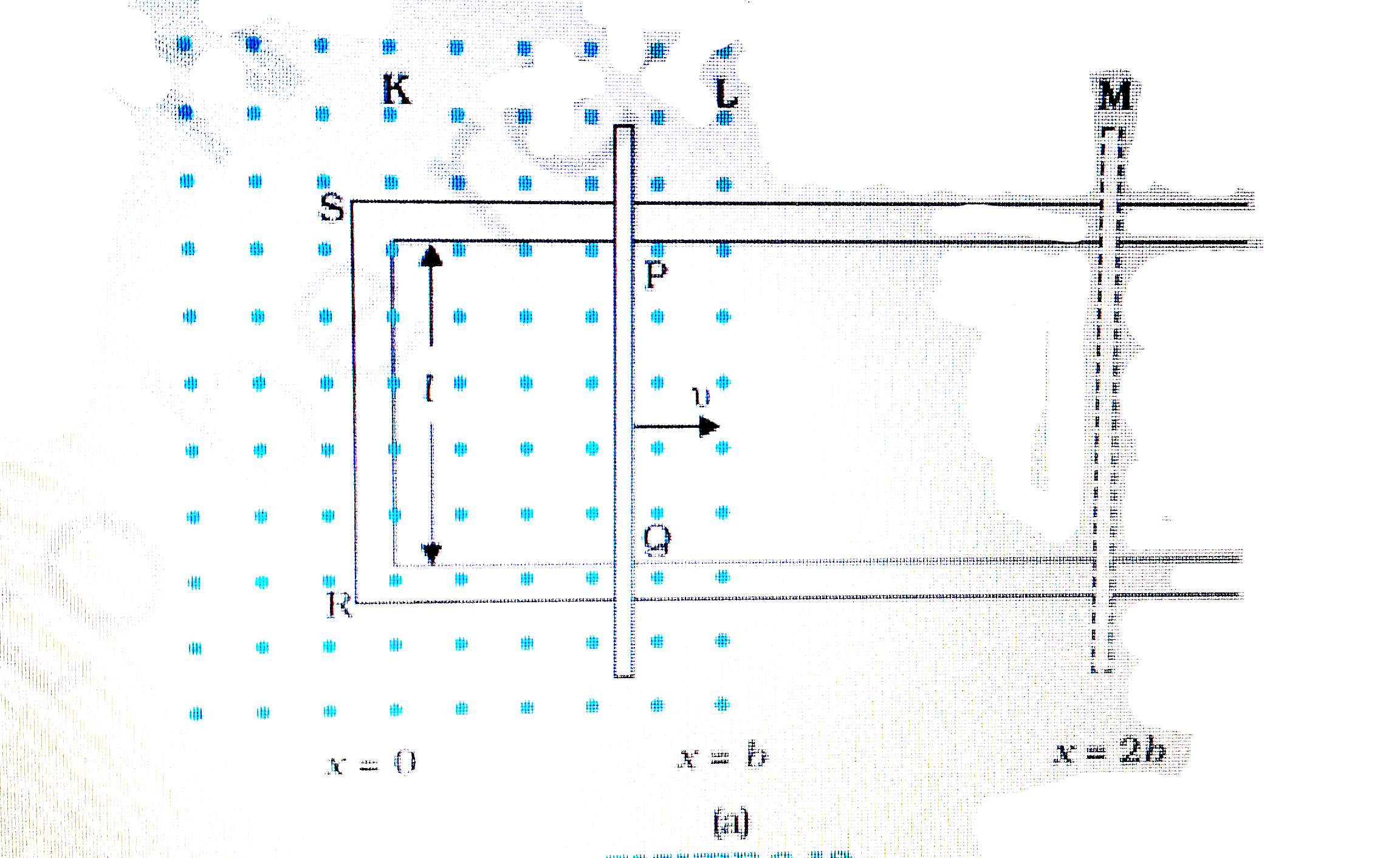
Refer to Fig. 6.12(a). The arm PQ of the rectangular conductor is moved from x = 0, outwards. The uniform magnetic field is perpendicular to the plane and extends from x = 0 to x = b and is zero for `x lt b`. Only the arm PQ possesses substantial resistance r. Consider the situation when the arm PQ is pulled outwards from x = 0 to x = 2b, and is then moved back to x = 0 with constant speed v. Obtain expressions for the flux, the induced emf, the force necessary to pull the arm and the power dissipated as Joule heat. Sketch the variation of these quantities with distance.

Promotional Banner

Similar Questions

Explore conceptually related problems

Refer to figure the arm PQ of the rectangular conductor is moved from x = 0, outwards. The uniform magnetic field is perpendicular to the plane and extends from x = 0 to x = b and is zero for x gt b. Only the arm PQ possesses substantial resistance r. Consider the situation when the arm PQ is pulled outwards from x = 0 to x = 2b and is then moved back to x = 0 with constant speed v. Obtain expressions for the flux, the induced emf, the force necessary to pull the arm and the power dissipated as Joule heat. Sketch the variation of these quantities with distance.

The arm PQ of the rectangular conductor is moved from x=0 , outwards. The uniform magnetic field is perpendicular to the plane and extends from x=0 to x=b and is zero for xgtb . Only the arm. PQ possesses substantial resistance r. Consider the situation when the arm PQ is pulled outwards from x=0 to x=2b , and is then moved back to x=0 with constant speed v. Obtain expressions for the flux, the induced emf, the force necessary to pull the arm and the power dissipated as Joule heat. Sketch the variation of these quantities with distance.

Refer to fig. The arm PQ of the rectangular conductor is moved from x=0 outwards. The uniform magnetic field is perpendicular to the plane and extends from x=0 to x=b and is zero for x gt b . Only the arm PQ possesses substantial resistance r. Consider the situation when the arm PQ is pulled outwards from x=0 to x=2b, and is then moved back x=0 with constant speed upsilon . Obtain expressions for the flux the induced emf, the force necessary to pull the arm and the power dissipated as Joule heat. Sketch the variation of these quantities with distance.

In the following diagram, the arm PQ of the rectangular conductor is moved from x = 0, outwards. The uniform magnetic field is perpendicular to the plane and extends from x = 0 to x = b and is zero for x gt b . Only the arm PQ possesses substantial resistance ‘r’. consider the situation when the arm PQ is pulled outwards from x = 0 to x = 2b, and is then moved back to x = 0 with constant speed ‘ѵ’. Obtain expressions for the (i) electric flux, (ii) the induced emf,(iii)the force necessary to pull the arm and (iv) the power dissipated as Joule heat. Sketch the variation of these quantities with distance.

The arm PQ of the rectangular conductor is moved from x=0 , outwards in the uniform magnetic field which extends from x=0 to x=b and is zero for x gt b as shown. Only the arm PQ possess substantial ressitance r . Consider the situation when the arm PQ is pulled outwards from x = 0 to x = 2b , and is then moved back to x = 0 with constant speed v . Obtain expression for the flux, the induced emf, the force necessary to pull the arm and the power dissipated as Joule heat. Sketch the variation of these quantities with distance.

Figure shows a rectangular conductor PQRS in which the conductor PQ is free to move in a uniform magnetic field B perpendicular to the plane of the paper.The field extends from x=0 to x=b and is zero for x>b.Assume that only the arm PQ posses resistance r.When the arm PQ is pulled outward from x=0 with constant speed v, obtain the expressions for the flux and the induced emf with distance 0≤x≤2b