

Home
Class 12
CHEMISTRY
Substances which alter the velocity of a...

Substances which alter the velocity of a reaction by mere presence, without undergoing any change in mass and compossition are termed catalyst and the phenomenon is known as catalysis
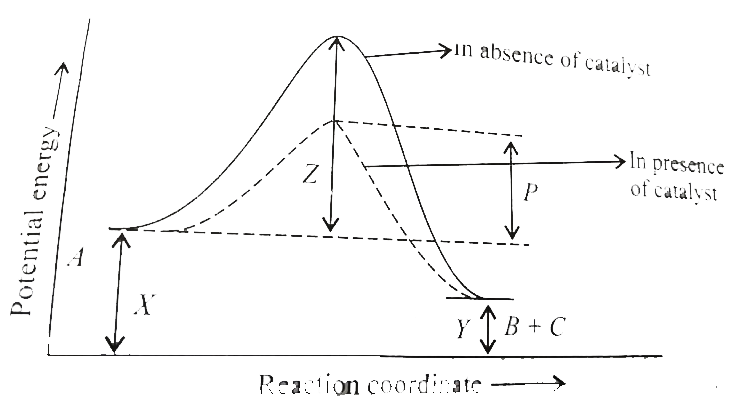
For the reaction `(ArarrB+C)` , the energy profile diagram is given in the figure below.

The decrease in ht eenergy of activation in hte presence of catalyst is

Promotional Banner

Similar Questions

Explore conceptually related problems

Substances which alter the velocity of a reaction by mere presence, without undergoing any change in mass and compossition are termed catalyst and the phenomenon is known as catalysis For the reaction (ArarrB+C) , the energy profile diagram is given in the figure below. The decrease in the energy of activation in the presence of catalyst is

Substances which alter the velocity of a reaction by mere presence, without undergoing any change in mass and compossition are termed catalyst and the phenomenon is known as catalysis Which is incorrect for a catalyst?

Substances which alter the velocity of a reaction by mere presence, without undergoing any change in mass and compossition are termed catalyst and the phenomenon is known as catalysis Which is incorrect for a catalyst?

For the reaction (A rarr B+C) , the energy profile diagram is given in the figure. The decrease in energy of activation in presence of catalyst is:

Substances which alter the velocity of a reaction by mere presence, without undergoing any change in mass and compossition are termed catalyst and the phenomenon is known as catalysis According to the adsorption theroy of catalysis, the rate of reaction increases because

Substances which alter the velocity of a reaction by mere presence, without undergoing any change in mass and compossition are termed catalyst and the phenomenon is known as catalysis According to the adsorption theroy of catalysis, the rate of reaction increases because

Substances which alter the velocity of a reaction by mere presence, without undergoing any change in mass and compossition are termed catalyst and the phenomenon is known as catalysis In homogenous catalytic reactions, there are three alternative paths A, B, and C (shown in figure). Which one of the following indicates the relative ease with which the reaction can take place?

Substances which alter the velocity of a reaction by mere presence, without undergoing any change in mass and compossition are termed catalyst and the phenomenon is known as catalysis In homogenous catalytic reactions, there are three alternative paths A, B, and C (shown in figure). Which one of the following indicates the relative ease with which the reaction can take place?

Substances which alter the velocity of a reaction by mere presence, without undergoing any change in mass and composition are termed catalysts and the phenomenon is known as catalysis. In homogenous catalytic reactions, there are three alternative paths A, B and C (shown in figure). Which one of the following indicates the relative case with which the reaction can take place?

Read the given passage and answer the questions A substance which alters the rate of chemical reaction without undergoing any change in mass and chemical composition at the end of reaction is called catalyst. It may be noted that catalyst which increases the speed of a reaction is called positive catalyst and catalyst which decrease the speed of reaction is called negative catalyst. The promoters are substances that enhance the activity of catalyst and poisons are the substances which decrease the activity of catalyts. How many types of catalysts are there ?