Home
Class 11
PHYSICS
The resultant of vectors vec(OA) and vec...

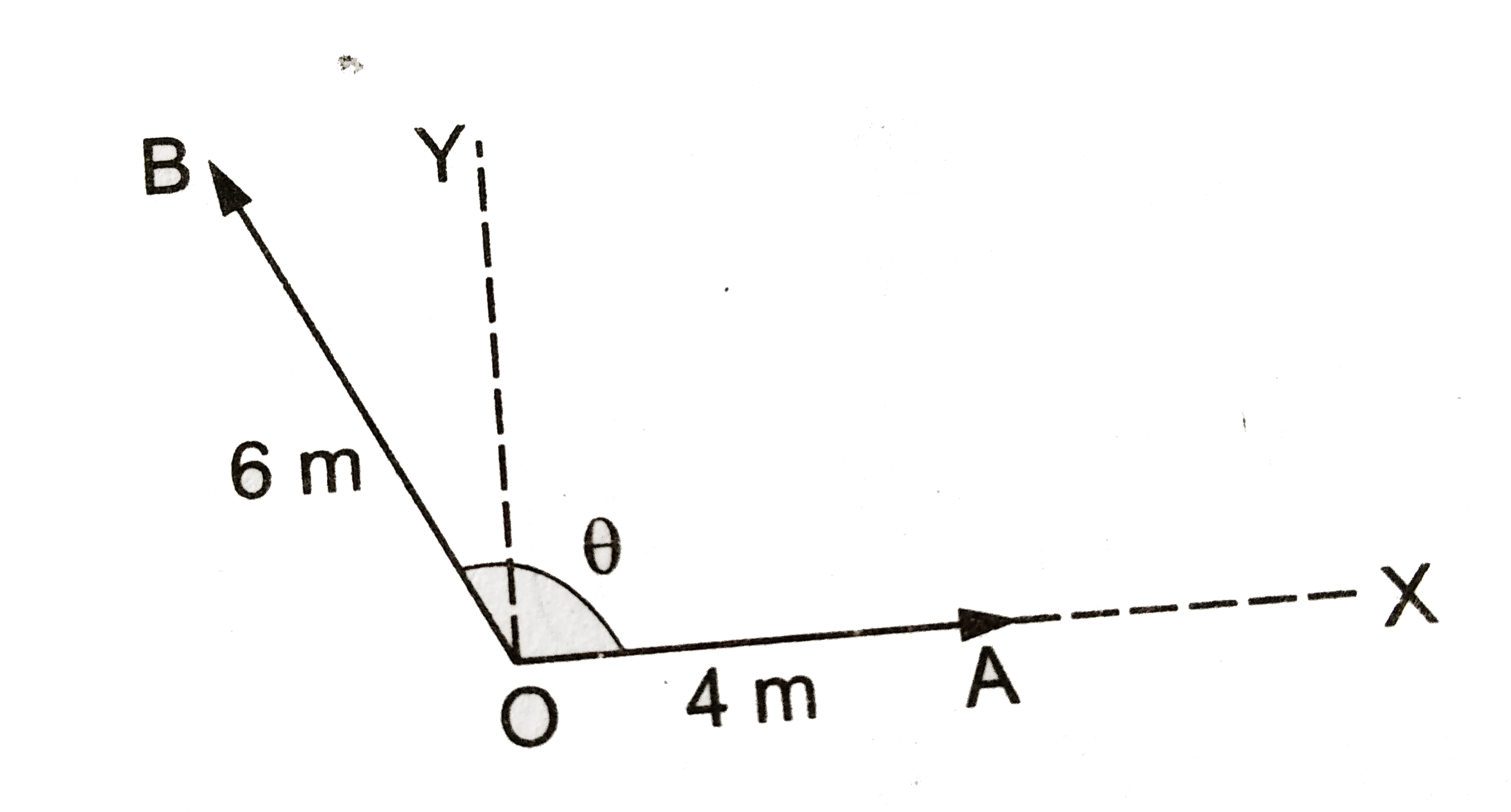
The resultant of vectors `vec(OA) and vec(OB)` is peerpendicular to `vec(OA)`. Find the angle AOB.

Text Solution

Verified by Experts

The correct Answer is:

A, B, C

Their x components should be equal and opposite.
`:. 6cos theta = -4`
or ` theta = cos^(-1) (-(2)/(3))`
Promotional Banner

Topper's Solved these Questions

  • VECTORS

    DC PANDEY|Exercise Example|39 Videos
  • VECTORS

    DC PANDEY|Exercise check point 2.1|15 Videos
  • VECTORS

    DC PANDEY|Exercise Single Correct|39 Videos
  • UNITS, DIMENSIONS & ERROR ANALYSIS

    DC PANDEY|Exercise Medical entrances gallery|32 Videos
  • WAVE MOTION

    DC PANDEY|Exercise Integer Type Question|11 Videos

Similar Questions

Explore conceptually related problems

The resultant of two vectors vec(A) and vec(B) is perpendicular to the vector vec(A) and its magnitudes is equal to half of the magnitudes of vector vec(B) (figure). The angle between vec(A) and vec(B) is

The resultant of two velocity vectors vec(A) and vec(B) is perpendicular to vec(A) . Magnitude of Resultant vec(R ) is equal to half magnitude of vec(B) . If the angle between vec(A) and vec(B) is (30 theta)^(@) , then value of theta is ?

The resultant of two vectors vec A and vec B is perpendicular to the vector vec A and its magnitude is equal to half the magnitude of vector vec B . What is the angle between vec A and vec B ?

The resultant of two vectors vec A and vec B perpendicular to the vector vec A and its magnitude id equal to half of the magnitude of the vector vec B . Find out the angle between vec A and vec B .

The resultant of the three vectors vec(OA), vec(OB) and vec(OC) shown in figure is

Magnitude of resultant of two vector vec(A) and vec(B) is equal to 2. angle between two vectors is 180^(@) if |vec(A)|=3 then find |vec(B)|

The magnitude of vectors vec(OA), vec(OB) and vec (OC) in figure are equal. Find the direction of vec(OA)+vec(OB)-vec(OC) . .

Find the resultant of the three vectors vec(OA), vec(OB) and vec(OC) shown in figure. Radius of the circle is R.

The angle between two vectors vec(A) and vec(B) is theta . The resultant of these vectors vec(R ) makes an angle of theta//2 with A. which of the following is true?

Let the angle between two non-zero vectors vec(A) and vec(B) be 120^(@) and its resultant be vec(C) then:

DC PANDEY-VECTORS-Subjective
  1. The work done by a force vecF during a displacement vecr is given by v...

    Text Solution

    |

  2. If vecA,vecB,vecC are mutually perpendicular show that vecCxx(vecAxxve...

    Text Solution

    |

  3. Prove that vecA.(vecAxxvecB)=0

    Text Solution

    |

  4. Find the resultant of the three vectors shown in figure (2W1). .

    Text Solution

    |

  5. Given an example for which vecA.vecB=vecC.vecB but vecA!=vecC.

    Text Solution

    |

  6. Obtain the angle between A+B and A-B if A = 2hati +3hatj and B = hati ...

    Text Solution

    |

  7. Deduce the condition for the vectors 2hati + 3hatj - 4hatk and 3hati -...

    Text Solution

    |

  8. Find the area of the parallelogram whose sides are represented by 2hat...

    Text Solution

    |

  9. If vectors A and B be respectively equal to 3hati - 4hatj + 5hatk and ...

    Text Solution

    |

  10. if A = 2hati - 3hatj+7hatk, B = hati + 2hatj and C=hatj - hatk. Find A...

    Text Solution

    |

  11. The x and y-components of vector A are 4 m and 6 m respectively. The x...

    Text Solution

    |

  12. Three vectors which are coplanar with respect to a certain rectangular...

    Text Solution

    |

  13. Let vecA and vecB be the two vectors of magnitude 10 unit each. If the...

    Text Solution

    |

  14. The resultant of vectors vec(OA) and vec(OB) is peerpendicular to vec(...

    Text Solution

    |

  15. Find the components of a vector A = 2hati + 3hatj along the direction...

    Text Solution

    |

  16. If two vectors are A = 2hati + hatj - hatk and B = hatj - 4hatk. By ca...

    Text Solution

    |

  17. The resultant of two vector A and B is at right angles to A and its ma...

    Text Solution

    |

  18. Four forces of magnitude P, 2P, 3P and 4P act along the four sides of ...

    Text Solution

    |

  19. If P + Q = R and P - Q = S, prove that R^2 + S^2 = 2(P^2 + Q^2)

    Text Solution

    |

  20. In an Delta ABC as showin in Fig. 2 . (2) .71 (a) prove that a/(sin...

    Text Solution

    |
