Home
Class 11
PHYSICS
A rod AB is shown in figure. End A of th...

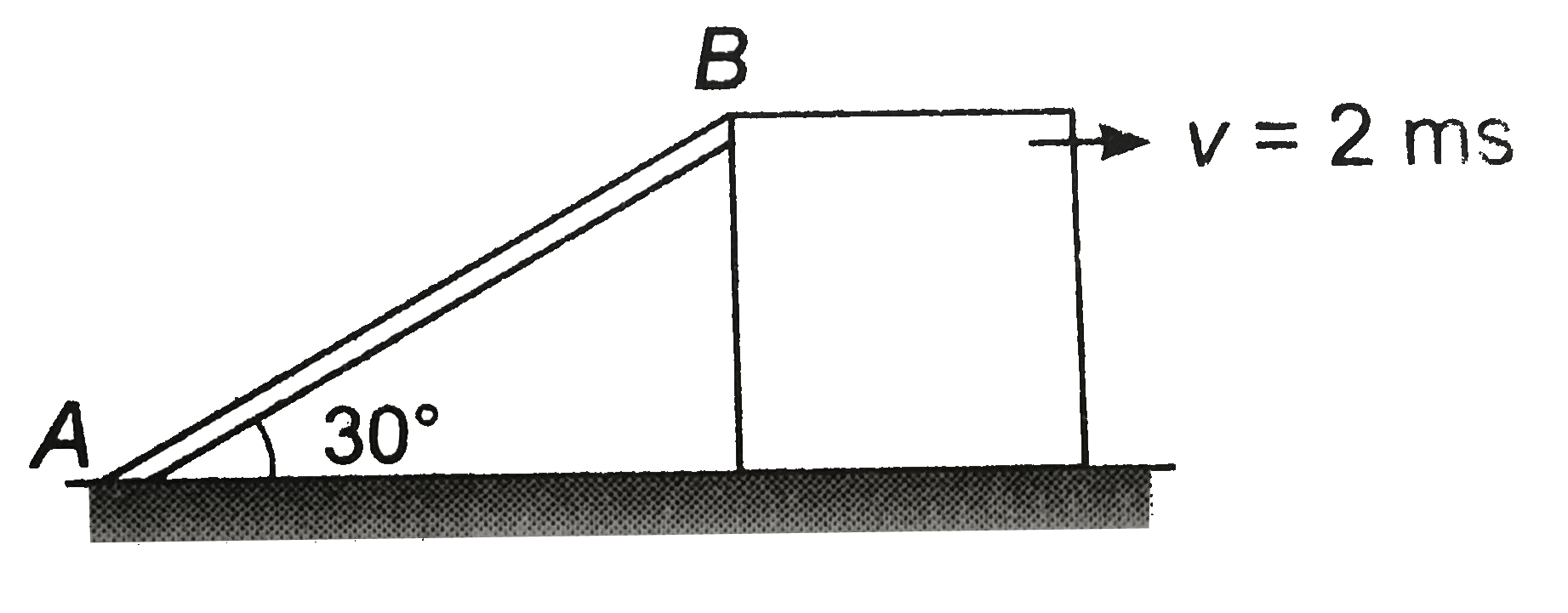
A rod AB is shown in figure. End A of the rod is fixed on the ground. Block is moving with velocity `2 ms^-1` towards right. The velocity of end B of rod at the instant shown in figure is

A

`sqrt3 ms^-1`

B

`2 ms^-1`

C

`2sqrt3 ms^-1`

D

`4ms^-1`

Text Solution

Verified by Experts

The correct Answer is:
D


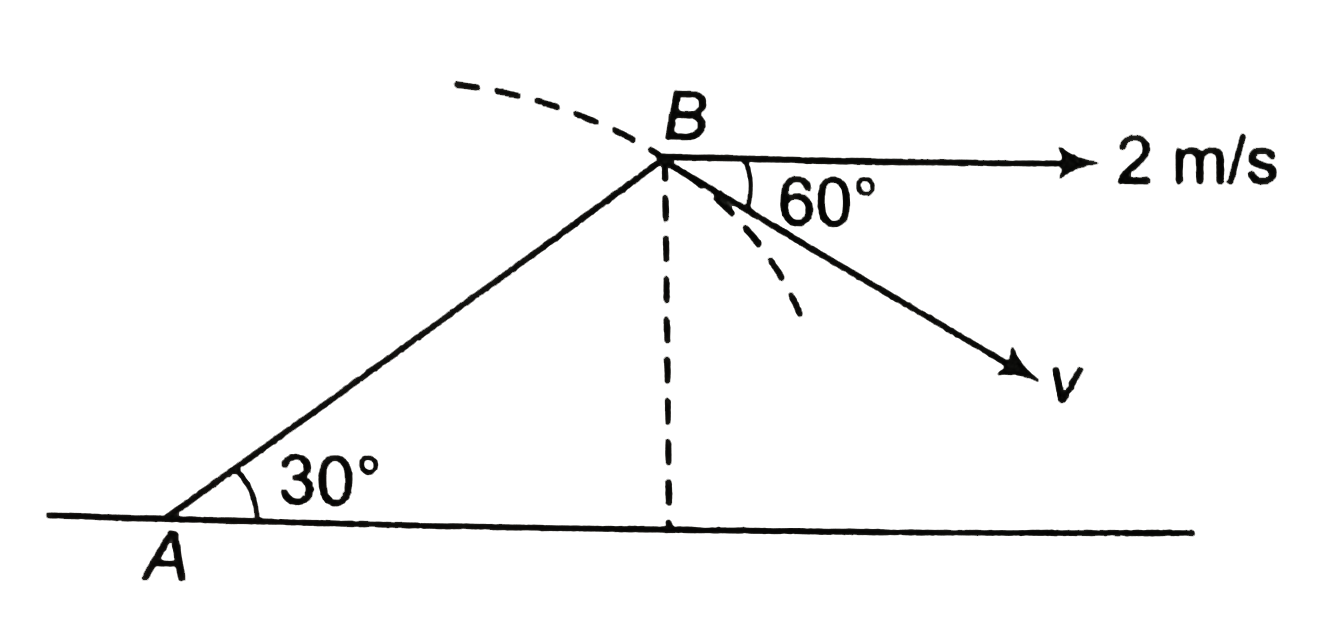
`v cos 60^@=2 m//s`
`:. V=4 m//s`
Promotional Banner

Topper's Solved these Questions

  • KINEMATICS

    DC PANDEY|Exercise More Than One Correct|6 Videos
  • KINEMATICS

    DC PANDEY|Exercise Comprehension|7 Videos
  • KINEMATICS

    DC PANDEY|Exercise Objective|45 Videos
  • GRAVITATION

    DC PANDEY|Exercise (C) Chapter Exercises|45 Videos
  • KINEMATICS 1

    DC PANDEY|Exercise INTEGER_TYPE|15 Videos

Similar Questions

Explore conceptually related problems

A rod AB is shown in figure. End A of the rod is fixed on ground. Block is moving with velocity m/s towards right. The velocity of end B of rod when rod makes an angle of 60^@ with ground is :

Find velocity of block 'B' at the instant shown in figure :

Find velocity of block 'B' at the instant shown in figure.

In the figure shown the block B moves with , velocity 10 ms^(-1) . The velocity of A in the position shown is

A rod AB of mass M and length L is shown in figure. End A of rod is hinged and end B is lying on the ground. Find the Normal reaction by ground on the rod

The velocity of point A on the rod is 2ms^(-1) (leftwards) at the instant shown in fig. The velocity of the point B on the rod at this instant is

A rod AB of mass M and length L is shown in figure. End A of rod is hinged and end B is lying on the ground. Find the Vertical component of the force applied by the hinge

A rod AB of mass M and length L is shown in figure. End A of rod is hinged and end B is lying on the ground. Find the Horizontal component of the force applied by the hinge

A rod AB moves with a uniform velocity v in a uniform magnetic field as shown in figure.

DC PANDEY-KINEMATICS-Subjective
  1. The relation between time t and displacement x is t = alpha x^2 + beta...

    Text Solution

    |

  2. A street car moves rectilinearly from station A to the next station B ...

    Text Solution

    |

  3. A particle of mass m moves on positive x-axis under the influence of f...

    Text Solution

    |

  4. A partial along a straight line whose velocity-displacement graph is a...

    Text Solution

    |

  5. A particle is falling freely under gravity. In first t second it cover...

    Text Solution

    |

  6. A rod AB is shown in figure. End A of the rod is fixed on the ground. ...

    Text Solution

    |

  7. A thief in a stolen car passes through a police check post at his top ...

    Text Solution

    |

  8. Anoop (A) hits a ball along the ground with a speed u in a direction w...

    Text Solution

    |

  9. A car is travelling on a straight road. The maximum velocity the car C...

    Text Solution

    |

  10. A car is travelling on a road. The maximum velocity the car can attain...

    Text Solution

    |

  11. Two particles are moving along two long straight lines, in the same pl...

    Text Solution

    |

  12. A particle having a velocity v = v0 at t= 0 is decelerated at the rate...

    Text Solution

    |

  13. At time t = 0, a car moving along a straight line has a velocity of 16...

    Text Solution

    |

  14. An object moves with constant acceleration a. Which of the following e...

    Text Solution

    |

  15. Ship A is located 4 km north and 3 km east of ship B. Ship A has a vel...

    Text Solution

    |

  16. Starting from rest a particle is first accelerated for time t1 with co...

    Text Solution

    |

  17. A particle is moving along a straight line. The displacement of the pa...

    Text Solution

    |

  18. A particle is resting over a smooth horizontal floor. At t=0, a horizo...

    Text Solution

    |

  19. A train starts from rest at S = 0 and is subjected to an acceleration ...

    Text Solution

    |

  20. For a moving particle, which of the following options may be correct? ...

    Text Solution

    |

