Home
Class 11
PHYSICS
A particle is projected from point O on ...

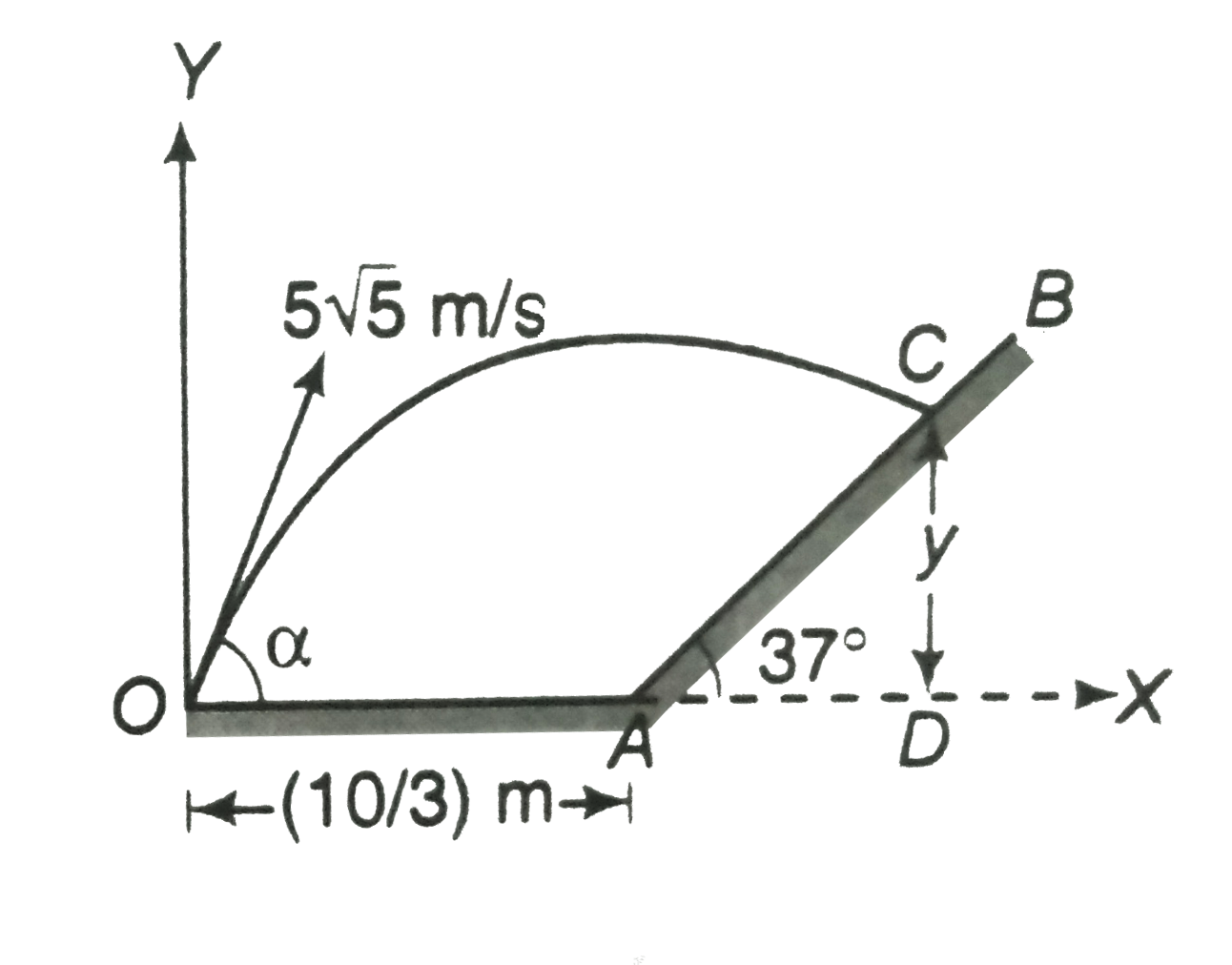
A particle is projected from point O on the ground with velocity `u = 5(sqrt5) m//s` at angle `alpha = tan^(-1) (0.5)`. It strikes at a point C on a fixed smooth plane AB having inclination of `37^@` with horizontal as shown in figure. If the particle does not rebound, calculate.
(a) coordinates of point C in reference to coordinate system as shown in the figure.
(b) maximum height from the ground to which the particles rises. `(g = 10 m//s^2)`

Text Solution

Verified by Experts

The correct Answer is:
A, B, D

(a) Let, (x,y) be the coordinates of point C.

`x = OD = OA + AD`
`:. x = 10/3 + y cot 37^@ = (10+4y)/3` ………(i)
As point C lies on the trajectory of a parabola,
we have
`y = x tan alpha - (gx)^2/(2u)^2 (1+tan^2alpha)`.........(ii)
Given that , `tan alpha = 0.5 = 1/2`
Solving Eqs. (i) and (ii), we get x = 5m and y = 1.25m.
Hence, the coordinates of point C are (5m, 1.25m).
(b) Let `v_y` be the vertical component of velocity of
the particle just before collision at C.

Using `v_y = u_y + a_yt, we have `
`v_y = u sin alpha - g (x//ucos alpha) (:' t = x//u cos alpha)`
`= (5sqrt5)/(sqrt5) - (10 xx 5)/(5 (sqrt5) xx 2//(sqrt5)) = 0`
Thus, at C, the particle has only horizontal
component of velocity
`v_x = u cos alpha = 5(sqrt5) xx (2//(sqrt5)) = 10 m//s`
Given, that the particle does not rebound after collision. So, the normal component of velocity
(normal to the plane AB) becomes zero. Now,
the particle slides up the plane due to tangential
component `v_x cos 37^@ = (10)(4/5) = 8m//s`
Let h be the further height raised by the particle.
Then,
`mgh = 1/2 m (8)^2 or h = 3.2 m `
Height of the particle from the ground `= y+h`
`:. H = 1.25 + 3.2 = 4.45m. `
Promotional Banner

Topper's Solved these Questions

  • PROJECTILE MOTION

    DC PANDEY|Exercise Level - 2 More Than One Correct|8 Videos
  • MOTION IN A PLANE

    DC PANDEY|Exercise (C )Medical entrances gallery|32 Videos
  • PROPERTIES OF MATTER

    DC PANDEY|Exercise Integer|8 Videos

Similar Questions

Explore conceptually related problems

A particle is project d from point A with velocity u at an angle alpha with horizontal. In its parabolic path, at point P the particle is moving at right angles to its initial direction of projection. Its velocity at P is:

A ball is projected from the point O with velocity 20 m//s at an angle of 60^(@) with horizontal as shown in figure. At highest point of its trajectory it strikes a smooth plane of inclination 30^(@) at point A. The collision is perfectly inelastic. The maximum height from the ground attained by the ball is (g=10 m//s^(2))

A particle is projected from a point A with velocity sqrt(2)u an angle of 45^(@) with horizontal as shown in figure. It strikes the plane BC at right angles. The velocity of the particle at the time of collision is

A particle is projected from a point A with velocity usqrt2 at an angle of 45^(@) with horizontal as shown in the figure. It strikes the plane BC at right angles. The velocity of the particle at the time of collision is

A projectile is projected on an inclined plane as shown in figure. 'D' is a point of maximum height from inclined plane then :

A particle is given velocity v_0 at point A as shown in the figure. Find the speed of particle at point B,C and D

A particle is projected along an inclined plane as shown in figure. What is the speed of the particle when it collides at point A ? (g = 10 m//s)

A ball thrown down the incline strikes at a point on the incline 25m below the horizontal as shown in the figure. If the ball rises to a maximum height of 20m above the point of projection, the angle of projection alpha (with horizontal x axis) is

A ball is projected from a point O as shown in figure it will strike the ground after (g = 10 m/ s^(2) )

A ball is projected from a point O as shown in figure. It will strike the ground after (g = 10 m//s^(2))

