Home
Class 11
PHYSICS
Using constraint method find the relatio...

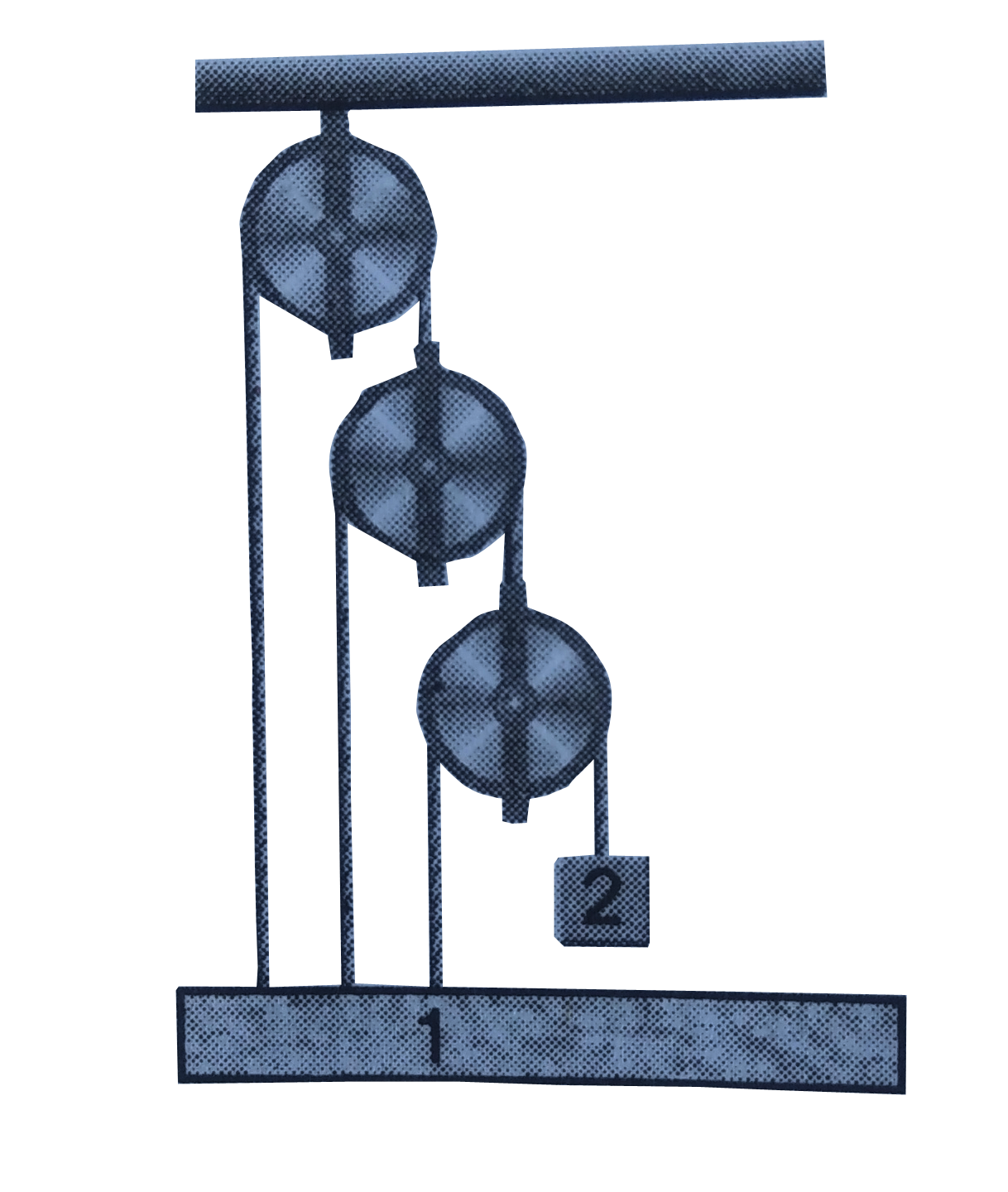
Using constraint method find the relation between of `a_(1)` and `a_ (2)`.

Text Solution

Verified by Experts
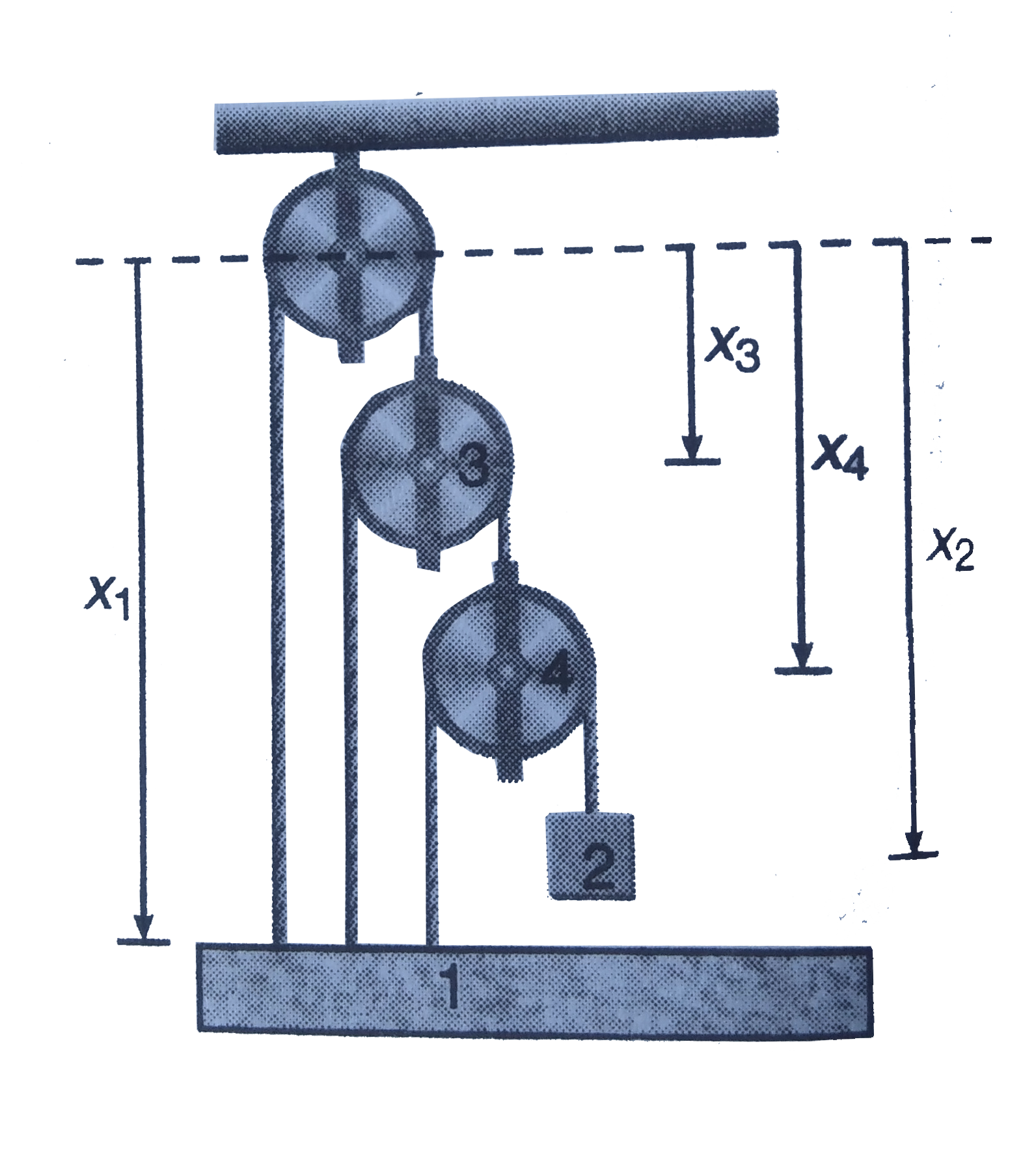
In fig `8.84` points `1,2,3` and `4` are movable . Let their displacements from a fixed dotted line be `x_(1),x_(2),x_(3)`and `x_(4)`
`x_(1)+x_(3)=l_(1)`
`(x_(1)-x_(3))+(x_(4)-x_(3))=l_(2)`
`(x_(1)-x_(4))+(x_(2)-x_(4))=l_(3)`
On double differentiating with respect to time, we will get following three constraint relations
`a_(1)+a_(3)=0 ` ...(i)
`a_(1) + a_(4) - 2a_(3) = 0 ` ...(ii)
`a_(1) + a_(2) - 2a_(4) = 0 ` ...(iii)
Solving Eqs. `(i),(ii)` and `(iii)`, we get
`a_(2) = - 7a_(1)`
Which is the desired ralation between `a_(1)` and `a_(2)`.
Promotional Banner

Similar Questions

Explore conceptually related problems

Using contraint equation. Find the relation between a_(1) and a_(2).

Find the relation between a_(1) and a_(2) .

Using constraint method find the relation between accelerations of 1 and 2 .

Find the relation between acceleration a_(1) and a_(2)

Make the constraint relation between a_(1),a_(2) and a_(3)

If the blocks are moving as shown in the figure the relation between a_(1) , a_(2) and a_(3) will be.

In the pulley-block arrangement shown in figure , find the relation between a_(A),a_(B) and a_(C)

In the figure shown find relation between magnitudes of a_(A) and a_(B) .

A planet moving around sun sweeps area A_(1) in 2 days, A_(2) in 3 days and A_(3) in 6 days, then find the relation between A_(1),A_(2) and A_(3)

In the adjacent figure, all the pulleys are frictioniess and massless, all the stringes are also massless. The relation between a_(1),a_(2) and a_(3) is (where a_(1),a_(2) and a_(3) are the acceleration of masses m_(1),m_(2) and m_(3) respectively in the direction as shown in the figure)

