Home
Class 11
PHYSICS
In the arrangement shown in figure what ...

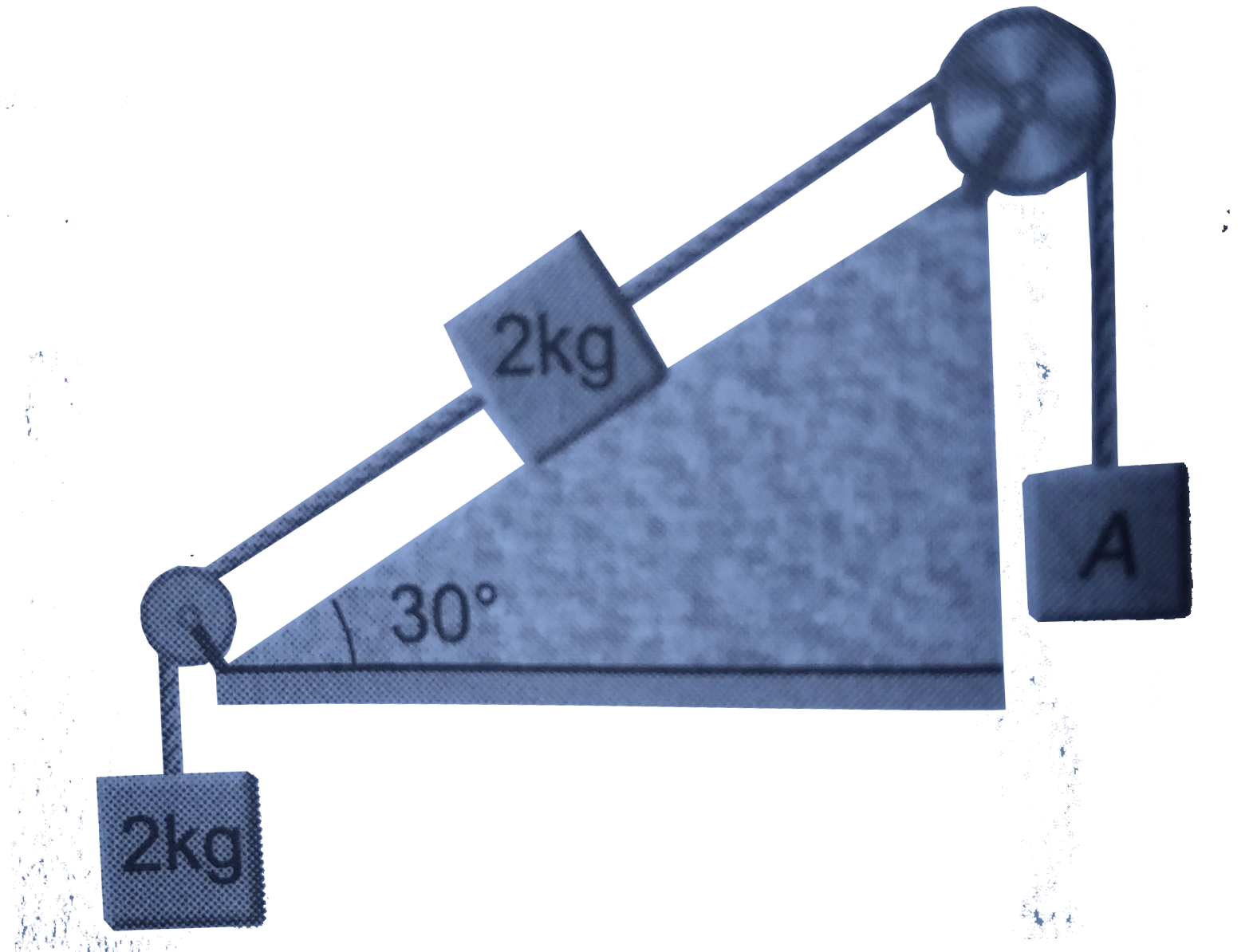
In the arrangement shown in figure what should be the mass of block `A`, so that the system remains at rest ? Neglect friction and mass of string.

Text Solution

Verified by Experts

`m_(A)g = (2) (g) + (2)g sin 30^(@)` as`a = 0`
`m_(A) = 3kg`
Promotional Banner

Topper's Solved these Questions

  • LAWS OF MOTION

    DC PANDEY|Exercise Exercise 8.3|8 Videos
  • LAWS OF MOTION

    DC PANDEY|Exercise Exercise 8.4|3 Videos
  • LAWS OF MOTION

    DC PANDEY|Exercise Exercise 8.1|10 Videos
  • KINEMATICS 1

    DC PANDEY|Exercise INTEGER_TYPE|15 Videos
  • LAWS OF THERMODYNAMICS

    DC PANDEY|Exercise Level 2 Subjective|18 Videos

Similar Questions

Explore conceptually related problems

In the arrangement shown in figure, what should be the mass of block A so that the system remains at rest. Also find force exerted by string on the pulley Q. (g = 10 m//s^(2))

In the arrangement shown in fig neglect the masses of pulleys and string and also friction Calculate acceleration of blocks A and B

Find the acceleration of the block of mass m in the arrangement shown in the following figures. The masses of the pulleys and the threads, as well as the friction are assumed to be negligible.

In the arrangement shown in figure the cylinder of mass M is at rest on an incline. The string between the cylinder and the pulley (P) is horizontal. Find the minimum coefficient of friction between the incline and the cylinder which can keep the system in equilibrium. Also find the mass of the block. Assume no friction between the pulley (P) and the string.

In the arrangement shown in the fig. all pulleys are mass less and the strings are inextensible and light. Block A has mass M. (a) If the system stays at rest after it is released, find the mass of the block B. (b) If mass of the block B is twice the value found in part (a) of the problem, calculate the acceleration of block A.

Find the maximum value of (m//m) in the situation shown in figure so that the system remains at rest. Friction coefficient of both the contacts is mu , string is massless an pulley is friction less.

In the arrangement shown in the figure, mass of the block B and A is 2m and m respectively. Surface between B and floor is smooth. The block B is connected to the block C by means of a string-pulley system. If the whole system is released, then find the minimum value of mass of block C so that A remains stationary w.e.t. B. Coefficient of friction between A and B is mu.

The block of mass m is at rest. Find the tension in the string A .

Two blocks A and B of equal masses are attached to a string passing over a smooth pulley fixed to a wedge as shown in figure. Find the magnitude of acceleration of centre of mass of the two blocks when they are released from rest. Neglect friction.
