Home
Class 11
PHYSICS
Find the mass M so that it remains at re...

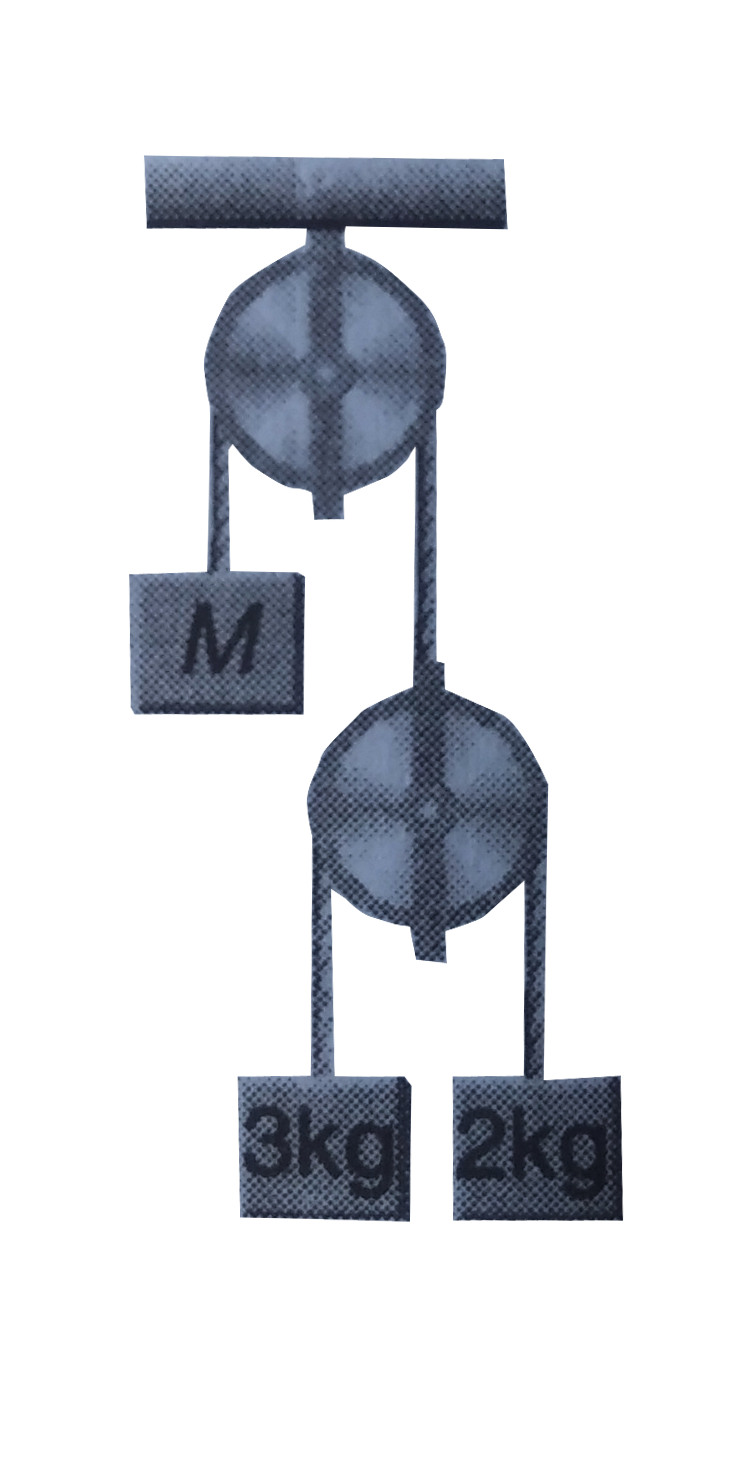
Find the mass `M` so that it remains at rest in the abjoining figure. Both the pulley and string are light and friction is absent everywhere. `(g = 10 m//s^(2))`

Text Solution

Verified by Experts
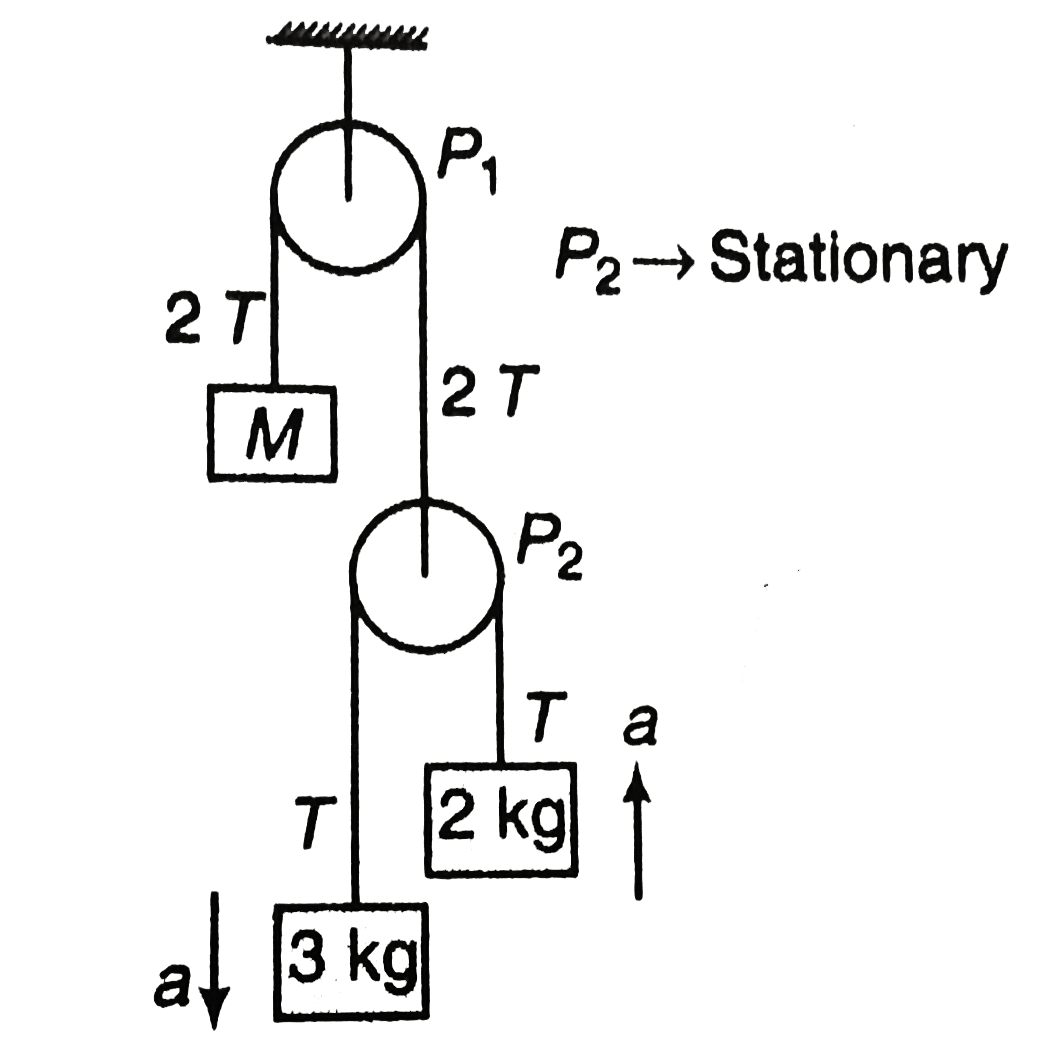
In the figure shown,
`a = ("Net pulling force")/("Total mass") = (30 - 20)/(3 + 2)`
`= 2 m//s^(2)`

`2 kg` `T - 20 = 2xxa = 4`
`:. T = 24N`
Now `Mg = 2T`
`M = (2T)/(g) = (48)/(10)`
`= 4.8 kg`
Promotional Banner

Topper's Solved these Questions

  • LAWS OF MOTION

    DC PANDEY|Exercise Exercise 8.4|3 Videos
  • LAWS OF MOTION

    DC PANDEY|Exercise Exercise 8.5|2 Videos
  • LAWS OF MOTION

    DC PANDEY|Exercise Exercise 8.2|9 Videos
  • KINEMATICS 1

    DC PANDEY|Exercise INTEGER_TYPE|15 Videos
  • LAWS OF THERMODYNAMICS

    DC PANDEY|Exercise Level 2 Subjective|18 Videos

Similar Questions

Explore conceptually related problems

Calculate the tension in the string shown in figure. The pulley and the string are light and all surfaces are frictionless. Take g=10 m/ s^2 .

Calculate the tension in the string shown in (a) The pulleys and the string are light and all surfaces are frictionless. (g=10m//s^(2))

For the system shown in the figure, the inclined plane is fixed, all the pulleys are light and friction is absent every where.The tension in the string will be

Consider the system as shown in the figure. The pulley and the string are light and all the surfaces are frictionless. The tension in the string is (=g10m//s^(2)) .

Consider4 the situation shown in figure. Bothe the pulleys and the string are light and all the surfaces are friction less. a. Find the acceleration of the mass M. b. Find the tension in the string c. Calculate the force exerted by the clamp on the pulley A in the figure.

For the arrangement shown in figure when the system is released, find the acceleration of wedge. Pulley and string are ideal and friction is absent.

In the given figure, Find mass of the block A, if it remains at rest, when the system is released from rest. Pulleys and strings are massless. [g=10m//s^(2)]

In the system shown in figure m_(B)=4kg , and m_(A)=2kg . The pulleys are massless and friction is absent everywhere. The acceleration of block A is.

