Home
Class 11
PHYSICS
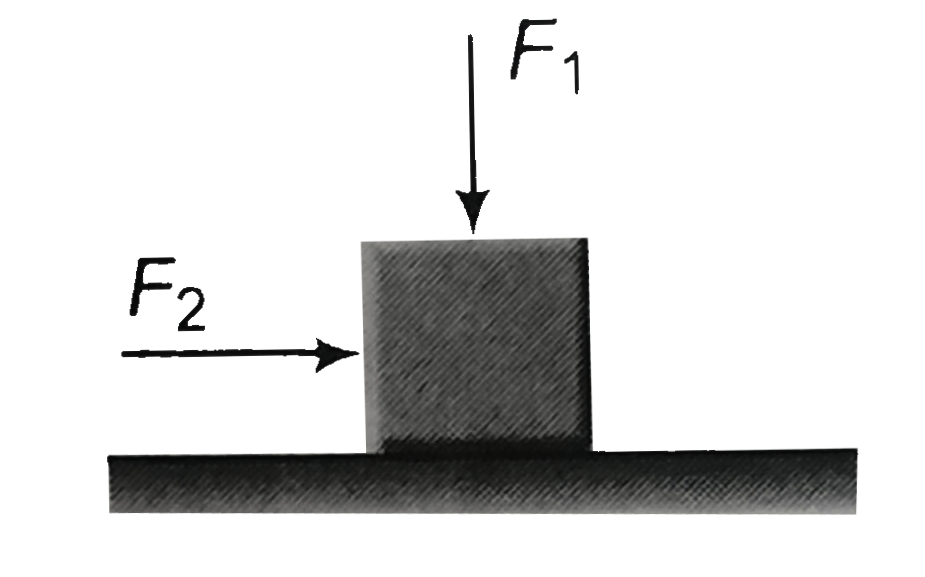
A block is kept at rest on a rought grou...

A block is kept at rest on a rought ground as shown. Two force `F_(1)`and `F_(2)` are acting on it. If we increased either of the two force `F_(1)`and `F_(2)`, force of friction acting on the block will increase.
By increasing `F_(1)`, normal reaction from ground will increase.

A

If both Accertion and Reason are true and the reason is correct explanation of the Assertion.

B

If both Accertion and Reason are true but reason is not the correct explanation of Assertion.

C

If Assertion is true, but the Reason is false.

D

If Assertion is false but the Reason is true.

Text Solution

Verified by Experts

The correct Answer is:

D

By increasing `F_(1)` limiting value of friction will increase. But it is not neccesary that actual value of friction acting on block will increase.
Promotional Banner

Similar Questions

Explore conceptually related problems

Two forces F_(1) " and " F_(2) are acting on a rod abc as shown in figure.

Two forces of mangitude F_(1) and F_(2) are acting on an object.The magnitude of the net force F_(n e t ) on the object will be in the range.

Two forces vec(F_(1)) and vec(F_(2)) are acting at right angles to each other , find their resultant ?

A block mass 'm' is kept on the ground as shown in figure. Are forces acting on block action - reaction pair.

Two forces F_(1) and F_(2) are acting on a body. One force is double that of the other force and the resultant is equal to the greater force. Then the angle between the two forces is

Two forces F_(1)=1N and F_(2)=2N act along the lines x=0 and y=0, respectively. Then find the resultant of forces.

Initially both blocks are at rest on a horizontal surface and string is just tight. At t=0, two constant horizontal force F_(1) and F_(2) start acting on blocks as shown. f_(1) and f_(2) are frication foces acting on 10 kg and 20 kg block (co-efficient of frication between and ground are 0.5 ). Values of F_(1) and F_(2) are given column-I. Then match magnitudes of f_(1), f_(2) and direction of overset(vec)(f_(1)) with corresponding values of F_(1) and F_(2) given in column-I [g = 10 m//s^(2)] .

Two force F_(1)" and "F_(2) are acting on a body. One force is double that of the other force and the resultant is equal to the greater force. Then the angle between the two forces is :-

Let us consider two forces F_(1) " and " F_(2) acting on a body of mass 2 kg as shown in the figure. F_(1)=10N , F_(2)= 2N , what will be the acceleration?
