Home
Class 11
PHYSICS
A single conservative force F(x) acts on...

A single conservative force F(x) acts on a on a (1.0kg ) particle that moves along the x-axis. The potential energy U(x) is given by:
`U(x) =20 + (x-2)^(2)`
where, x is meters. At `x=5.0m` the particle has a kinetic energy of `20J`
(a) What is the mechanical energy of the system?
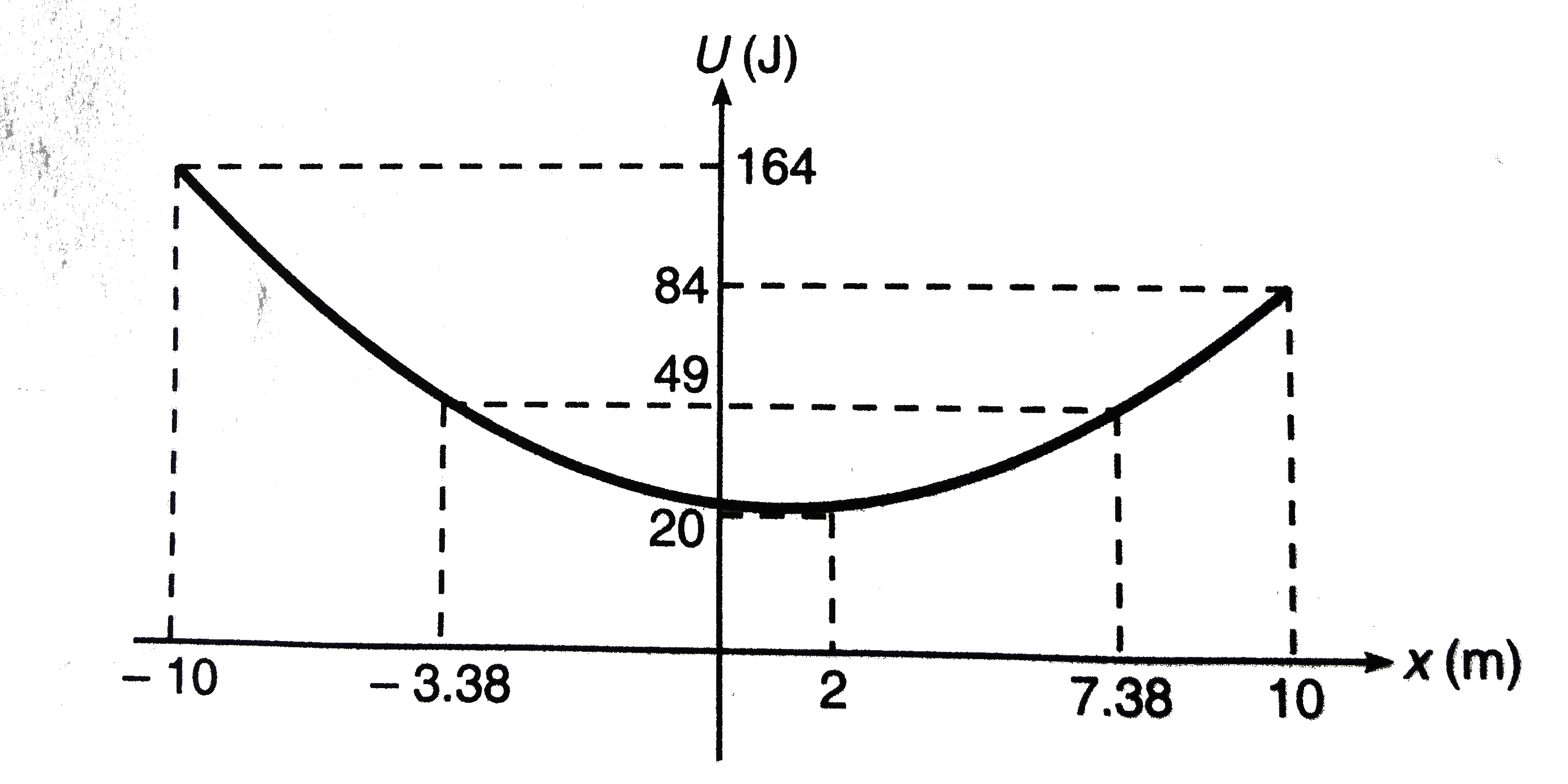
(b) Make a plot of U(x) as a function of x for `-10mlexle10m`, and on the same graph draw the line that represents the mechanical energy of the system. Use part (b) to determine.
(c) The least value of x and
(d) the greatest value of x between which the particle can move.
(e) The maximum kinetic energy of the particle and
(f) the value of x at which it occurs.
(g) Datermine the equation for `F(x)` as a function of x.
(h) For what (finite ) value of x does `F(x) =0`?.

Text Solution

Verified by Experts

The correct Answer is:
B, C

(a) Potential energy at `x=5.0 m` is
`U=20 + (5-2)^(2) =29J`
`:.` Mechanical energy
`E=K + U=20 + 29=49J`
.
(b) At `x=10m` `U=84J` at `x=-10m`, `U=164J`
and at `x=2m`, `U="minimum"=20J`
(c) and (d) Particle will move between the points where its kinetic energy becomes zero or its potential energy is equal to its mechanical energy.
Thus, `49=20 + (x-2)^(2)`
or `(x-2)^(2) =29`
or `x-2 =+-sqrt(29) =+-5.38m`
`:. x=7.38m` and `-3.38m`
or the particle will move between `x=-3.38 m` and `x=7.38 m`
(e) and (f) Maximum kinetic energy is at `x=2m`, where the potential energy is minimum and this maximum kinetic energy is,
`K_("max")=E-U_("min")=49-20`
`=29 J`
(g) `F =-(dU)/(dx) =-2(x-2) =2(2-x)`
(h) `F(x) =0`, at `x=2.0m`
where potential energy is minimum (the position of stable equilibrium).
Promotional Banner

Topper's Solved these Questions

  • WORK, ENERGY & POWER

    DC PANDEY|Exercise Exercise 9.1|10 Videos
  • WORK, ENERGY & POWER

    DC PANDEY|Exercise Exercise 9.2|9 Videos
  • WORK, ENERGY & POWER

    DC PANDEY|Exercise TYPE2|1 Videos
  • WAVE MOTION

    DC PANDEY|Exercise Integer Type Question|11 Videos
  • WORK, ENERGY AND POWER

    DC PANDEY|Exercise MEDICAL ENTRACES GALLERY|33 Videos

Similar Questions

Explore conceptually related problems

A single conservative force F(x) acts on a 1.0-kg particle that moves along the x-axis. The potential energy U(x) is given by U(x)=20+(x-2)^2 where x is in meters. At x=5.0m , the particle has a kinetic energy of 20J . What is the mechanical energy of a system?

A single conservative force F(x) acts on a 1.0-kg particle that moves along the x-axis. The potential energy U(x) is given by U(x)=20+(x-2)^2 where x is in meters. At x=5.0m , the particle has a kinetic energy of 20J . Determine the equation of F(x) as a function of x.

A single conservative force F(x) acts on a 1.0-kg particle that moves along the x-axis. The potential energy U(x) is given by U(x)=20+(x-2)^2 where x is in meters. At x=5.0m , the particle has a kinetic energy of 20J . The maximum and minimum values of x, respectively, are

A single conservative f_((x)) acts on a m = 1 kg particle moving along the x-axis. The potential energy U_((x)) is given by : U_((x)) = 20 + (x - 2)^(2) where x is in metres. At x = 5 m , a particle has kintetic energy of 20 J The maximum value of potential energy is:

A single conservative force F(x) acts on a 1.0-kg particle that moves along the x-axis. The potential energy U(x) is given by U(x)=20+(x-2)^2 where x is in meters. At x=5.0m , the particle has a kinetic energy of 20J . The maximum kinetic energy of the particle and the value of x at which maximum kinetic energy occurs are

A single conservative f_((x)) acts on a m = 1 kg particle moving along the x-axis. The potential energy U_((x)) is given by : U_((x)) = 20 + (x - 2)^(2) where x is in metres. At x = 5 m , a particle has kintetic energy of 20 J The maximum speed of the particle is:

A single conservative f_((x)) acts on a m = 1 kg particle moving along the x-axis. The potential energy U_((x)) is given by : U_((x)) = 20 + (x - 2)^(2) where x is in metres. At x = 5 m , a particle has kintetic energy of 20 J The minimum speed of the particle is:

A single conservative f_((x)) acts on a m = 1 kg particle moving along the x-axis. The potential energy U_((x)) is given by : U_((x)) = 20 + (x - 2)^(2) where x is in metres. At x = 5 m , a particle has kintetic energy of 20 J The largest value of x will be:

A single conservative f_((x)) acts on a m = 1 kg particle moving along the x-axis. The potential energy U_((x)) is given by : U_((x)) = 20 + (x - 2)^(2) where x is in metres. At x = 5 m , a particle has kintetic energy of 20 J The position of equilibrium and its nature is:

A single conservative f_((x)) acts on a m = 1 kg particle moving along the x-axis. The potential energy U_((x)) is given by : U_((x)) = 20 + (x - 2)^(2) where x is in metres. At x = 5 m , a particle has kintetic energy of 20 J The least value of x (position of particle is ) will be:

