Home
Class 11
PHYSICS
Two blocksA andB are connected to each o...

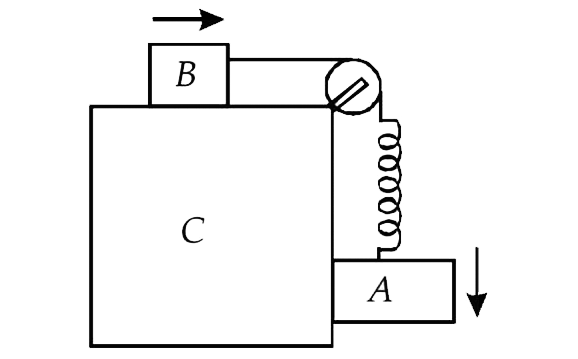
Two blocks`A` and`B` are connected to each other by a string and a spring , the spring pases and a frictionlesss pulley as down over in the figure . Block `B` sides over the horizental top surface of a strionry block `C` both with the verical side of `C` , both with the same conform speed

The coefficient of friction between the surface the of block is `0.2` force constant of the spring is `1960` newtons , if mass of block `A` is `2` kg , celculate the mass of block `F` and `B` and the energy stored is the spring

Text Solution

Verified by Experts

The correct Answer is:
A

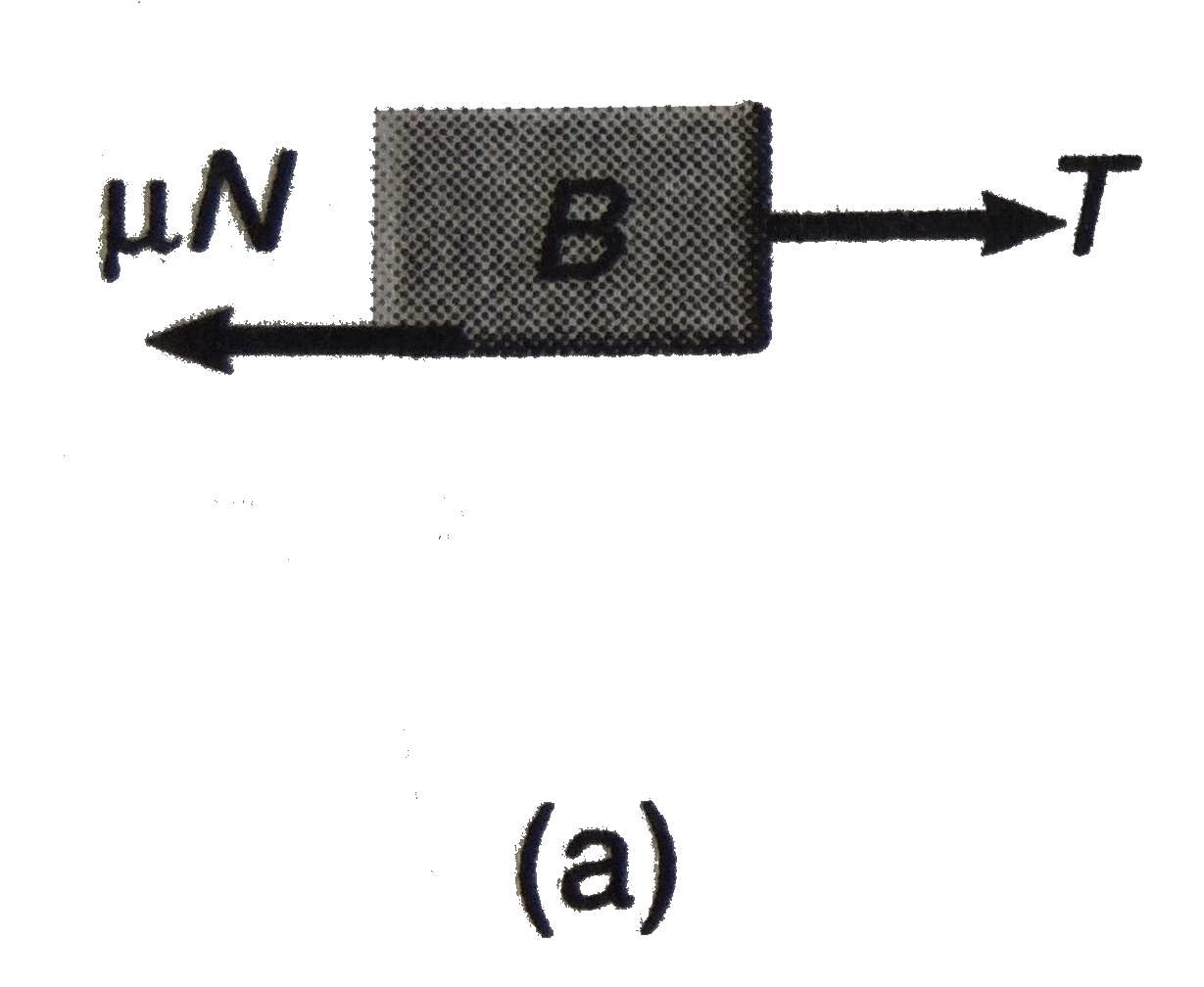
Let m be the mass of B. From its free-body diagram
`T-muN=m xx 0 =0`
.
where, `T="tension" of the string and `N=mg`
`:. T=mumg`
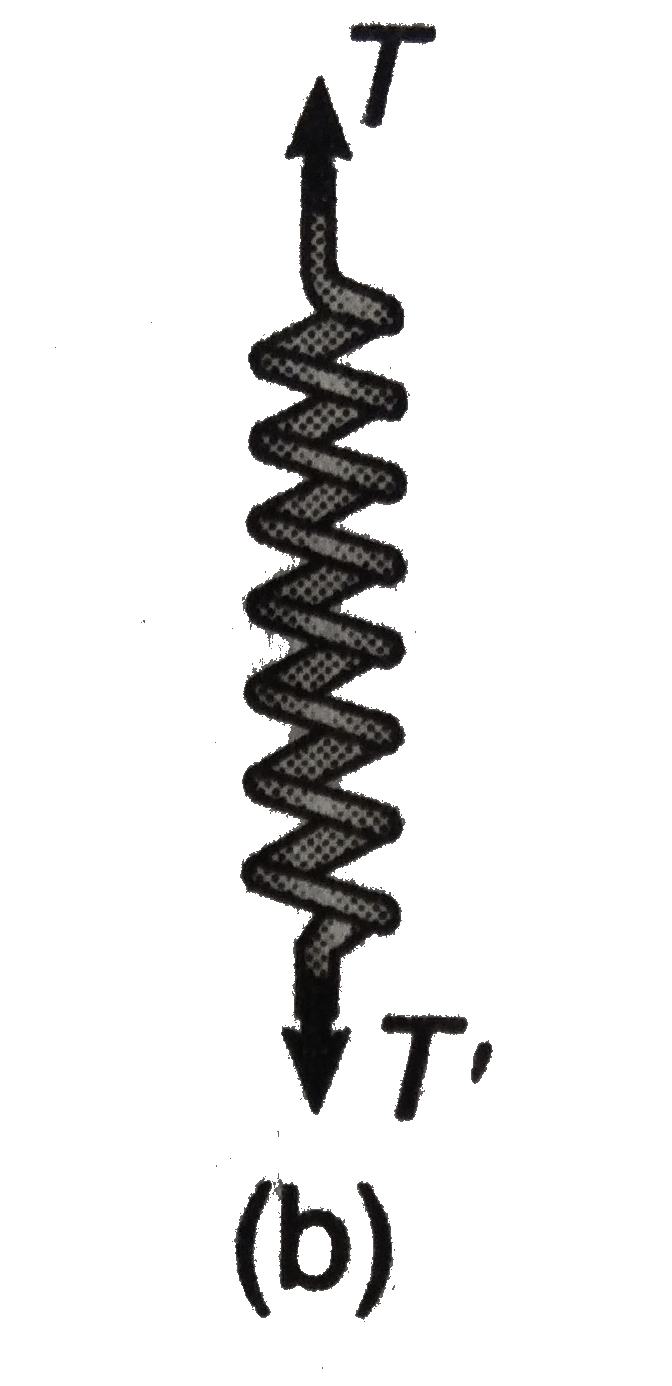
From the free-body diagram of the spring
`T-T'=0`
where, T' is the force exerted by A on the spring or `T'=mumg`
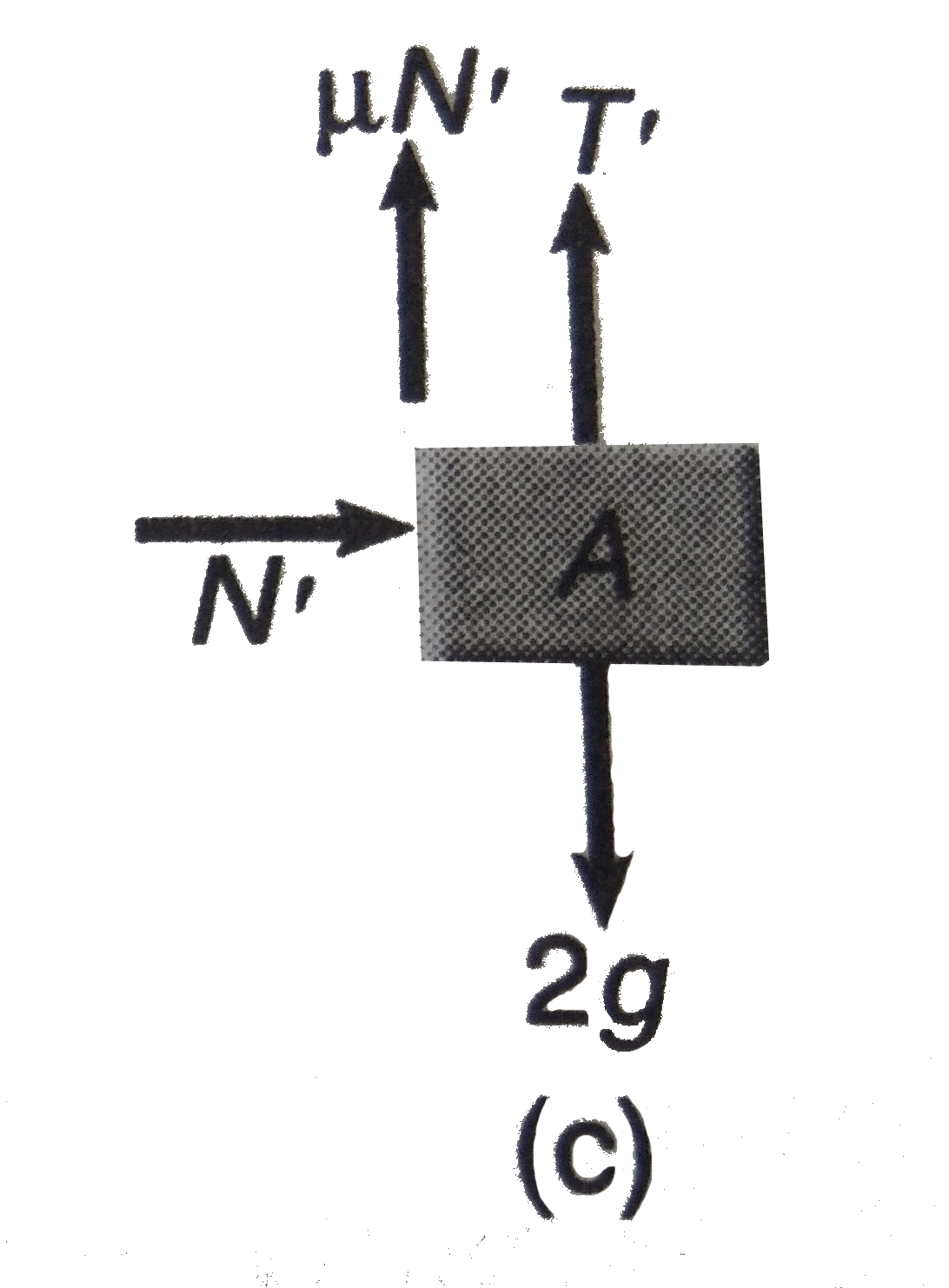
From the free-body diagram of A `2g-(T' + muN') =2xx0=0`
where, N' is the normal reaction of the vertical wall of C on A and `N' + 2 xx 0` (as there is no horizontal acceleration of A)
Now, in a spring tensile force=force constant xx enxtension
`:. 19.6 =1960x` or `x=(1)/(100)m` or `U("energy of a spring") =(1)/(2)kx^(2)`
`=1/2 xx 1960 xx ((1)/(100))^(2) =0.098 J`

Promotional Banner

Topper's Solved these Questions

  • WORK, ENERGY & POWER

    DC PANDEY|Exercise Exercise 9.1|10 Videos
  • WORK, ENERGY & POWER

    DC PANDEY|Exercise Exercise 9.2|9 Videos
  • WORK, ENERGY & POWER

    DC PANDEY|Exercise TYPE2|1 Videos
  • WAVE MOTION

    DC PANDEY|Exercise Integer Type Question|11 Videos
  • WORK, ENERGY AND POWER

    DC PANDEY|Exercise MEDICAL ENTRACES GALLERY|33 Videos

Similar Questions

Explore conceptually related problems

Two blocks A and B are connected to each other by a string and a spring, the string passes over a frictionless pulley as shown in Block B slides over the horizontal surface of a stationary block C and the block. A slides along the vertical side of C, both with same uniform speed. The coefficient of friction between the surface of the blocks is 0.2 Force constant of the spring is 1960 N//m if the mass of block A is 2 kg calculate the mass of the block B and the energy stored in the spring.

Two blocks A and B are connected to each other by a string and a spring , the string passes over a frictionless pulley as shown in the figure. Block B slides over the horizontal top surface of a stationary block C and the block A slides along the vertical side of C , both with the same uniform speed. The coefficient of friction between the surface and blocks is 0.5 K = 2000 N//m . If mass of A is 2 kg calculate mass of B . .

If the two blocks moves with a constant uniform speed then find coefficient of fricition between the surface of the block B and the table. The spring is massless and the pulley is fricitionless.

Two blocks are connected by a cord passing over a small frictionless pulley and resting on frictionless planes as shown in the figure The accleration of the blocks is-

Two blocks are connected by a cord passing over a small frictionless pulley and resting on frictionless planes as shown in the figure. The acceleration of the blocks is :

Block A of mass M in the system shown in the figure slides down the incline at a constant speed. The coefficient of friction between block A and the surface is 1 3 3 . The mass of block B is-

Two blocks A and B , each of mass 10 kg , are connected by a light string passing over a smooth pulley as shown in the figure. Block A will remain at rest if the friction on it is

If coefficient of friction between both the block is mu- (1)/(2) . Find friction force acting between both block.

For the arrangement shown in the figure the coefficient of friction between the two blocks is mu . If both the blocks are identical and moving ,then the acceleration of each block is

A block of mass m is moving with a speed v on a horizontal rought surface and collides with a horizontal monted spring of spring constant k as shown in the figure .The coefficient of friction between the block and the floor is mu The maximum cobnpression of the spring is