Home
Class 11
PHYSICS
Two point charges +q and fixed at (a,0,0...

Two point charges `+q` and fixed at `(a,0,0)` and `(-a,0,0)`. A third point charge `-q` is at origin. State whether ite equlilbrium is stable, unstable or neutral if it is slightly displaced:
(a) along x-axis. , (b) along y-axis.

Text Solution

Verified by Experts

The correct Answer is:
A, B

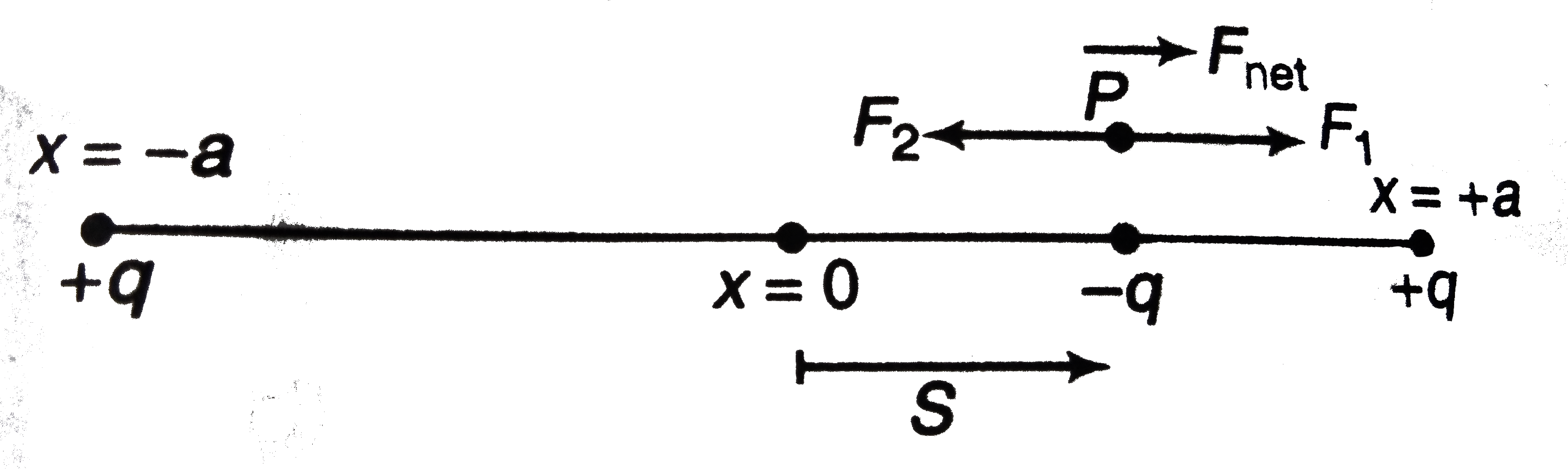
(a) At `x=0, F=0`. At `P`,
attraction on-q or
`F_(1)gt "attraction" F_(2)`
.
`:.` Net force is in the direction of displacement.
So, equilirium is unstable.
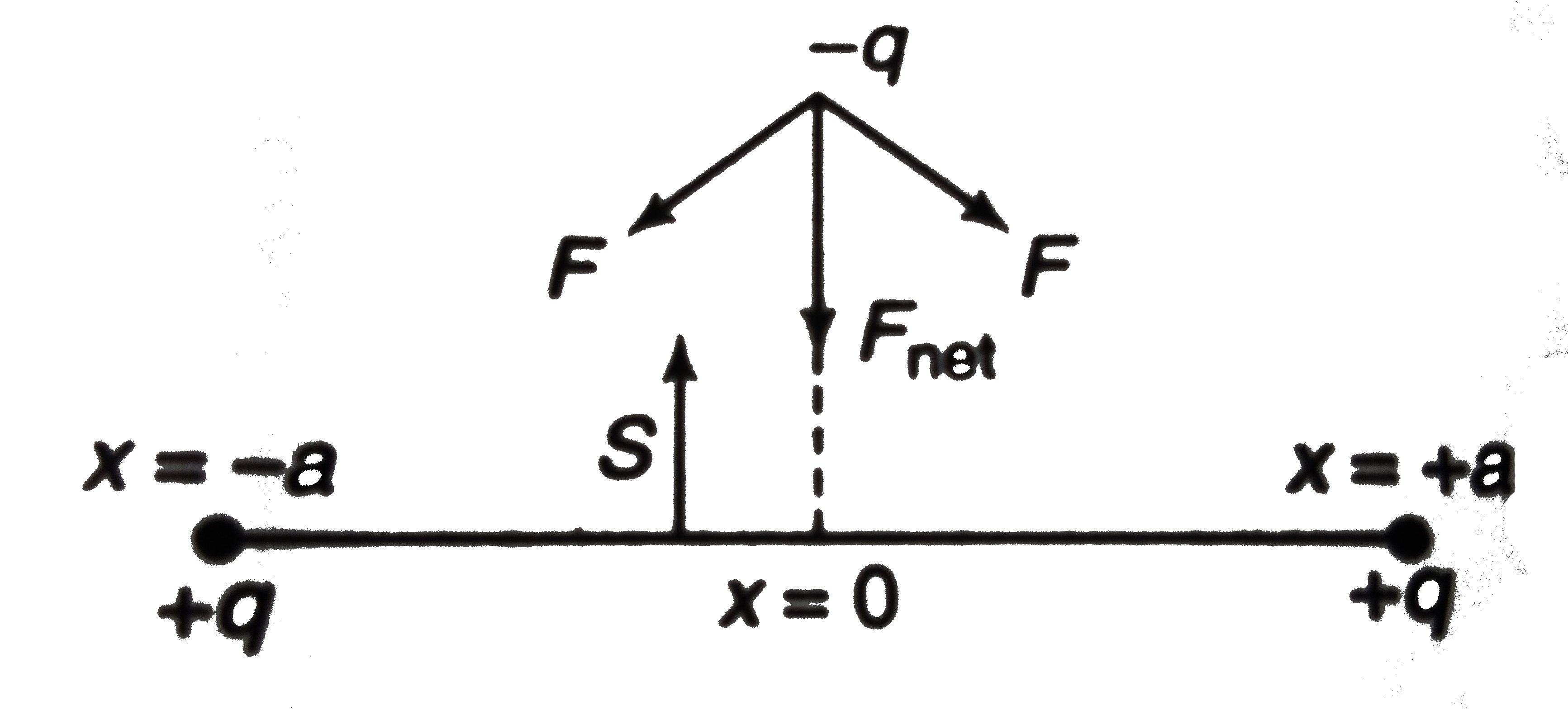
(b) `F_("net")` is in opposition of S. Therefore equilibrum is stable.
.
Promotional Banner

Topper's Solved these Questions

  • WORK, ENERGY & POWER

    DC PANDEY|Exercise Exercise 9.5|2 Videos
  • WORK, ENERGY & POWER

    DC PANDEY|Exercise Introductory|1 Videos
  • WORK, ENERGY & POWER

    DC PANDEY|Exercise Exercise 9.3|2 Videos
  • WAVE MOTION

    DC PANDEY|Exercise Integer Type Question|11 Videos
  • WORK, ENERGY AND POWER

    DC PANDEY|Exercise MEDICAL ENTRACES GALLERY|33 Videos

Similar Questions

Explore conceptually related problems

Two point charges q each are fixed at (a,0) and (-a,0). A third charge Q is placed at origin. Electrons potential energy of the system will

Two point charges+q nd -q are held fixed at (-a,0) and (a,0) respectively of a x-y coordinate system then

Two point charges (Q each are placed at (0,y) and (0-y) A point charge q of the sme polarity can move along the x-axis. Then

Two equal point charges are fixed at x=-a and x=+a on the x-axis. Another point charge Q is placed at the origin. The change in the electrical potential energy of Q, when it is displaced by a small distance x along the x-axis, is approximately proportional to

Two equal positive point charges 'Q' are fixed at points B (a, 0) and A(-a, 0). Another test charge q_(0) is also placed at O (0, 0). Show that the equilibrium at 'O' is (i) Stable for displacement along X-axis (ii) Unstable for displacement along Y-axis.

Two point charges +q and -q are held fixed at (-d,o) and (d,0) respectively of a x-y coordinate system. Then

Two equal positive charges Q are fixed at points (a, 0) and (-a,0) on the x-axis. An opposite charge -q at rest is relased from point (0, a) on the y-axis. The charge -q will

Two small particles P and Q each of mass m are fixed along x-axis at points (a,0) and (-a,0). A third particle R is kept at origin. Then