Home
Class 11
PHYSICS
A rod of length 1.0 m and mass 0.5 kg fi...

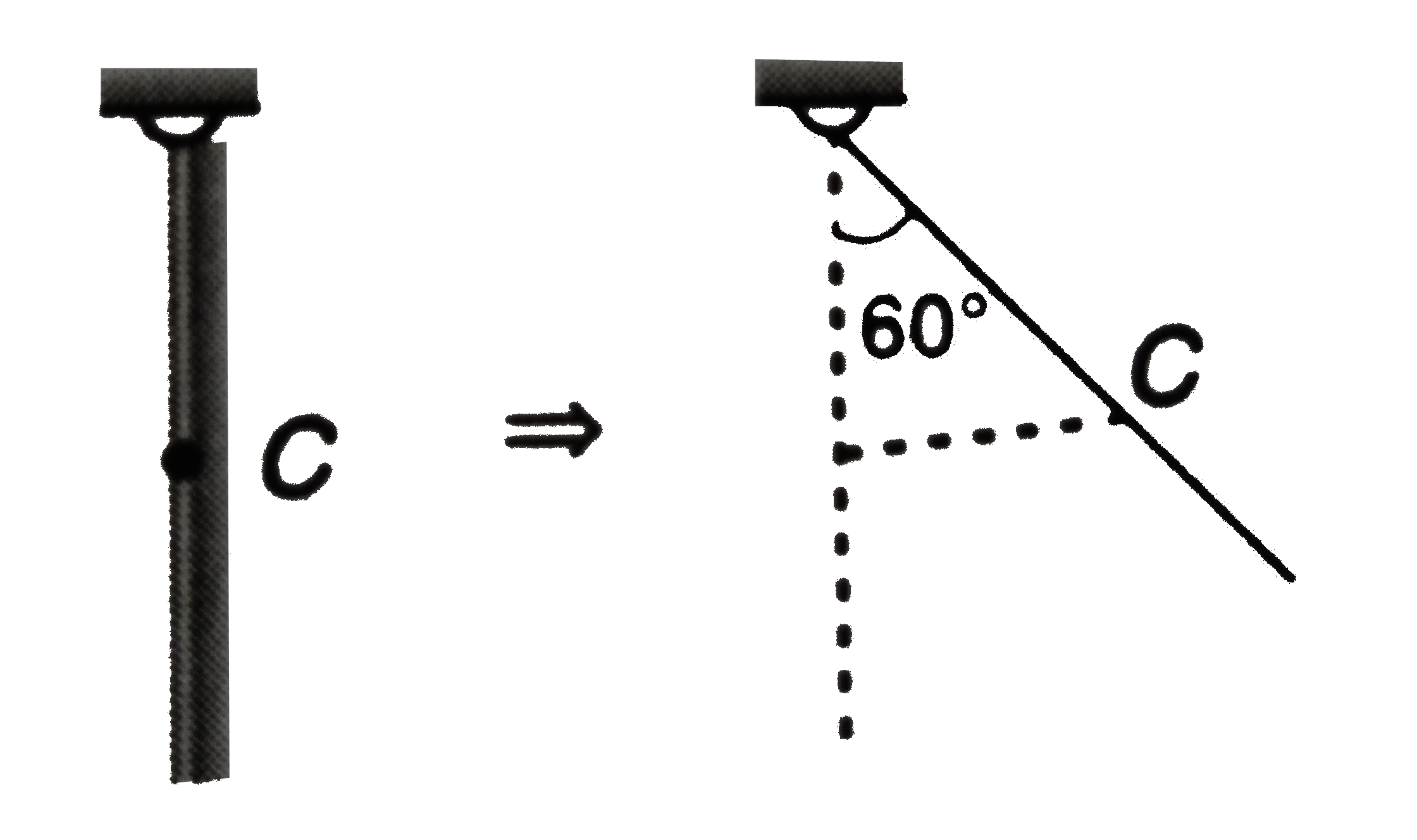
A rod of length `1.0 m` and mass `0.5 kg` fixed at ond is initially hanging vertical. The other end is now raised until it makes an angle `60^@` with the vertical. How much work is required?

Text Solution

Verified by Experts

The correct Answer is:
A, B

For increase in gravitational potential energy of a rod we see the centre of the rod.
.
`W =` change in potential energy
`=mgl/2(1-cos theta)`
Substituting the values, we have
` W =(0.5) (9.8)((1.0)/(2))(1-cos60^(@))`
`=1.225 J`.
Promotional Banner

Similar Questions

Explore conceptually related problems

A rod of length 1m and mass 0.5 kg is fixed at one end is initially hanging vertical. The other end is now raised until it makes an angle 60^(@) with the vertical. How much work is required ?

A body of mass m hangs at one end of a string of length l , the other end of which is fixed. It is given a horizontal velocity so that the string would just reach where it makes an angle of 60^(@) with the vertical. The tension in the string at mean position is

A body of mass m hangs at one end of a string of length l, the other and of which is fixed . It is given a horizontal velocity so that the string would just reach where it makes an angle of 30^@ with the vertical . The tension in the string at mean position is

A uniform rod of mass M & length L is hinged about its one end as shown. Initially it is held vartical and then allowed to rotate, the angular velocity of rod when it makes an angle of 37^(@) with the vertical is

A body of mass m hangs at one end of a string of lenth l, the other end of which is fixed. It is given a horizontal velocity so that the string would just reach where it makes an angle of 60^(@) with the vertical. The tension in the string at bottommost point position is

A 40 kg mass, hanging at the end fo a rope of length l, oscillates in a vertical plane with an angular amplitude theta_0. What is the tension in the rope when it makes en angle theta with the vertical ? If the breaking strength of the rope is 80kg, what is the maximum amplitude with which the mass can oscillate without the rope breaking?

A 40-kg mass hanging at the end of a rope of length l . Oscillates in a vertical plane with an angular of theta_(0) . What is the tension in the rope when it makes an angle theta with the vertial ? If the breaking strength of the rope is 80 kg, what is the maximum angular amplitude with which the mass can oscillate without the rope breaking ?

In the figure shown one end of a light spring of natural length l_(0)=sqrt(5/8)m(~~0.8m) is fixed at point D and other end is attached to the centre B of a uniform rod AF of length l_(0)//sqrt(3) and mass 10kg. The rod is free to rotate in a vertical plane about a fixed horizontal axis passing through the end A of the rod. The rod is held at rest in horizontal position and the spring is in relaxed state. It is found that, when the rod is released to move it makes an angle of 60^(@) with the horizontal when it comes to rest for the first time. Find the (a) the maximum elogation in the spring . (Approximately) (b) the spring constant. (Approximately)

A bob of mass 2 kg hangs from a string of length 5 m . It swings from its rest position to one of the sides so that the string makes an angle of 60^(@) with the vertical Calculate the gain in potential energy of the bob .

