Home
Class 11
PHYSICS
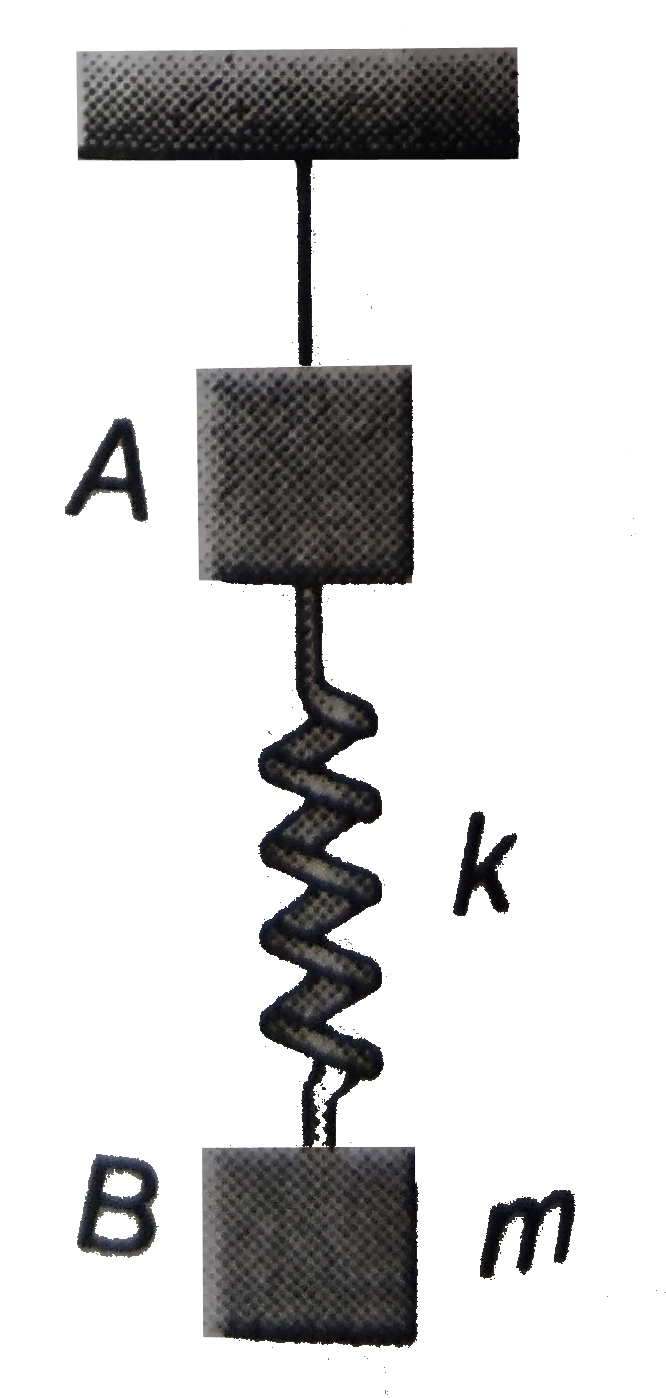
Initially the system shown in figure is ...

Initially the system shown in figure is in equilibrium. At the moment, the string is cut the downward of `a(1)` and `a_(2)` are.
.

A

(a) zero and zero

B

(b) 2g and zero

C

(c) g and zero

D

(d) None of the above

Text Solution

Verified by Experts

The correct Answer is:

B

`T =2mg`
As soon as string is cut T (on A) suddenly becomes zero . Therefore a force of 2mg on upward direction on A suddenly becomes zero.
So net force on it will become 2mg downwards.
`:. a^(1) = (2mg)/(m) =2g` (downwards)
Spring force dorce not become instantly zero so acceleration of B will not change abruptly.
or `a_(2) =0`
Promotional Banner

Similar Questions

Explore conceptually related problems

For the system shown in figure, the tensions in the string

The rod shown is in equilibrium position. Find stress in the string.

The system shown in figure is in equilibrium. Find the magnitude of tension in each string, T_(1), T_(2), T_(3) and T_(4) ( g = 10 m//s^(-2))

The system shown in figure is initially in equilibrium. What is the acceleration of B just after the string connecting B to ground is cut ?

The system shown in the Fig. is in equilibrium. Find the initial acceleration of A, B and C just after the spring 2 is cut.

In the system shown in figure, the block A is released from rest. Find Tension in the string.

The system shown in the figure is in equilibrium and all the blocks are at rest. Assume that the masses of the strings, the pulley and the spring and negligible with respect to the masses of the blocks and friction is absent. Find the acceleration of block C, just after cutting the spring 1. [g=10ms^(-2)]

System shown in fig is in equilibrium and at rest. The spring and string are massless now the string is cut. The acceleration of mass 2m and m just after the string is cut will be:

For the system shown in fog. m_(1) gt m_(2) gtm_(3) gt m_(4) . Initially, the system is at rest in equilibrium condition., if the string joining m_(4) and ground is cut, then just after the string is cut. Statement I: m_(1), m_(2), m_(3) remain stationary. Statement II: The value of acceleration of all the four blocks can be determined. Statement III: Only m_(4) remain stationary. Statement IV: Only m_(4) accelerates.
