Home
Class 11
PHYSICS
Two light vertical springs with equal na...

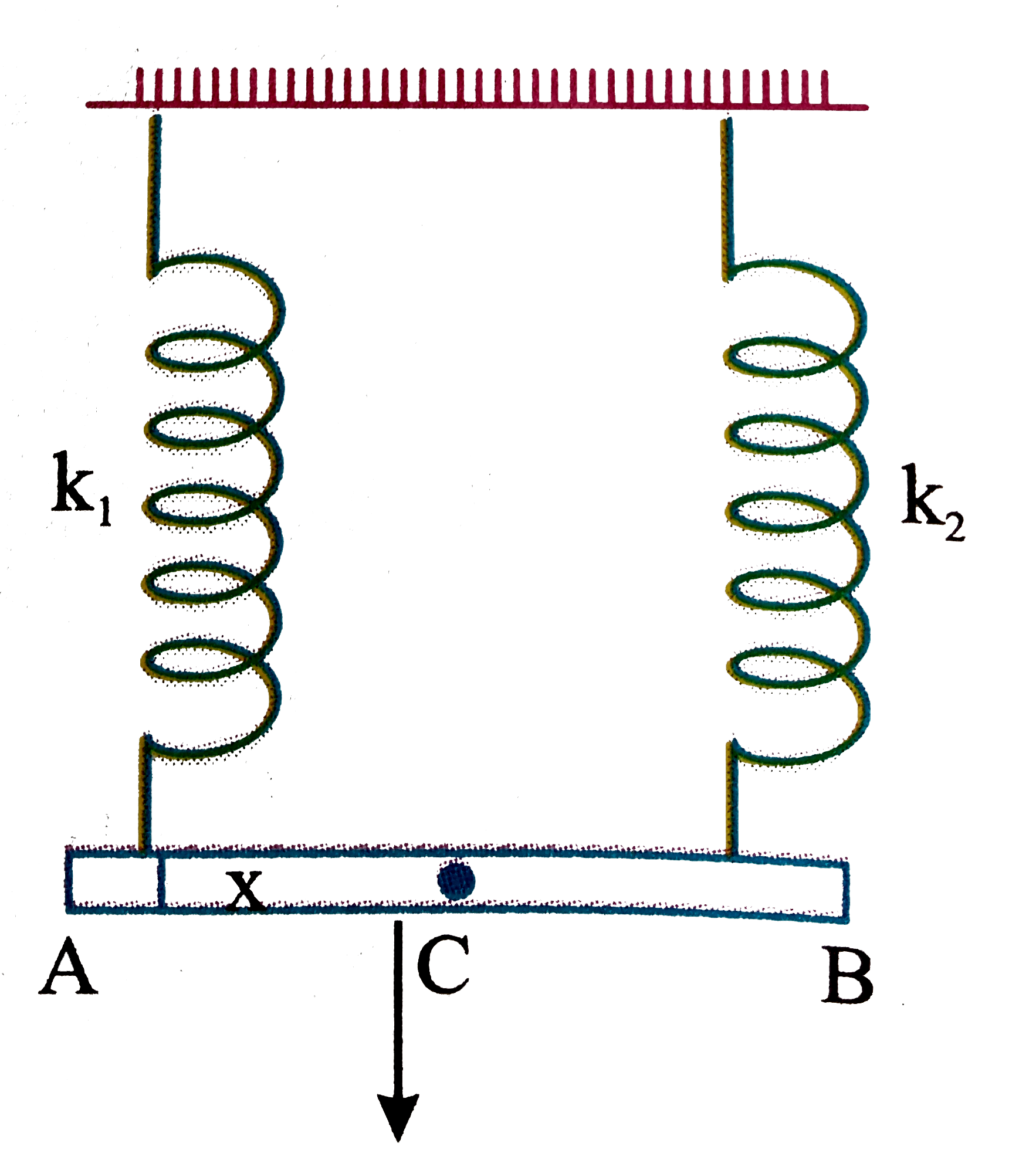
Two light vertical springs with equal natural length and spring constants `k_(1)` and `k_(2)` are separated by a distance `l`. Their upper end the ends `A` and `B` of a light horizontal rod `AB`. A vertical downwards force `F` is applied at point `C` on the rod. `AB` will remain horizontal in equilibrium if the distance `AC` is

A

`(lk_(1))/(k_(2))`

B

`(lk_(1))/(k_(2) + k_(1))`

C

`(lk_(2))/(k_(1))`

D

`(lk_(2))/(k_(1) + k_(2))`

Text Solution

Verified by Experts

The correct Answer is:

D

`sum ("Moments about" C) =0`
`:. (k_(1)x) AC=(k_(2)x) BC`
`:. (AC)/(BC) =k_(2)/k_(1)`….(i)
`AC + BC =l`….(ii)
Soving these two equation we get,
`AC=((k_(1))/(k_(1)+k_(2)))l`
Promotional Banner

Similar Questions

Explore conceptually related problems

A stick AB of mass M is tied at one end to a light string OA. A horizontal force F = Mg is applied at end B of the stick and its remains in equilibrium in position shown. Calculate angles alpha and beta .

Two ideal springs of same make (the springs differ in their lengths only) have been suspended from points A and B such that their free ends C and D are at same horizontal level. A massless rod PQ is attached to the ends of the springs. A block of mass m is attached to the rod at point R. The rod remains horizontal in equilibrium. Now the block is pulled down and released. It performs vertical oscillations with time period T =2 pi sqrt((m)/(3k)) where k is the force constant of the longer spring. (a) Find the ratio of length RC and RD. (b) Find the difference in heights of point A and B if it is given that natural length of spring BD is L.

A very stiff bar (AB) of negligible mass is suspended horizontally by two vertical rods as shown in figure. Length of the bar is 2.5 L. The steel rod has length L and cross sectional radius of r and the brass rod has length 2L and cross sectional radius of 2r . A vertically downward force F is applied to the bar at a distance x from the steel rod and the bar remains horizontal. Find the value of x if it is given that ratio of Young’s modulus of steel and brass is (Y_(s))/(Y_(B)) = 2 .

One end a light spring of natural length d and spring constant k ( = mg //d) is fixed on a rigid support and the other end is fixed to a smoth ring of mass m which can slide without friction on a vertical rod fixed at a distance d from the support. Initially , the spring makes an angle of 37^(@) with the horizontal as shown in the figure. The system is released from rest. The speed of the ring at the same angle subtended downward will be

One end of a light spring of natural length d and spring constant k is fixed on a rigid wall and the other is attached to a smooth ring of mass m which can slide without friction on a vertical rod fixed at a distance d from the wall. Initially the spring makes an angle of 37^(@) with the horizontal as shown in fig. When the system is released from rest, find the speed of the ring when the spring becomes horizontal. [ sin 37^(@) = 3/5]

two light identical springs of spring constant K are attached horizontally at the two ends of a uniform horizontal rod AB of length l and mass m. the rod is pivoted at its centre 'o' and can rotate freely in horizontal plane . The other ends of the two springs are fixed to rigid supportss as shown in figure . the rod is gently pushed through a small angle and released , the frequency of resulting oscillation is :

A ring of mass m is attached to a horizontal spring of spring constant k and natural length l_0 . The other end of the spring is fixed and the ring can slide on a horizontal rod as shown. Now the ring is shifted to position B and released Find the speed of the ring when the spring attains its natural length.

A uniform rod AB hinged about a fixed point P is initially vertical. A rod is released from vertical position. When rod is in horizontal position: The acceleration of end B of the rod is
