Home
Class 11
PHYSICS
A block (A) of mass 45kg is placed on an...

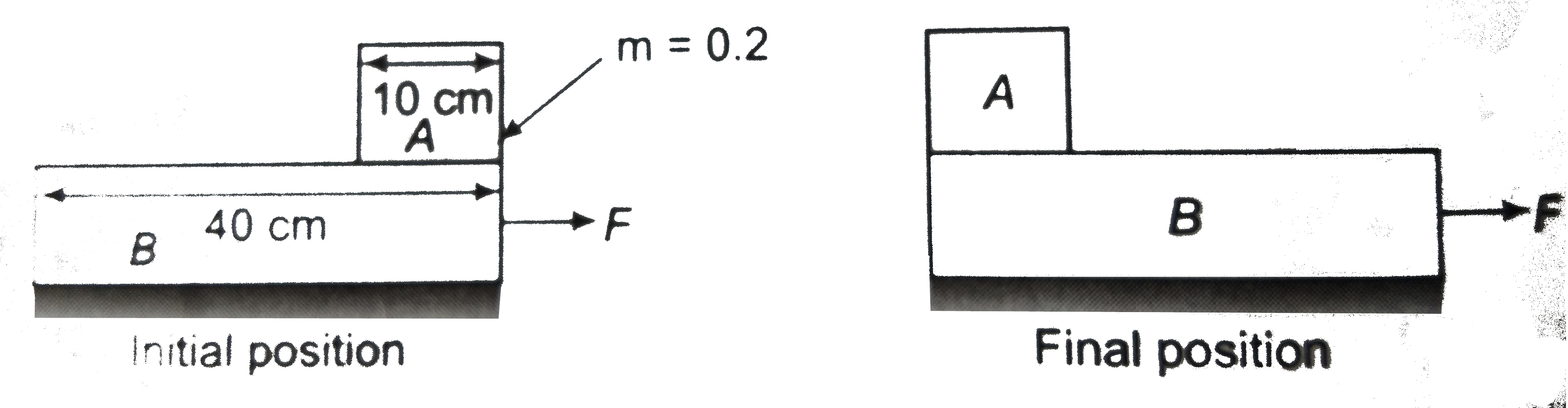
A block (A) of mass `45kg` is placed on another block (B) of mass `123 gk. Now block (B) is displaced by extenal agent by `50 cm` horizontally towards right. During the same time block (A) just reaches to the left end of block (B), Initial and final positions are shown in figures . the work done on block (A) in ground frame is
,

A

`-18 J`

B

`18 J`

C

`36 J`

D

`-36 J`.

Text Solution

Verified by Experts

The correct Answer is:
B

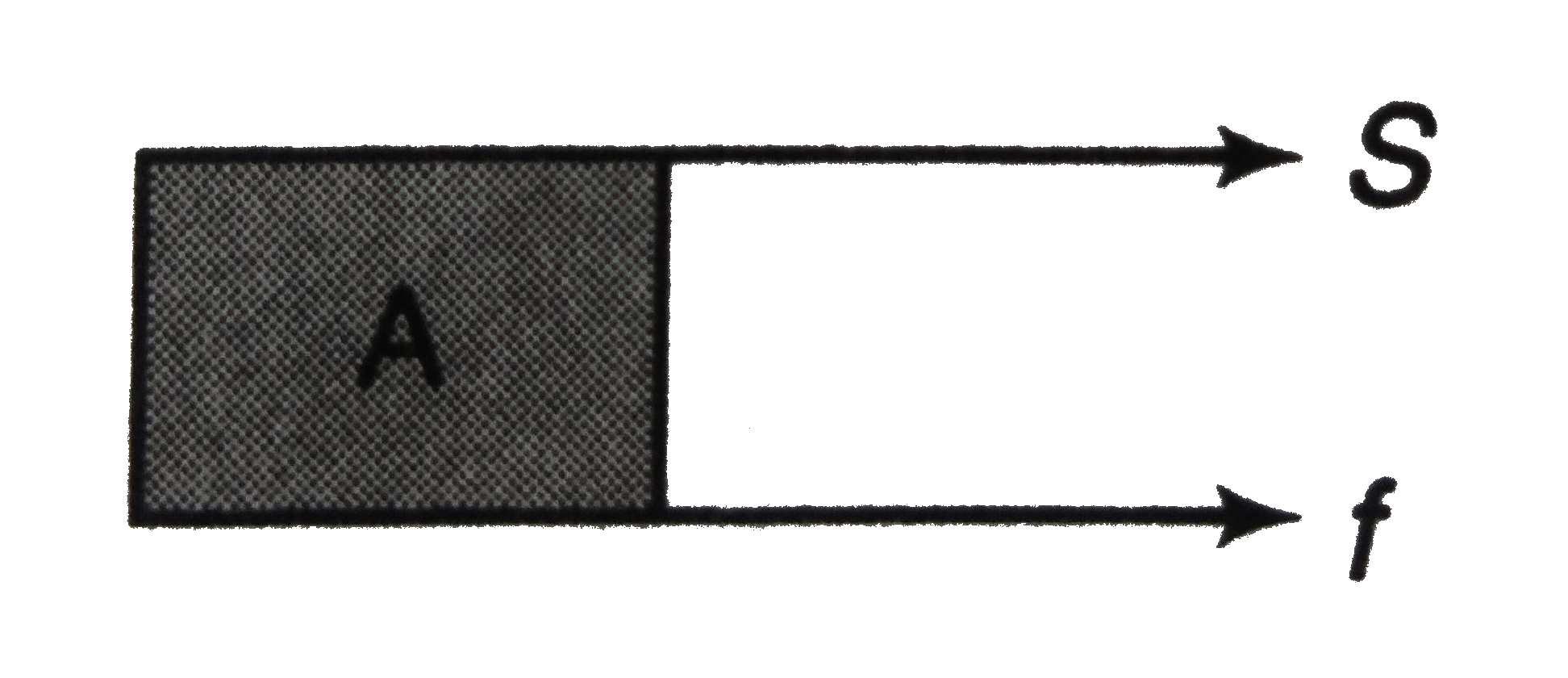
There is slip, so maximum friction will act on A the direction of motion (or towards right)

`f-mu mg=0.2xx45xx10 =90 N`
`S=40-10-10=20 cm =0.2`
`W=fS =18 J`.
Promotional Banner

Similar Questions

Explore conceptually related problems

Block A of mass 1 kg is placed on the rough surface of block B of mass 3 kg . Block B is placed on smooth horizontal surface. Blocks are given the velocities as shown. Find net work done by the frictional force. [in (-) ve J ]. .

Block A of mass 3 kg is placed on another block B of mass 5 kg placed on the smooth surface. If coefficient of friction between two blocks is 1/2 and 32 N force is applied on block B as shown in the figure, then the work done by the frictional force on block A in first two second will be (initial velocity of the system is zero and g = 10 m/s^2 )

A block of mass m is at rest on an another block of same as shown in figure lower block is atteched to the spring than the maximum amplitude of motion as than both the block will remain as mat both the block will remain in contact is

Block A of mass m is placed on a smooth surface and block B of mass km (klt1) is projected towards other end of block A. If work done against friction is n times the initial kinetic energy of block B, the graph between k and n is

A block of mas m is placed on a triangular block of mas m, which in tunis placed on a horizontal surface as shown in figure. Assuming frictionless surfaces find the velocity of the triangular block when the smaller block reaches the bottom end.

A block of mass m is released from a wedge of mass m as shown in figure . Find the time taken by the block to reach the end of the wedge.

A block of mass 50 kg is kept on another block of mass 1 kg as shown in figure. A horizontal force of 10 N is applied on the 1 kg block. (All surface are smooth). Find (g=10m//s^(2)) Force exerted by B on A.

A block of mass 1 kg is pushed towards another block of mass 2 kg from a 6 m distance as shown in the figure. If just after the collision, the velocity of 2 kg block is 4ms^(-1) , then

A block of mass 50 kg is kept on another block of mass 1 kg as shown in figure. A horizontal force of 10 N is applied on the 50kg block. (All surface are smooth). Find (g = 10 m//s^(2)) Acceleration of block A and B.

