Home
Class 11
PHYSICS
Two block tied with a massless string of...

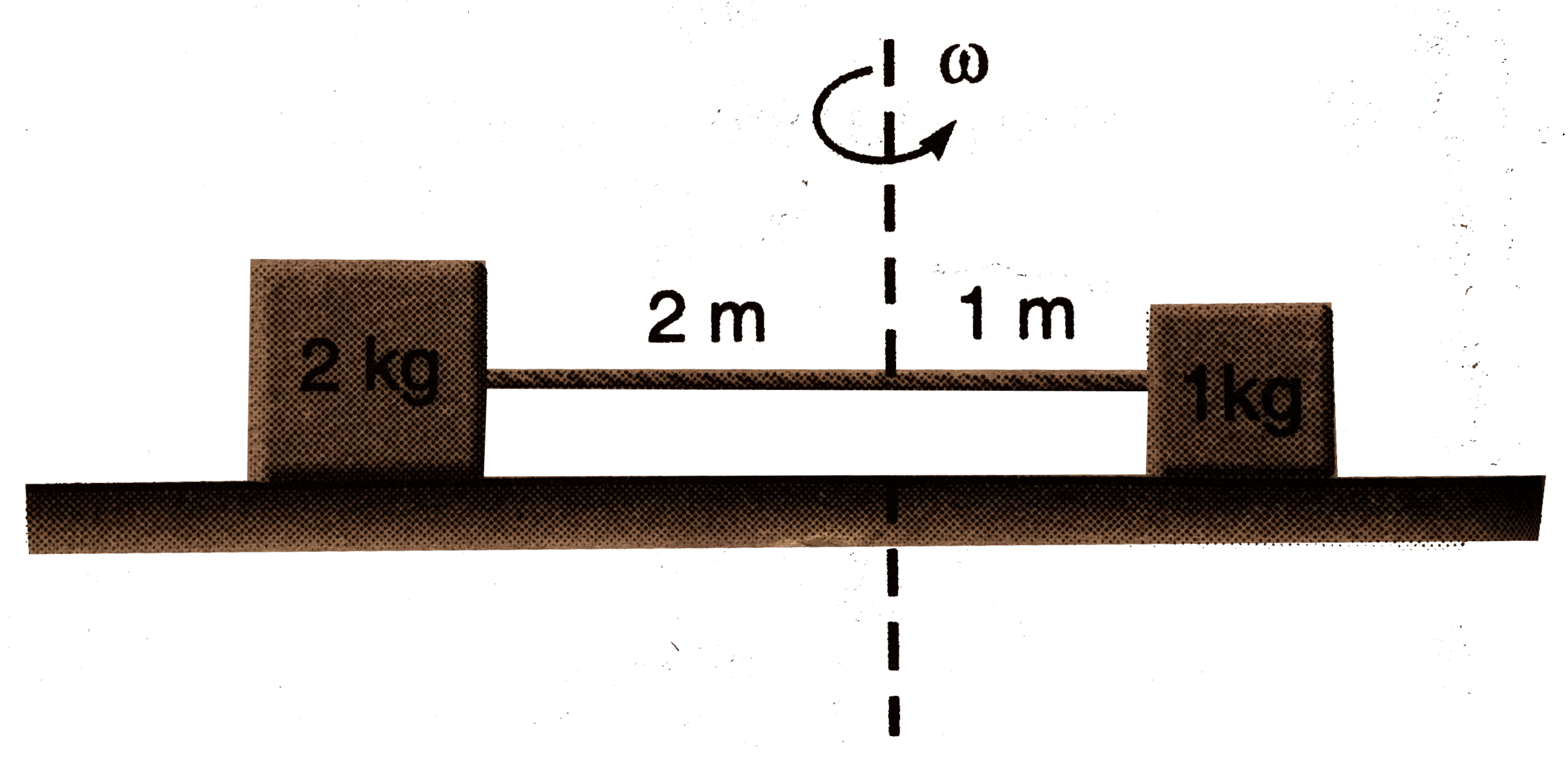
Two block tied with a massless string of length `3m` are placed on a rotating table as shown. The axis of rotation is `1m` from `1kg` mass and `2m` from `2kg` mass. The angular speed
`omega=4rad//s` . Ground below `2kg` block is smooth and below `1kg` block is rough. `(g=10m//s^(2))`
(a) Find tension in the string, force of friction on `1kg` block and its direction.
If coefficient of friction between `1kg` block and groung is `mu=0.8` Find maximum angular speed so that neither of the blocksd slips.
(c) If maximum tension in the string can be `100N` , then maximum angular speed so that neither of the blocks slips.

Text Solution

Verified by Experts

The correct Answer is:
A, B, C, D

`2KgrarrT`
`T=m_(2)r_(2)omega^(2)=(2)(2)(4)^(2)=64N`
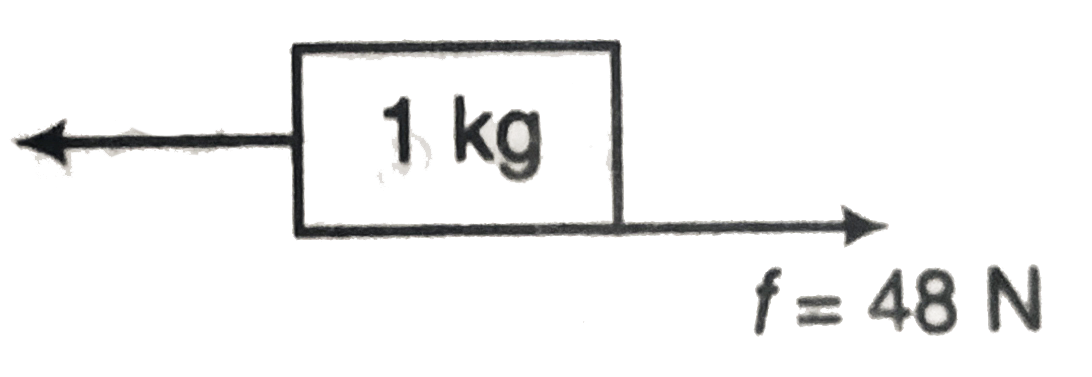
Centripetal force required to `1Kg` block is

`F_(c)=m_(1)r_(1)omega^(2)=(1)(1)(4)^(2)=16N`
But available tensions is `64N` . So, the extra force of `48N` is balance by friction acting radially outward from the centre.
(b) `f_(max)=mu_(1)g=0.8xx1xx10=8N`

`T=m_(2)r_(2)omega^(2)=(2)(2)omega^(2)=4omega^(4)`
`T-8=m_(1)r_(1)omega^(2)=(1)(1)(omega^(2))=omega^(2)`
Solving Eqs. `(i)` and `(ii)` we get,
`omega=1.63rad//s`
(c) `T=m_(2)r_(2)omega^(2)`
`2KgrarrT`
`rarrm_(2)r_(2)omega^(2)`
:. `100=(2)(2)omega^(2)`
or `omega=5rad//s`
Promotional Banner

Topper's Solved these Questions

  • CIRCULAR MOTION

    DC PANDEY|Exercise Level 2 Single Correct|18 Videos
  • CIRCULAR MOTION

    DC PANDEY|Exercise Level 2 More Than One Correct|5 Videos
  • CIRCULAR MOTION

    DC PANDEY|Exercise Level 1 Objective|14 Videos
  • CENTRE OF MASS, LINEAR MOMENTUM AND COLLISION

    DC PANDEY|Exercise Level 2 Subjective|21 Videos
  • COMMUNICATION SYSTEM

    DC PANDEY|Exercise Only One Option is Correct|27 Videos

Similar Questions

Explore conceptually related problems

In the diagram shown coefficient of friction between 2 kg block and 4 kg block is mu =0.1 and between 4 kg and ground is mu =0.2 then answer the following quwstions .(tis time) Force of friction on 2 kg block at t=(1)/(2) s will be

2gk block is kept on 1kg block as shown . The friction between 1kg block and fixed surface is absent and the coefficient of friction between 2kg block is mu=0.1 . A constant horizontal force F=4N is applied on 1kg block. If the work done by the friction on 1 kg block in 2s is -X J , then find X . Take g=10m//s^(2) .

A block of mass m=2kg is placed in equilibrium on a moving plank accelerating with a=1m//s^(2) . If coefficient of friction between plank and block mu=0.2 . The friction force acting on theblock is:

The coefficient of friction between 4 kg and 5 kg blocks is 0.2 and between 5 kg block and ground is 0.1 respectively. Choose the correct statement : (Take g=10m//s^(2) )

A is a 100kg block, and B is a 200kg block. As shown in figure the block A is attached to a string tied to a wall. The coefficient of friction between A and B is 0.2 and the coefficient of fricition between B and floor is 0.3. Then calculate the minimum force required to move the block B. (take g=10m//s^(2) ).

Two blocks of mass 2kg and 1kg are at rest on a smooth surface as shown. There is friction between 2kg and 1kg block with mu = 0.5 . Find maximum force to be applied on 1 kg for the two blocks to move together.

If coeffiecient of friction between the block of mass 2kg and table is 0.4 then out acceleration of the system and tension in the string. (g=10m//s^(2))

Mass of upper block and lower block kept over the table is 2 kg and 1 kg respectively and coefficient of friction between the blocks is 0.1. Table surface is smooth. The maximum mass M for which all the three blocks move with same acceleration is (g = 10 m/s2) -

The coefficient of static friction mu_(s) between block A of mass 2kg and the table as shown in is 0.1 What would be the maximum mass value of blocks B so that the two bloks do not move ? The string and the pulley are assumed to be smooth and massless (g = 10m//s^(2)) .

A block of mass m is placed on another block of mass M lying on a smooth horizontal surface as shown in the figure. The co-efficient of friction between the blocks is mu . Find the maximum horizontal force F (in Newton) that can be applied to the block M so that the blocks together with same acceleration? (M=3kg, m=2kg, mu=0.1, g=10m//s^(2))