Home
Class 11
PHYSICS
A wooden plank of mass 20kg is resting o...

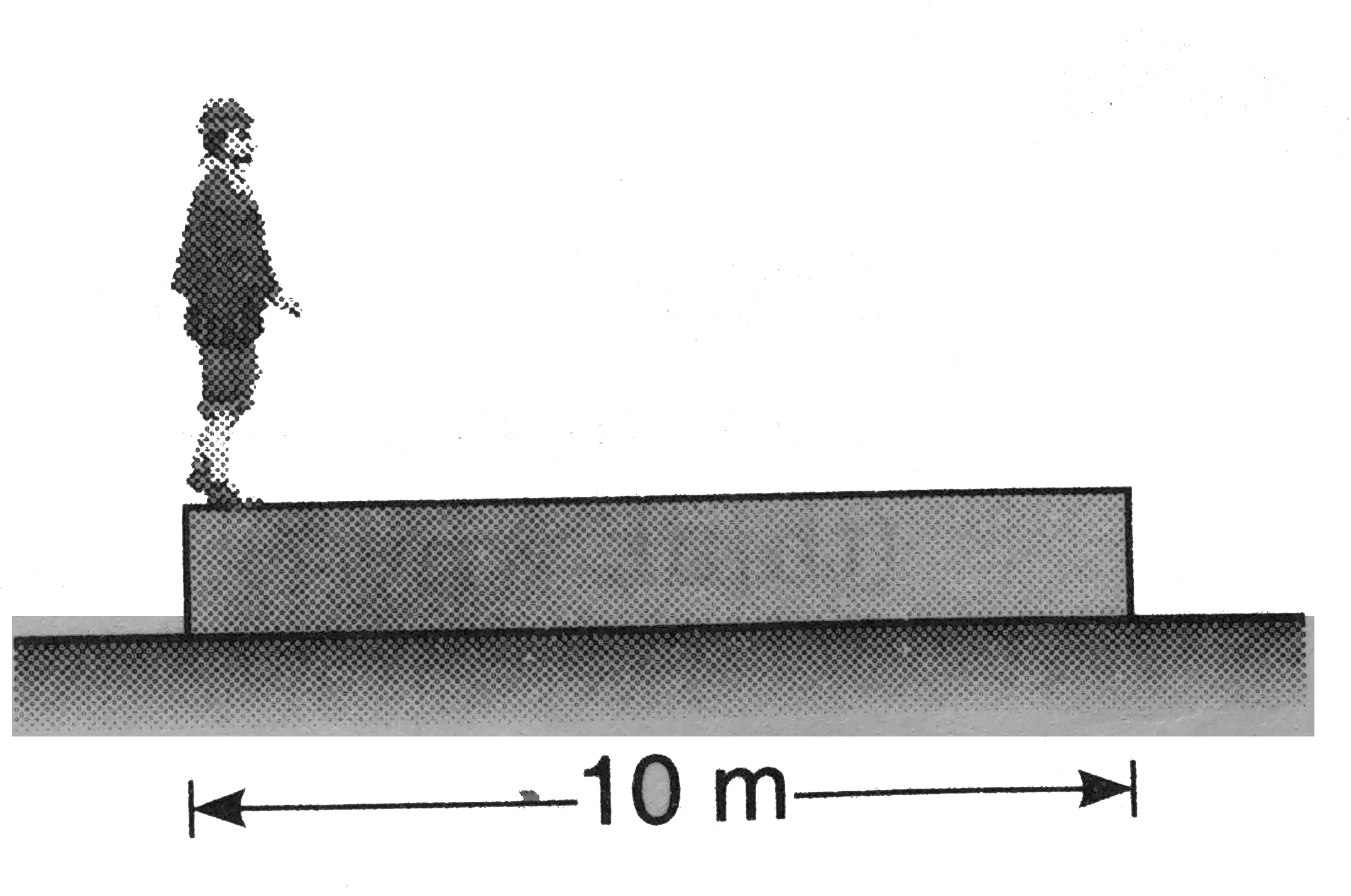
A wooden plank of mass `20kg` is resting on a smooth horizontal floor. A man of mass `60kg` starts moving from one end of the plank to the other end. The length of the plank is `10m`. Find the displacement of the plank over the floor when the man reaches the other end of the plank.

Text Solution

Verified by Experts
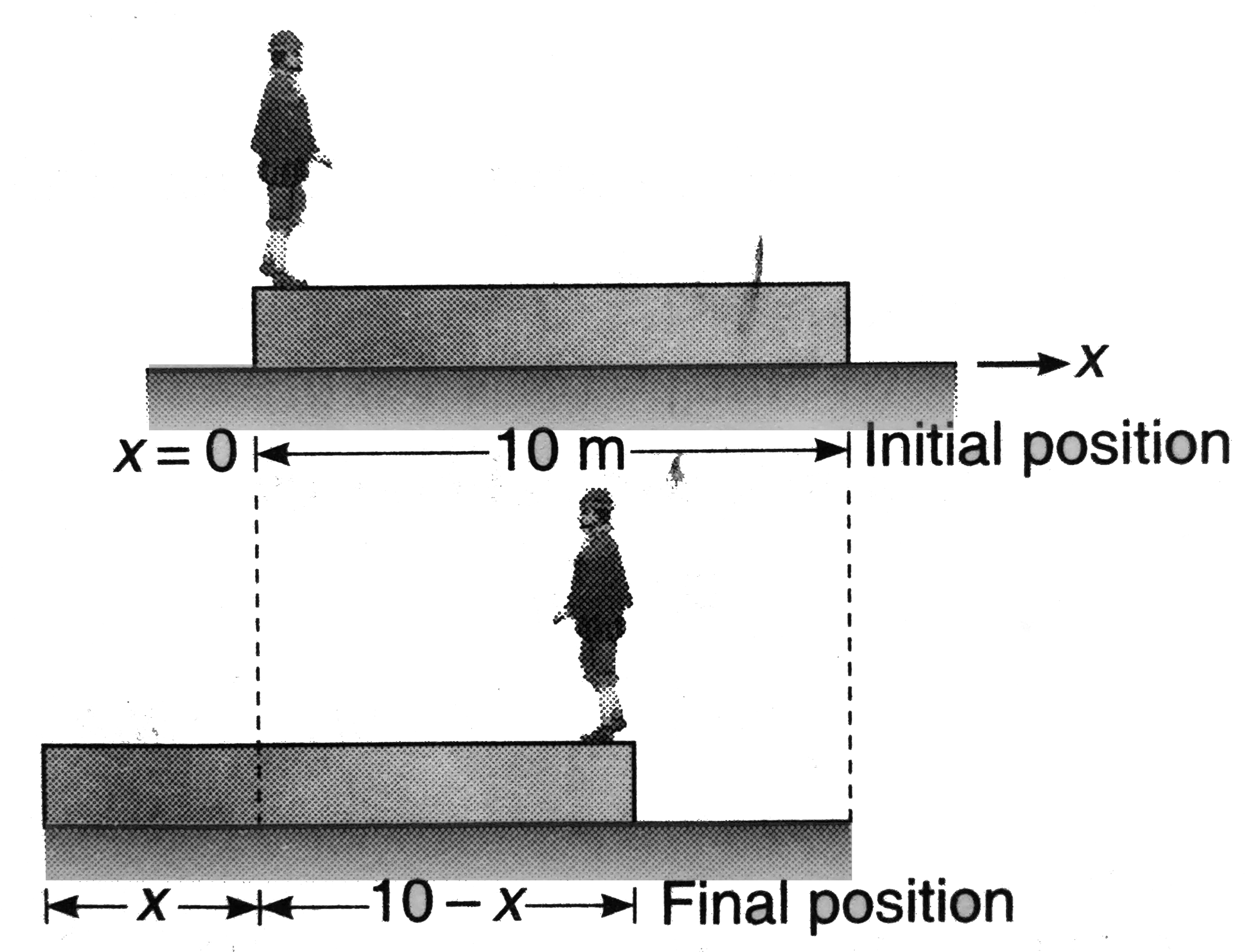
Here, the system is man+plank. Net force on this system in horizontal direction is zero and initially the centre of mass of the system is at rest. Therefore, the centre of mass does not move in horizontal direction.
Let x be the displacement of the Plank. Assuming the origin, i.e. `x=0` at the position show in figure

As we said earlier also, the centre of mass will not move in horizontal direction (x-axis). Therefore, for centre of mass to remain stationary,
`x_i=x_f`
`((60)(0)+20(10/2))/(60+20)=((60)(10-x)+20(10/2-x))/(60+20)`
`5/4=(6(10-x)+2(10/2-x))/(8)=(60-6x+10-2x)/(8)`
or `5=30-3x+5-x`
or `4x=30`
or `x=30/4m` or `x=7.5m`
Alternate Method
`x_L="displacement of plank towards left"=x`
`m_L="mass of plank displaced towards left"=20kg`
`x_R="displacement of man relative to ground towards right" =10-x`
and `m_R="mass of man displaced towards right"=60kg`
Applying `x_Rm_R=x_Lm_L`, we get
`(10-x)(60)=20x`
or `x=30-3x`
or `4x=30`
`:. x=30/4=7.5m`
Promotional Banner

Topper's Solved these Questions

  • CENTRE OF MASS, LINEAR MOMENTUM AND COLLISION

    DC PANDEY|Exercise Type 1|1 Videos
  • CENTRE OF MASS, LINEAR MOMENTUM AND COLLISION

    DC PANDEY|Exercise MiscellaneousExamples|9 Videos
  • CENTRE OF MASS, LINEAR MOMENTUM AND COLLISION

    DC PANDEY|Exercise Level 2 Subjective|21 Videos
  • CENTRE OF MASS, IMPULSE AND MOMENTUM

    DC PANDEY|Exercise Comprehension type questions|15 Videos
  • CIRCULAR MOTION

    DC PANDEY|Exercise Medical entrances s gallery|19 Videos

Similar Questions

Explore conceptually related problems

A wooden plank of mass 20 kg is resting on a smooth horizontal floor. A man of mass 60 kg starts moving from one end of the plank to the other end. The length of the plank is 10 m. Find the displacement of the plank over the floor when the man reaches the other end of the plank.

A uniform wooden plank of mass 150 kg and length 8 m is floating on still water with a man of 50 kg at one end of it . The man walks to the other end of the plank and stops. Than the distance covered by the plank is

A man of mass m is standing on a plank of equal mass m resting on a smooth horizontal surface. The man starts moving on the plank with speed u relative to the plank. The speed of the man relative to the ground is

No external force: Stationery mass relative to an inertial frame remains at rest A man of mass m is standing at one end of of a plank of mass M. The length of the plank is L and it rests on a frictionless horizontal ground. The man walks to the other end of the plank. Find displacement of the plank and man relative to the ground.

A man of mass M stands at one end of a stationary plank of length L, lying on a smooth surface. The man walks to the other end of the plank. If the mass of the plank is M//3 , the distance that the man moves relative to the ground is

A plank of mass M and length L is at rest on a frictionless floor. At one end of it a child of mass m is standing as shown in figure-4.41. If child walks towards the other end, find the distance, which the plank moves (a) till the child reaches the centre of the plank, (b) till the child reaches the other end of the plank.

A man of mass 80 kg stands on a plank of mass 40 kg . The plank is lying on a smooth horizontal floor. Initianlly both are at rest. The man starts walking on the plank towards north and stops after moving a distance of 6 m on the plank. Then

A boy of mass m stands on one end of a wooden plank of length L and mass M. The plank is floating on water. If the boy walks from one end of the plank to the other end at a constant speed, the resulting displacement of the plank is given by :

A uniform plank is resting over a smooth horizontal floor and is pulled by applying a horizontal force at its one end. Which of the following statements are not correct?

