Home
Class 11
PHYSICS
Two balls of masses m and 2m and momenta...

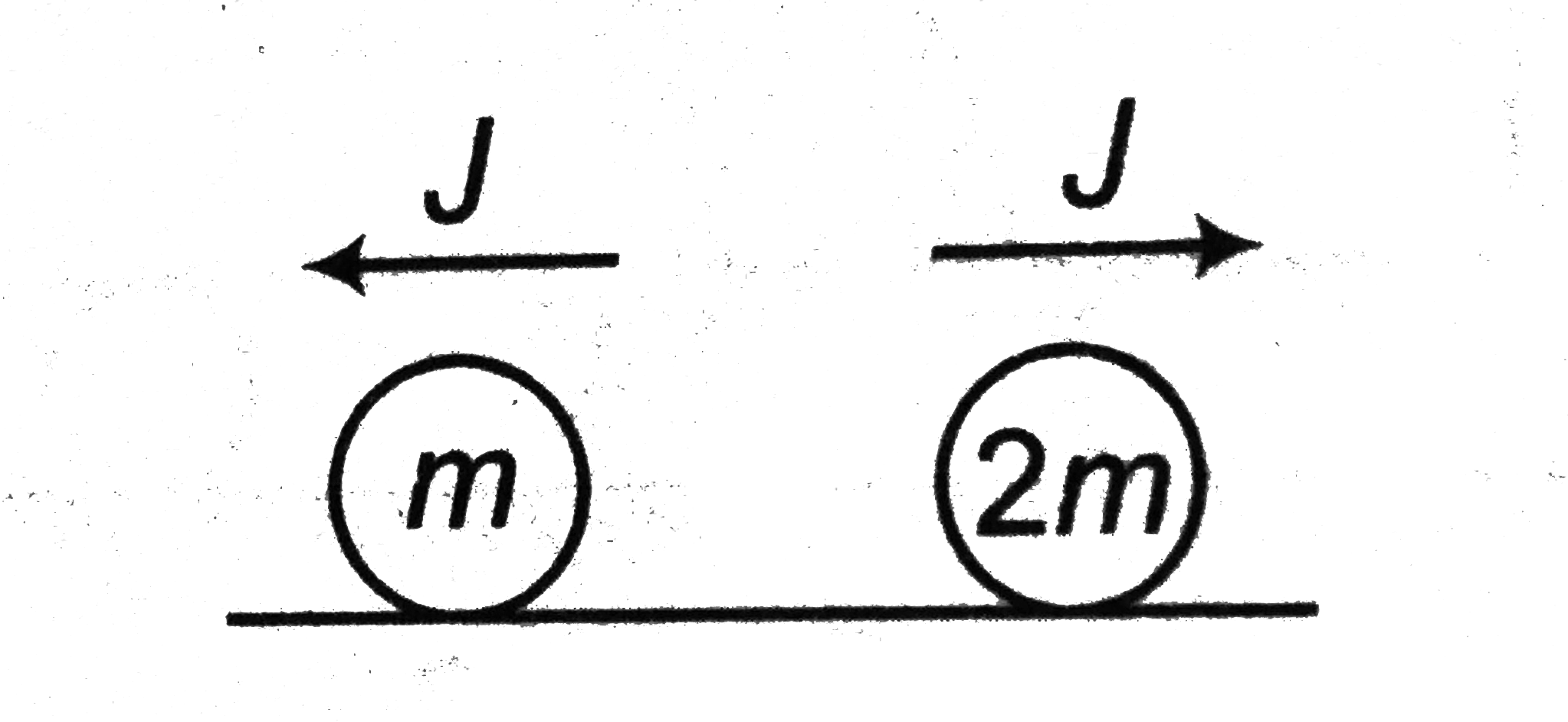
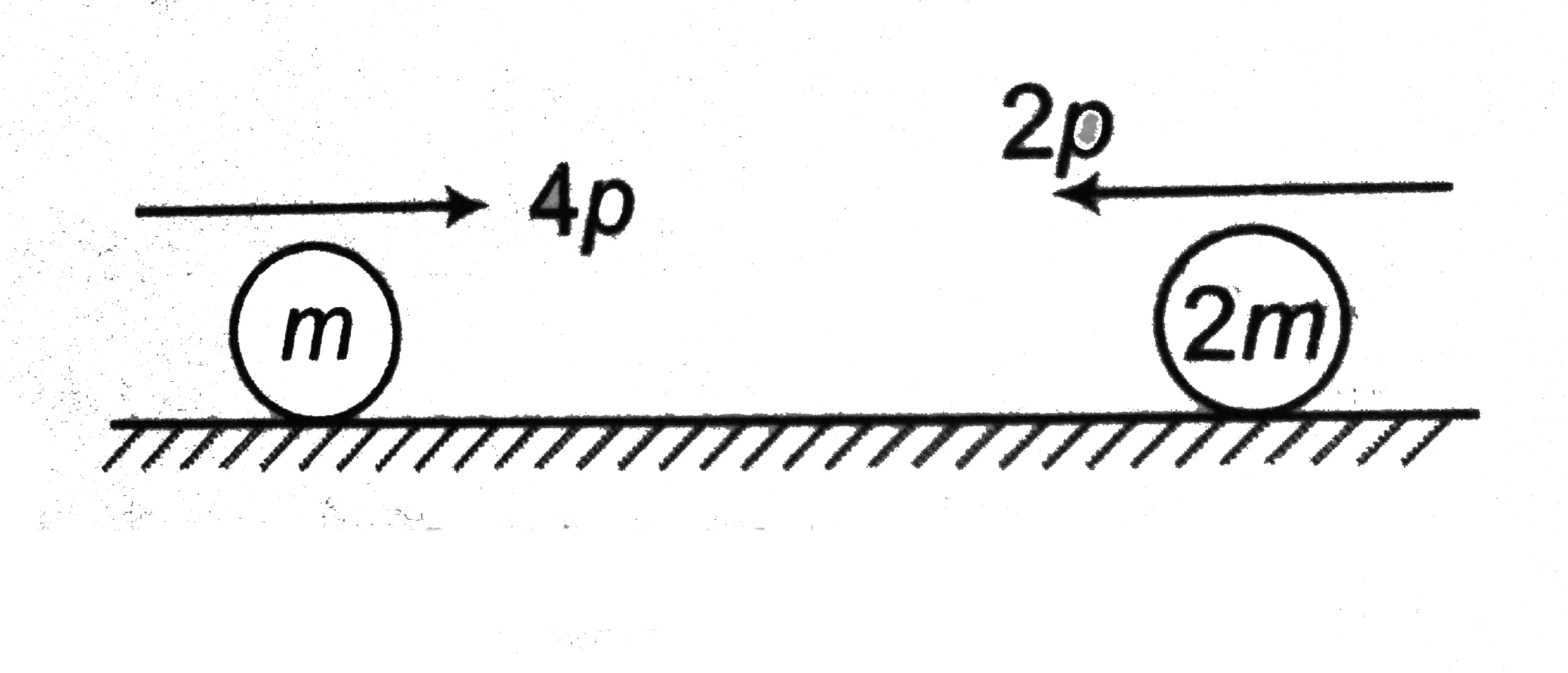
Two balls of masses `m` and `2m` and momenta `4p` and `2p` (in the directions shown) collide as shown in figure. During collsion, the value of linear impulse between them is J. In terms of J and p find coefficient of restitution 'e'. Under what condition collision is elastic. Also find the condition of perfectly inelastic collision.

Text Solution

Verified by Experts

The correct Answer is:
A, B, C

Directions of linear impulses on the two colliding bodies at the time of collision are shown in fig.

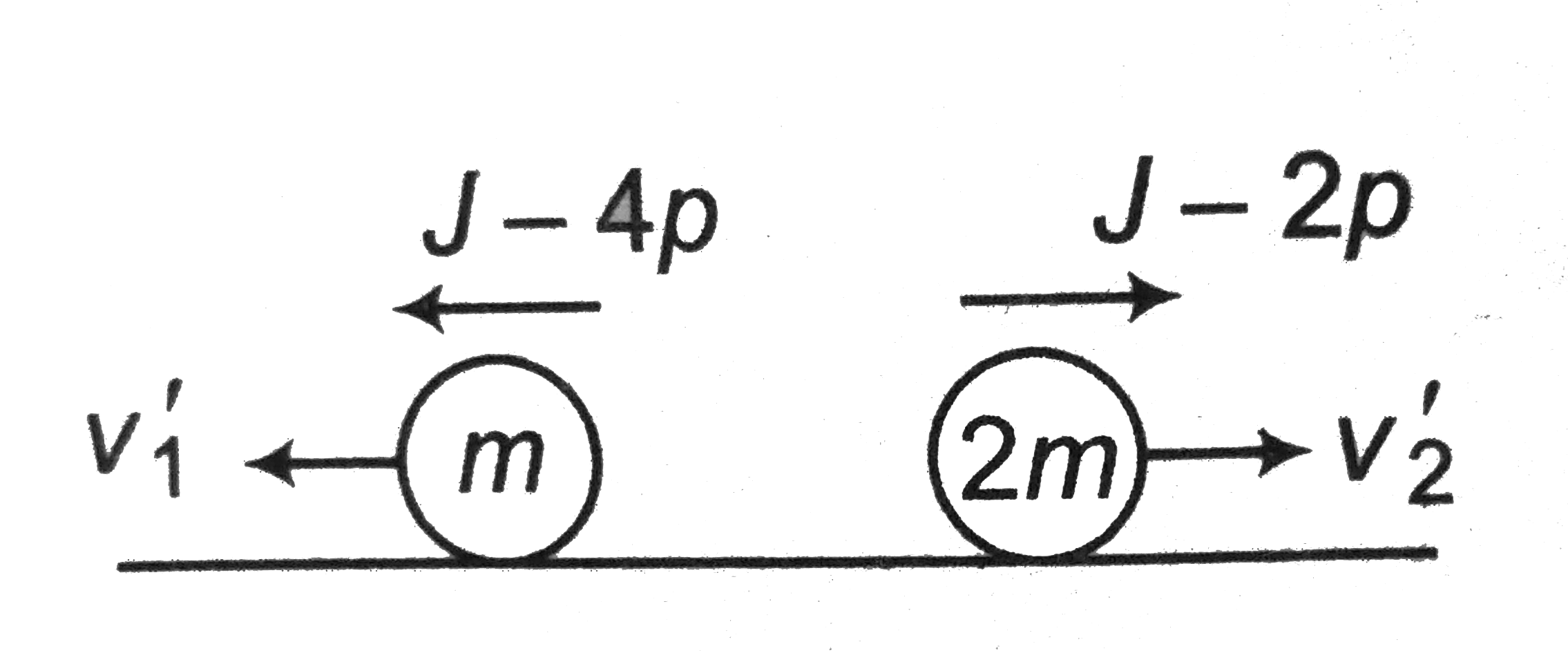
Linear impulse is equal to the change in linear momentum. Hence, momenta of the balls after collision are shown in figure.
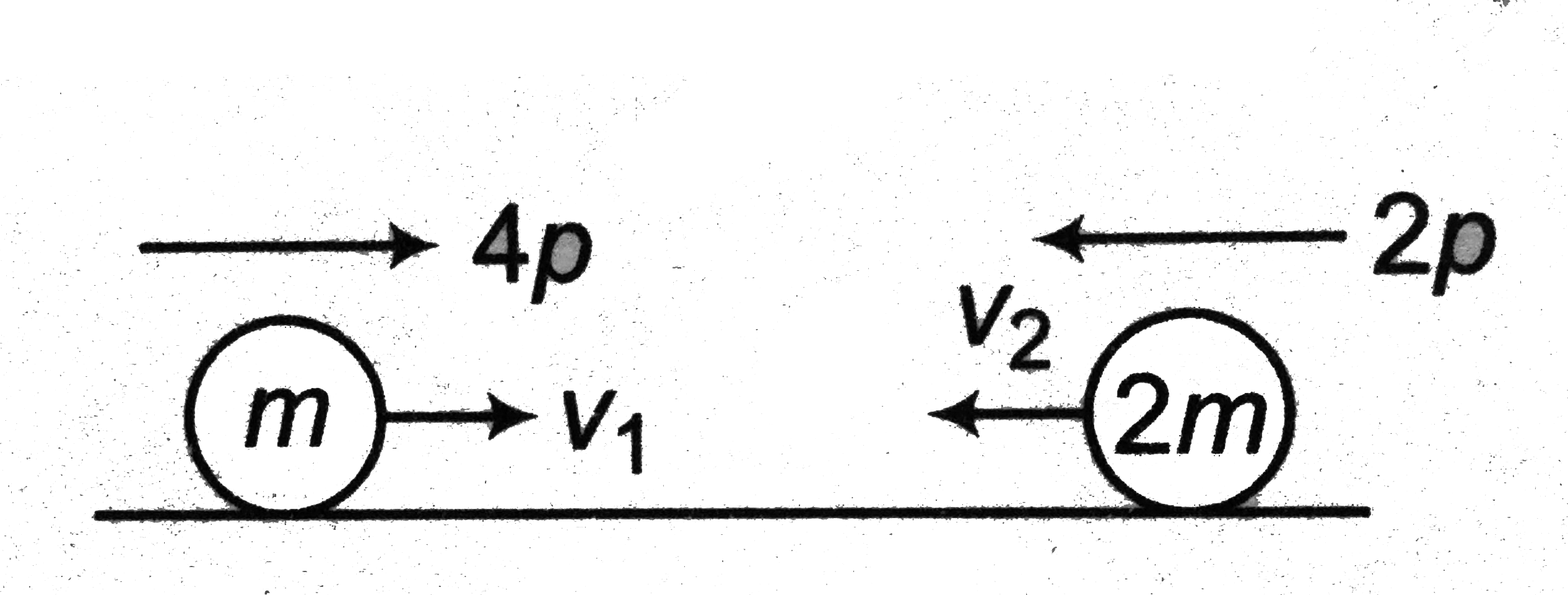
Let `v_1` and `v_(2)` are their velocities before collision [in the directions shown in figure(a)] and `v_1^'` and `v_2` are the velocities after collision as shown in figure (c).
v=("linear momentum"/("mass")
e=("relative speed of separation")/("relative speed of approach")`
or `e=(v_1'+v_2')/(v_1+v_2)=((J-4p)/(m)+(J-2p)/(2m))/((4p)/(m)+(2p)/(2m))`
or `e=(3J-10p)/(10p)=(3J)/(10p)-1`
For elastic collision,
`e=1rArr(3J)/(10p)=2` or `J=(20)/(3p)`
For perfectly inelastic collision,
`e=0rArr(3J)/(10p)=1` or `J=10/3p`
Promotional Banner

Topper's Solved these Questions

  • CENTRE OF MASS, LINEAR MOMENTUM AND COLLISION

    DC PANDEY|Exercise Type 1|1 Videos
  • CENTRE OF MASS, LINEAR MOMENTUM AND COLLISION

    DC PANDEY|Exercise MiscellaneousExamples|9 Videos
  • CENTRE OF MASS, LINEAR MOMENTUM AND COLLISION

    DC PANDEY|Exercise Level 2 Subjective|21 Videos
  • CENTRE OF MASS, IMPULSE AND MOMENTUM

    DC PANDEY|Exercise Comprehension type questions|15 Videos
  • CIRCULAR MOTION

    DC PANDEY|Exercise Medical entrances s gallery|19 Videos

Similar Questions

Explore conceptually related problems

Two balls of masses m and 2m moving in opposite directions collide head on elastically with velocities v and 2v . Find their velocities after collision.

Two particles of mass m and 2 m moving in opposite directions collide elastically with velocities v and 2v. Find their velocities after collision.

A body X with a momentum p collides with another identical stationary body Y one dimensionally. During the collision, Y gives an impulse J to body X . Then coefficient of restitution is

Two particles of masses m and 2m moving in opposite directions collide elastically with velocity 2v and v , respectiely. Find their velocities after collision.

Two balls of mass m and 2 m each have momentum 2p and p in the direction shown in figure. During collision they exert and impulse of magnitude p on each other. {:(,"Column I",,"Column II",),((A),"After collision momentum of m",(p),2p,),((B),"After collision momentum of 2m",(q),p,),((C ),"Coefficient of restituation between them",(r ),1,),(,,(s),"None",):}

A ball of mass m moving with speed u collides with a smooth horizontal surface at angle theta with it as shown in figure. The magnitude of impulse imparted to surface by ball is [Coefficient of restitution of collision is e]

A glass ball collides with an identical ball at rest with v_(0)=2 m/sec. If the coefficient of restitution of collision is e = 0.5, find the velocities of the glass balls just after the collision.

Three identical balls, ball I, ball II and ball III are placed on a smooth floor on a straight line at the separation of 10m between balls as shown in figure. Initially balls are stationary. But I is given velocity of 10m//s towards ball II, collision between balls I and II is inelastic with coefficient of restitution 0.5 but collision between balls II and III is perfectly elastic. What is the time interval between two consecutive collisions between ball I and II?

A ball moving with speed v collides with a horizontal smooth surface at an angle theta with normal to surface as shown in figure. If coefficient of restitution of collision is e, then find v'

A ball of mass m moving with velocity u strikes another identical ball at rest. Find the velocities of the balls after the collision if the coefficient of restitution is e and the collision is head -on. Also , calculate the loss in K.E.