Home
Class 11
PHYSICS
A planck of mass 5kg is placed on a fric...

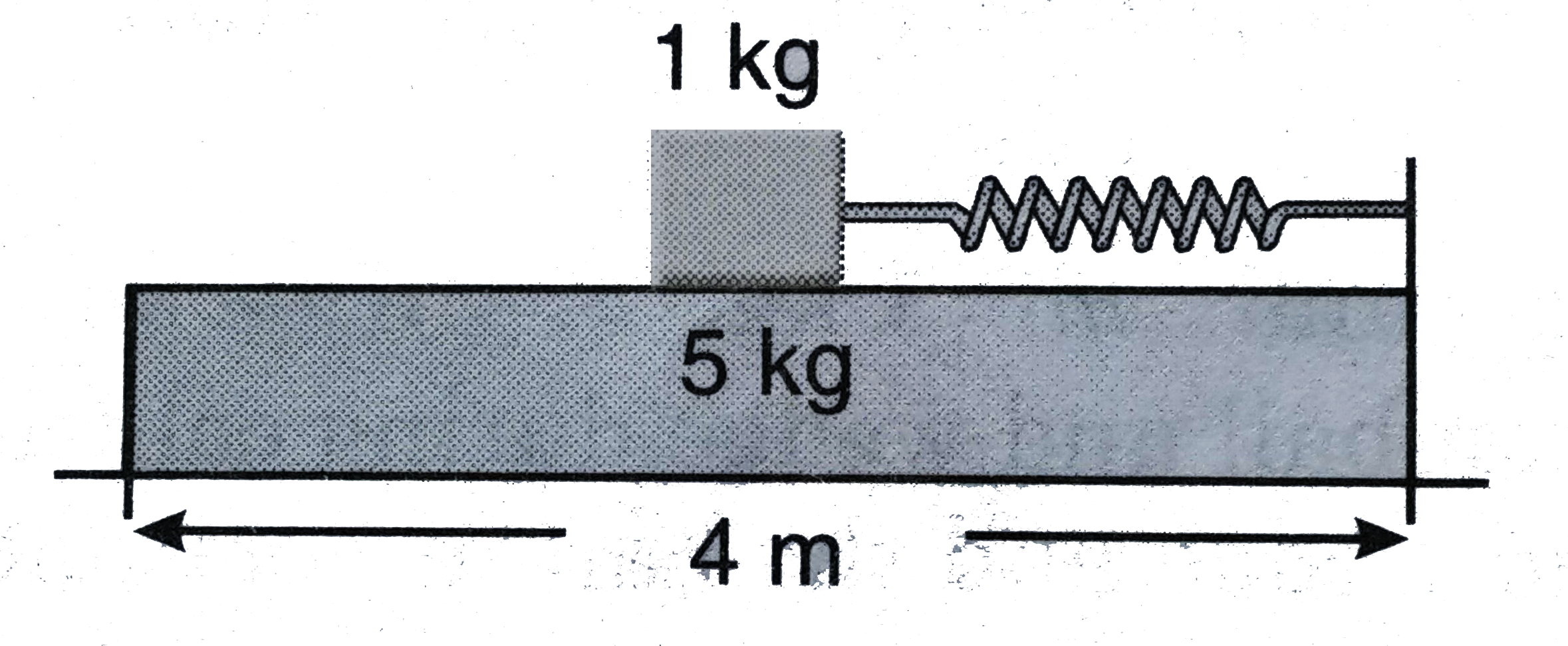
A planck of mass `5kg` is placed on a frictionless horizontal plane. Further a block of mass `1kg` is placed over the plank. A massless spring of natural length `2m` is fixed to the plank by its one end. The other end of spring is compressed by the block by half of spring's natural length. They system is now released from the rest. What is the velocity of the plank when block leaves the plank? (The stiffness constant of spring is `100N//m`)

Text Solution

Verified by Experts

The correct Answer is:

A, C

Let the velocity of the block and the plank, when the block leaves the spring be u and v respectively.
By conservation of energy `1/2kx^2=1/2mu^2+1/2Mv^2[M="mass of the plank", m="mass of the block"]`
`implies 100=u^2+5v^2` …`(i)`
By conservation of momentum
`mu+M_v=0=u=-5v` ...`(ii)`
Solving Eqs. `(i)` and `(ii)` `30v^2=100impliesv=sqrt(10/3)m//s`
From this moment until block falls, both plank and block keep their velocity constant.
Thus, when block falls, velocity of plank `=sqrt(10/3)m//s`.
Promotional Banner

Topper's Solved these Questions

  • CENTRE OF MASS, LINEAR MOMENTUM AND COLLISION

    DC PANDEY|Exercise Exercise 11.1|13 Videos
  • CENTRE OF MASS, LINEAR MOMENTUM AND COLLISION

    DC PANDEY|Exercise Exercise 11.2|6 Videos
  • CENTRE OF MASS, LINEAR MOMENTUM AND COLLISION

    DC PANDEY|Exercise Type 1|1 Videos
  • CENTRE OF MASS, IMPULSE AND MOMENTUM

    DC PANDEY|Exercise Comprehension type questions|15 Videos
  • CIRCULAR MOTION

    DC PANDEY|Exercise Medical entrances s gallery|19 Videos

Similar Questions

Explore conceptually related problems

Find the maximum tension in the spring if initially spring at its natural length when block is released from rest.

A block of mass 2 kg is moving on a frictionless horizontal surface with a velocity of 1m//s towards another block of equal mass kept at rest. The spring constant of the spring fixed at one end is 100 N//m. Find the rnaximum compression of the spring

A block of mass 'm' is attached to a spring in natural length of spring constant 'k' . The other end A of the spring is moved with a constat velocity v away from the block . Find the maximum extension in the spring.

A block Q of mass 2m is placed on a horizontal frictionless plane. A second block of mass m is placed on it and is connected to a spring of spring constant K, the two block are pulled by distance A. Block Q oscillates without slipping. The work done by the friction force on block Q when the spring regains its natural length is:

A massless spring of natural length of 0.5 m and spring constant 50 N/m has one end fixed and the other end attached to a mass of 250 g. The spring mass system is on a smooth floor. The mass is pulled until the length of the spring is 0.6 m and then released from rest. The kinetic energy of the mass when the length of the spring is 0.5 m is

A block of mass m is placed in equilibrium on a moving plank. The maximum horizontal acceleration of the plank for mu=0.2 is:

Block A of mass m is placed on a plank B . A light support S is fixed on plank B and is attached with the block A with a spring of spring constant K. Consider that initialy spring is in the natural length, and the system is at rest. Find the maximum compression in the spring, if the plank B is moved with a constant acceleration 'a' . (All the surface are smooth) :

A plank of mass 2 kg and length 1 m is placed on horizontal floor.A small block of mass 1 kg is placed on top of the plank , at its right extreme end .The coefficient of friction between plank and floor is 0.5 and that between plank and block is 0.2 . If a horizontal force = 30 N starts acting on the plank to the right ,the time after which the block will fall off the plank is (g = 10 ms^(-2))

A spring has natural length 40 cm and spring constant 500 N//m . A block of mass 1 kg is attached at one end of the spring and other end of the spring is attached to a ceiling. The block is relesed from the position, where the spring has length 45 cm .
