Home
Class 11
PHYSICS
A ball of mass m=1kg falling vertically ...

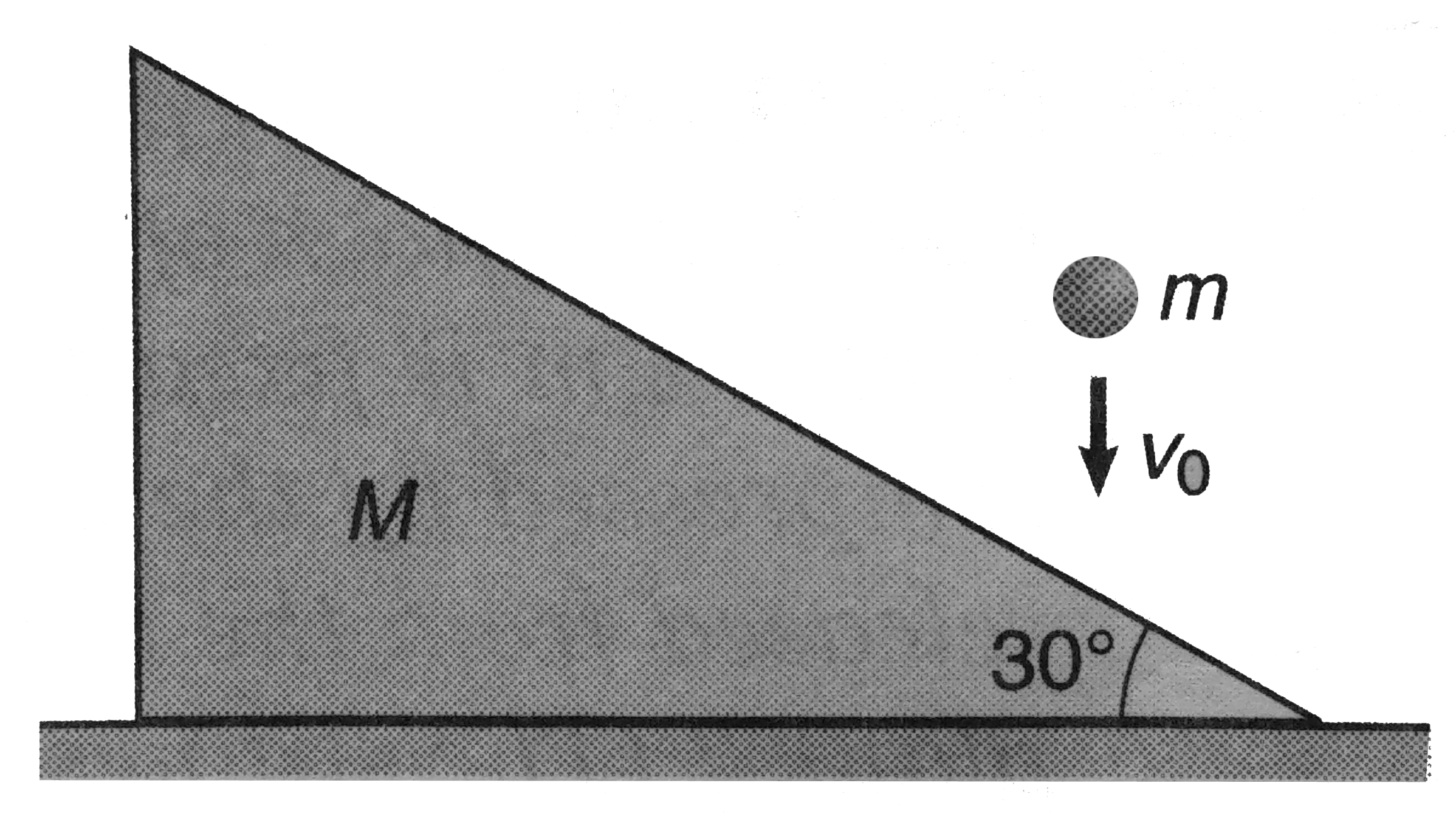
A ball of mass `m=1kg` falling vertically with a velocity `v_0=2m//s` strikes a wedge of mass `M=2kg` kept on a smooth, horizontal surface as shown in figure. If impulse between ball and wedge during collision is J. Then make two equations which relate J with velocity components of wedge and ball. Also find impulse on wedges from ground during impact.

Text Solution

Verified by Experts

The correct Answer is:
A

Given `M=2kg` and `m=1kg`
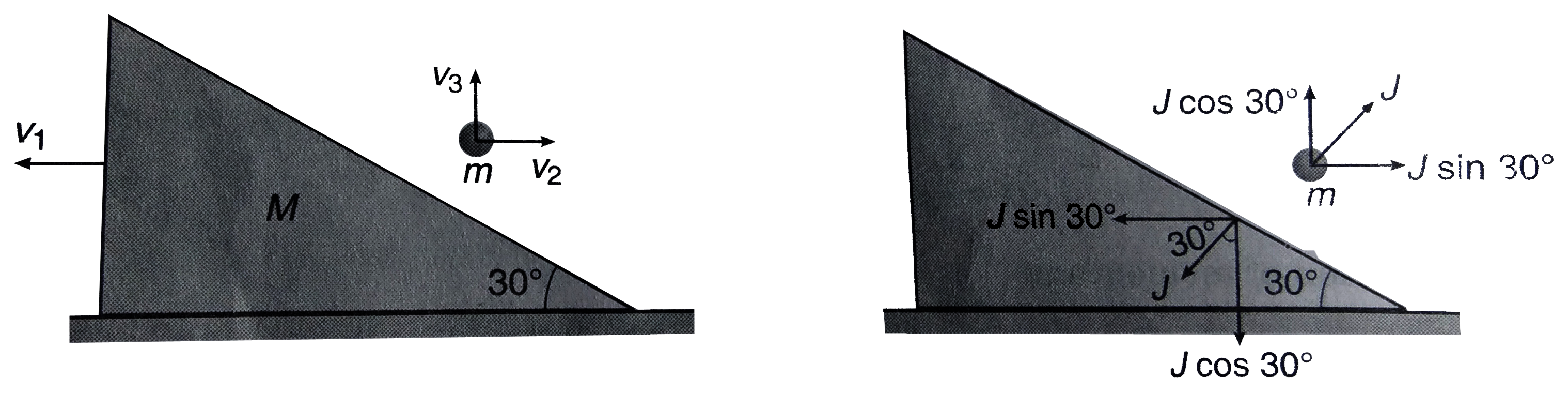
Let, J be the impulse between ball and wedge during collision and `v_1`, `v_2` and `v_3` be the components of velocity of the wedge and the ball in horizontal and vertical directions respectively.

Applying `"impulse"="change in momentum"`
we get `Jsin30^@=Mv_1=mv_2`
or `J/2=2v_1=v_2`...`(i)`
`J cos 30^@=m(v_3+v_0)`
or `sqrt3/2J=(v_3+2)` ...`(ii)`
So these are two equations relating J and velocity components of wedge and ball. Further, net vertical impulse on wedge should be zero. Therefore, impulse on wedge from ground is `Jsin30^@` or `J/2` in upward direction.
Promotional Banner

Topper's Solved these Questions

  • CENTRE OF MASS, LINEAR MOMENTUM AND COLLISION

    DC PANDEY|Exercise Exercise 11.1|13 Videos
  • CENTRE OF MASS, LINEAR MOMENTUM AND COLLISION

    DC PANDEY|Exercise Exercise 11.2|6 Videos
  • CENTRE OF MASS, LINEAR MOMENTUM AND COLLISION

    DC PANDEY|Exercise Type 1|1 Videos
  • CENTRE OF MASS, IMPULSE AND MOMENTUM

    DC PANDEY|Exercise Comprehension type questions|15 Videos
  • CIRCULAR MOTION

    DC PANDEY|Exercise Medical entrances s gallery|19 Videos

Similar Questions

Explore conceptually related problems

A ball of mass m=1kg falling vertically with a velocity v_(0)=2m//s strikes a wedge of mass M=2kg kept o a smooth, horizontal surface as shown in figure. The coefficient of resitution between the ball and the wege is e=1//2 . Find the velocity of the wedge is e=1/2. find the velocity of the wedge and the ball immediately after collison.

A ball of mass m=1kg strikes a smooth horizontal floor as shown in figure. The impulse exerted on the floor is

A particle of mass m strikes normally to a stationary wedge of mass 5m kept on the smooth horizontal surface as shown.If the particle sticks to the wedge then loss in kinetic energy of the system during collision is?

A block of mass m rests on a stationary wedge of mass M. The wedge can slide freely on a smooth horizontal surface as shown in figure. If the block starts from rest

A ball mass 2 kg moving horizontally with velocity 10 m/s hits a wedge of mass 5 kg placed on a horizontal surface as shown in the figure. Just after collision klvelocity of wedge is 3.2 m/s. There is no friction at any contact surface. Then (take sin 30^(@)=3//5 )

A small particle of mass m = 2 kg moving with constant horizontal velocity u = 10 m//s strikes a wedge shaped block of mass M = 4 kg placed on smooth horizontal surface on its inclined surface as shown in figure. After collision particle starts moving up the inclined plane. Calculate the velocity of wedge immediately after collision.

A small block of mass m is placed at rest on the top of a smooth wedge of mass M, which in turn is placed at rest on a smooth horizontal surface as shown in figure. It h be the height of wedge and theta is the inclination, then the distacne moved by the wedge as the block reaches the foot of the wedge is

A ball of mass m moving horizotally which velocity u hits a wedge of mass M . The wedge is situated on a smooth horizontal source. If after striking with wedge the ball starts moving in vertical direction and the wedge starts moving in horizotal plane. calculate a. the velocity of wedge V . b. the velocity (v) at which the ball moves in vertical direction. c. the impulse imparted by the ball on the wedge. d. the coefficient of restitution e=?

A 250 g ball moving horizontally with velocity 10.0m/s strikes inclined surface of a 720g smooth wedge as shown in the figure. The wedge is placed at rest on a frictionless horizontal ground. If the coefficient of restitution is 0.8, calculate the velocity of the wedge after the impact.

