Home
Class 11
PHYSICS
Two blocks A and B of masses m and 2m re...

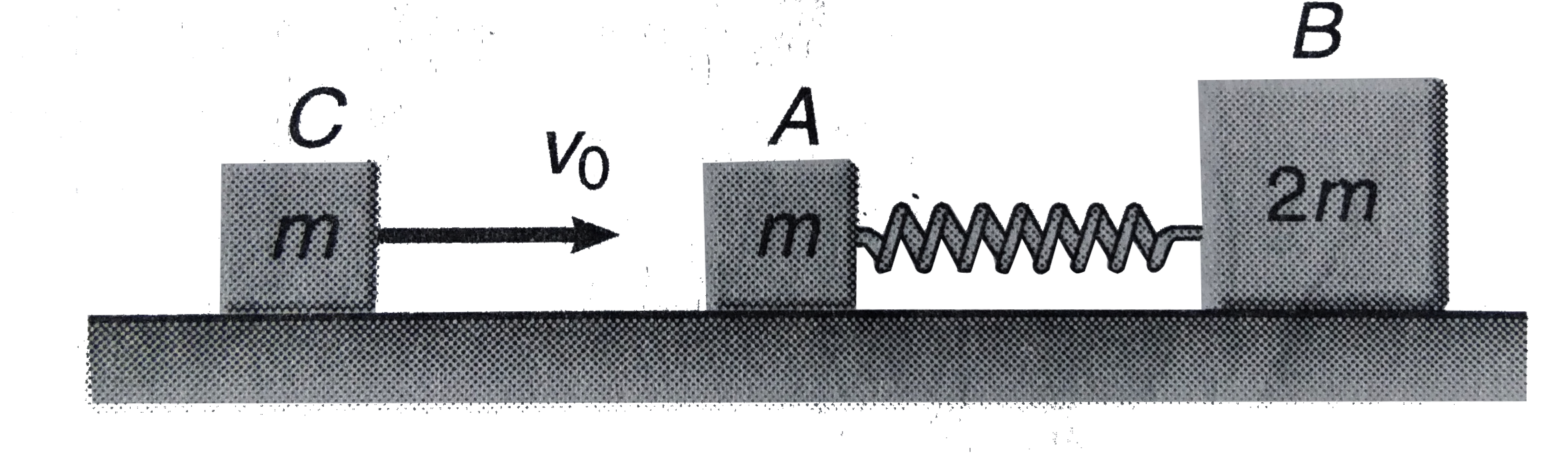
Two blocks A and B of masses m and 2m respectively are placed on a smooth floor. They are connected by a spring. A third block C of mass m moves with a velocity `v_0` along the line joing A and B and collides elastically with A, as shown in figure. At a certain instant of time `t_0` after collision, it is found that the instantaneous velocities of A and B are the same. Further, at this instant the compression of the spring is found to be `x_0`. Determine (i) the common velocity of A and B at time `t_0`, and (ii) the spring constant.

Text Solution

Verified by Experts

The correct Answer is:

B, C

Initially, the blocks A and B are at rest and C is moving with velocity `v_0` to the right. As masses of C and A are same and the collision is elastic the body C treansfers its whole momentum `mv_0` to body A and as a result the body C stops and A starts moving with velocity `v_0` to the right. As this instant the spring is uncompressed and the body B is still at rest.
The momentum of the system at this instant `=mv_0`
Now, the spring is compressed and the body B comes in motion. After time `t_0`, the compression of the spring is `x_0` and common velocity of A and B is v(say).
As external force on the system is zero, the law of conservation of linear momentum gives
`mv_0=mv+(2m)v` or `v=(v_0)/(3)`
The law of conservation of energy gives
`1/2mv_0^2=1/2mv^2+1/2(2m)v^2+1/2kx_0^2`
or `1/2mv_0^2=3/2mv^2+1/2kx_0^2`
`1/2mv_0^2=3/2m(v_0/3)^2+1/2kx_0^2`
`:. 1/2kx_0^2=1/2mv_0^2-1/6mv_0^2`
or `1/2kx_0^2=1/3mv_0^2`
`k=2/3(mv_0^2)/(x_0^2)`
Promotional Banner

Topper's Solved these Questions

  • CENTRE OF MASS, LINEAR MOMENTUM AND COLLISION

    DC PANDEY|Exercise Exercise 11.1|13 Videos
  • CENTRE OF MASS, LINEAR MOMENTUM AND COLLISION

    DC PANDEY|Exercise Exercise 11.2|6 Videos
  • CENTRE OF MASS, LINEAR MOMENTUM AND COLLISION

    DC PANDEY|Exercise Type 1|1 Videos
  • CENTRE OF MASS, IMPULSE AND MOMENTUM

    DC PANDEY|Exercise Comprehension type questions|15 Videos
  • CIRCULAR MOTION

    DC PANDEY|Exercise Medical entrances s gallery|19 Videos

Similar Questions

Explore conceptually related problems

Two bodies A and B of masses m and 2 m respectively are placed on a smooth floor. They are connected by a spring. A third body C of mass m moves with velocity v_0 along the line joining A and B and collides elastically with A as shown in Fig. At a certain instant of time t_0 after collision, it is found that the instantaneous velocities of A and B are the same. Further at this instant the compression of the spring is found to be x_0 . Determine (i) the common velocity of A and B at time t_0 , and (ii) the spring constant.

Two blocks A and B of masses in and 2m respectively placed on a smooth floor are connected by a spring. A third body C of mass m moves with velocity v_(0) along the line joining A and B and collides elastically with A . At a certain instant of time after collision it is found that the instantaneous velocities of A and B are same then:

Two identical blocks A and B each of mass m resting on the smooth horizontal floor are connected by a light spring of natural length L and spring constant K. A third block Cof mass m moving with a speed v along the line joining A and B collides with A. The maximum compression in the spring is

A ball A of mass M collides elastically with a similar ball B at rest as shown in figure. Initially velocity of ball A is u m/s. After collision,

A block C of mass m is moving with velocity v_(0) and collides elastically with block A of mass m and connected to another block B of mass 2m through spring constant k. What is k if x_(0) is compression of spring when velocity of A and B is same?

A block of mass m moving with velocity v_(0) on a smooth horizontal surface hits the spring of constant k as shown. Two maximum compression in spring is
