Home
Class 11
PHYSICS
A uniform bar of length 12 L and mass 48...

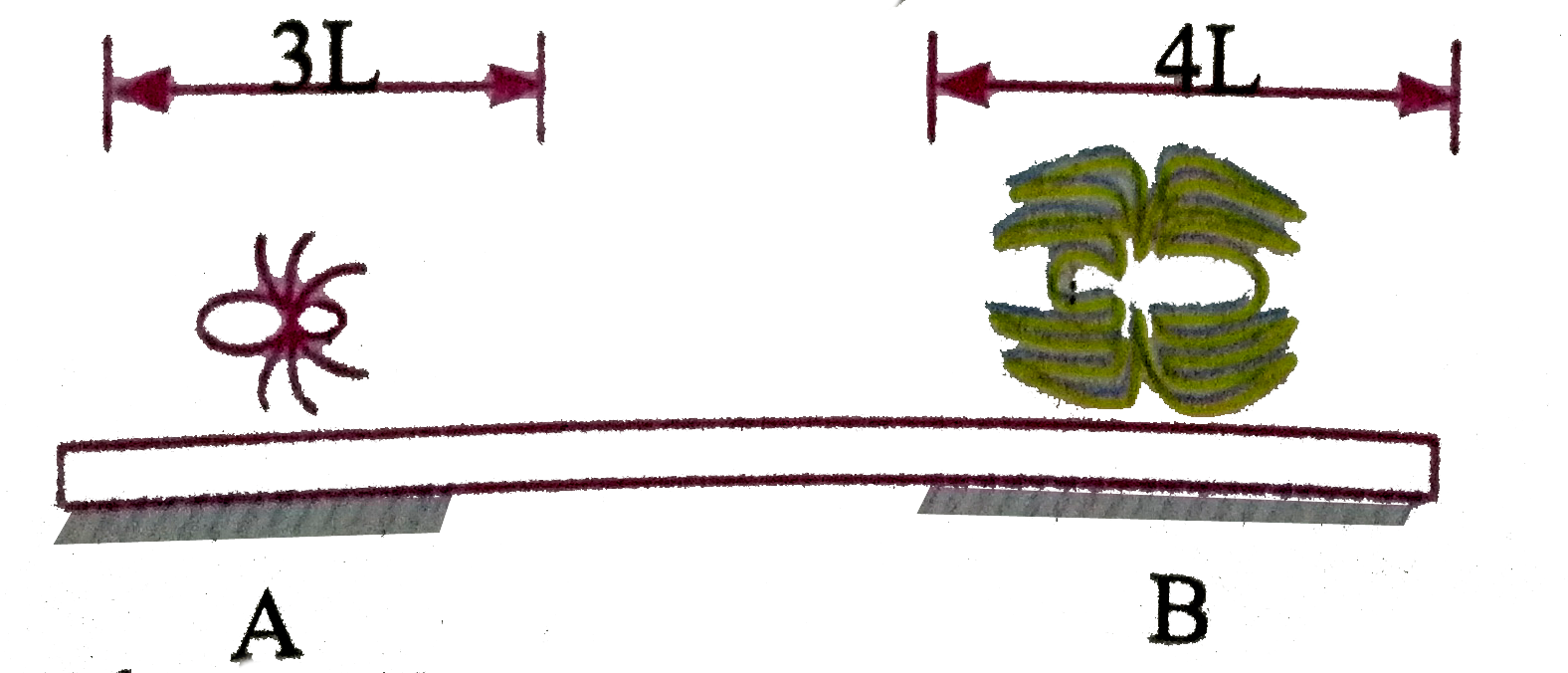
A uniform bar of length `12 L` and mass `48 m` is supported horizontally on two smooth tables as shown in the figure. A small moth (an insect) of mass `8m` is sitting on end `A` of the rod and a spider (an insect) of mass `16 m` is sitting on the other end `B`. Both the insects start moving towards each other along the rod with moth moving at speed `2v` and the spider at half of this speed. They meet at a point `P` on the rod and the spider eats the moth. After this the spider moves with a velocity `v//2` relative to the rod towards the end `A`. The spider takes negligible time in eating the insect. Also, let `v = L//T`, where `T` is a constant having value `4 sec`.

The speed of the bar after the spider eats up the moth and moves towards `A` is

A

(a) `v/2`

B

(b) `v`

C

(c) `v/6`

D

(d) `2v`

Text Solution

Verified by Experts

The correct Answer is:
C

`(24m)(v/2-u)=(48m)u`

`:. u=v/6`
Promotional Banner

Topper's Solved these Questions

  • CENTRE OF MASS, LINEAR MOMENTUM AND COLLISION

    DC PANDEY|Exercise Level 2 Comprehension Based Questions|3 Videos
  • CENTRE OF MASS, LINEAR MOMENTUM AND COLLISION

    DC PANDEY|Exercise Level 2 Subjective|21 Videos
  • CENTRE OF MASS, LINEAR MOMENTUM AND COLLISION

    DC PANDEY|Exercise Level 2 More Than One Correct|8 Videos
  • CENTRE OF MASS, IMPULSE AND MOMENTUM

    DC PANDEY|Exercise Comprehension type questions|15 Videos
  • CIRCULAR MOTION

    DC PANDEY|Exercise Medical entrances s gallery|19 Videos

Similar Questions

Explore conceptually related problems

A uniform bar of length 12 L and mass 48 m is supported horizontally on two smooth tables as shown in the figure. A small moth (an insect) of mass 8m is sitting on end A of the rod and a spider (an insect) of mass 16 m is sitting on the other end B . Both the insects start moving towards each other along the rod with moth moving at speed 2v and the spider at half of this speed. They meet at a point P on the rod and the spider eats the moth. After this the spider moves with a velocity v//2 relative to the rod towards the end A . The spider takes negligible time in eating the insect. Also, let v = L//T , where T is a constant having value 4 sec . The point P is at

A uniform bar of length 12 L and mass 48 m is supported horizontally on two smooth tables as shown in the figure. A small moth (an insect) of mass 8m is sitting on end A of the rod and a spider (an insect) of mass 16 m is sitting on the other end B . Both the insects start moving towards each other along the rod with moth moving at speed 2v and the spider at half of this speed. They meet at a point P on the rod and the spider eats the moth. After this the spider moves with a velocity v//2 relative to the rod towards the end A . The spider takes negligible time in eating the insect. Also, let v = L//T , where T is a constant having value 4 sec . Displacement of the rod by the time when the insects meet is

A uniform rod of length l and mass 2m rests on a smooth horizontal table. A point of mass m moving horizontally at right angle to the rod with velocity v collides with one end of the rod and sticks to it, then:

A uniform rod of length l and mass 2 m rests on a smooth horizontal table. A point mass m moving horizontally at right angles to the rod with velocity v collides with one end of the rod and sticks it. Then

A uniform bar AB of length 6a has been placed on a horizontal smooth table of width 5 a as shown in the figure. Length 2a of the bar is overhanging. Mass of the bar is 4m. An insect of mass m is sitting at the end A of the bar. The insect walks along the length of the bar to reach its other end B. (a) Will the bar topple when the insect reaches end B of the bar ? (b) After the insect reaches at B, another insect of mass M lands on the end A of the bar. Find the largest value of M which will not topple the bar.

Two uniform thin rods each of length L and mass m are joined as shown in the figure. Find the distance of centre of mass the system from point O

A strip of wood mass M and length l is placed on a smooth horizontal surface. An insect of mass m starts from rest at one end of the strip and walks to the other end in time t , moving with a constant speed.

A uniform rod of length l and mass 2m rests on a smooth horizontal table. A point mass m moving horizontally at right angles to the rod with initial velocity v collides with one end of the rod and sticks to it. Determine the position of the point on the rod which remains stationary immediately after collision.

