Home
Class 11
PHYSICS
A standing wave xi= a sin kx. Cos omegat...

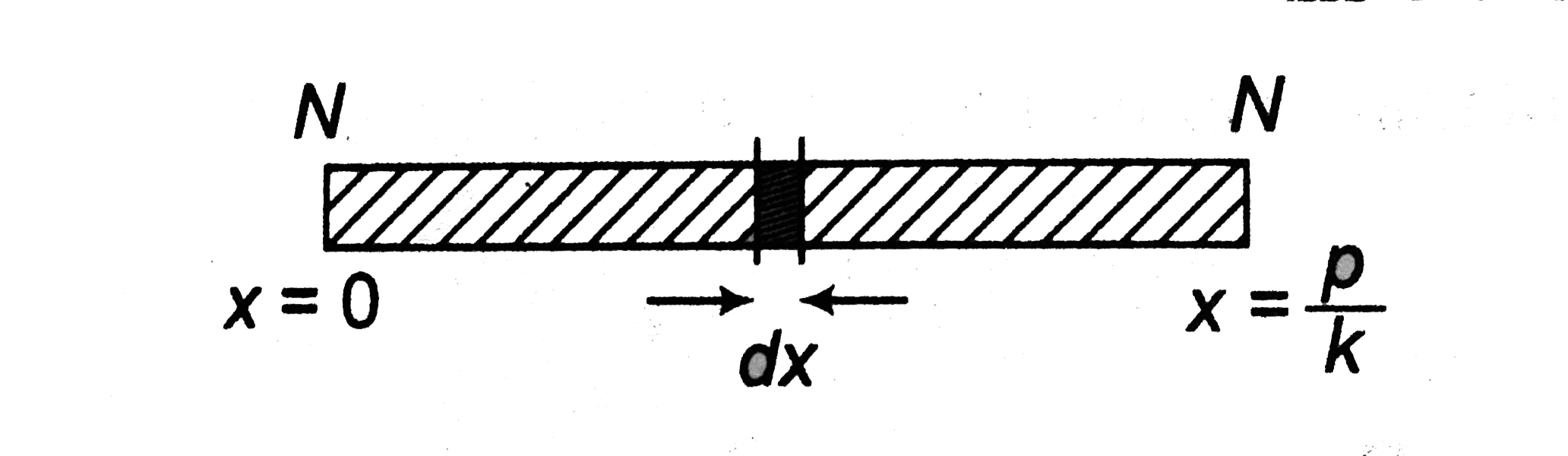
A standing wave `xi= a sin kx. Cos omegat ` is maintained in a homogeneous rod with cross `-` sectional area `S` and density `rho`. Find the total mechanical energy confined between the sections corresponding to the adjacent displacement nodes.

Text Solution

Verified by Experts

The correct Answer is:
A, B, D

Amplitude at a distance x is `A = a sin kx`
First node can be obtained at x=0,
and the second at `x = pi//k`
At position x, mass of the element PQ is
`dm = (rhoS) dx`
Its amplitude is `A = a sin kx`
Hence mechanical energy stored in this element is

(energy of particle in SHM) ` dE = 1/2 (dm) A^2 omega^2 `
or ` dE = 1/2 (rho SA^2omega^2)dx`
`= 1.2 (rhoSa^2omega^2sin^2kx)dx`
Therefore, total energy stored between two
adjacent nodes will be
`E = int_(x=0)^(x = pi//k) dE`
Solving this, we get
`E = (piSrhoomega^2a^2)/(4k)` .
Promotional Banner

Topper's Solved these Questions

  • SUPERPOSITION OF WAVES

    DC PANDEY|Exercise Level 2 Comprehension Based|3 Videos
  • SOUND WAVES

    DC PANDEY|Exercise Exercise 19.7|4 Videos
  • THERMOMETRY THERMAL EXPANSION AND KINETIC THEORY OF GASES

    DC PANDEY|Exercise Medical entrance gallary|30 Videos

Similar Questions

Explore conceptually related problems

A longitudinal standing wave xi a cos kx. Cos omega t is maintained in a homogeneous medium of density rho . Find the expressions for the space density of (a) potential energy w_(p)(x,t), (b) kinetic energy w_(k)(x,t), Plot the space density distribution of the total energy w in the space between the displacement nodes at the moments t=0 and t=T//4 , where T is oscillation period.

A longitudinal standing wave y = a cos kx cos omega t is maintained in a homogeneious medium of density rho . Here omega is the angular speed and k , the wave number and a is the amplitude of the standing wave . This standing wave exists all over a given region of space. If a graph E ( = E_(p) + E_(k)) versus t , i.e., total space energy density verus time were drawn at the instants of time t = 0 and t = T//4 , between two successive nodes separated by distance lambda//2 which of the following graphs correctly shows the total energy (E) distribution at the two instants.

A longitudinal standing wave y = a cos kx cos omega t is maintained in a homogeneious medium of density rho . Here omega is the angular speed and k , the wave number and a is the amplitude of the standing wave . This standing wave exists all over a given region of space. The space density of the potential energy PE = E_(p)(x , t) at a point (x , t) in this space is

A longitudinal standing wave y = a cos kx cos omega t is maintained in a homogeneious medium of density rho . Here omega is the angular speed and k , the wave number and a is the amplitude of the standing wave . This standing wave exists all over a given region of space. The space density of the kinetic energy . KE = E_(k) ( x, t) at the point (x, t) is given by

A plane elastic wave xi=a e ^(-gammax)cos( omega t - kx) , where a, gamma, omega, and k are constants , propagates in a homogeneous medium. Find the phase difference between the oscillations at the points where the particles, displacement amplitudes differ by eta=1.0 %, if gamma=0.42 m ^(-1) and the wavelength is lambda=50 cm .

y_1 = 8 sin (omegat - kx) and y_2 = 6 sin (omegat + kx) are two waves travelling in a string of area of cross-section s and density rho. These two waves are superimposed to produce a standing wave. (a) Find the energy of the standing wave between two consecutive nodes. (b) Find the total amount of energy crossing through a node per second.

A standing wave y = A sin kx .cos omegat is established in a string fixed at its ends. (a) What is value of instantaneous power transfer at a cross section of the string when the string is passing through its mean position? (b) What is value of instantaneous power transfer at a cross section of the string when the string is at its extreme position? (c) At what frequency is the power transmitted through a cross section changing with time?

A transverse wave is passing through a light string shown in fig.The equation of wave is y=A sin(wt-kx) the area of cross-section of string A and density is rho the hanging mass is :

